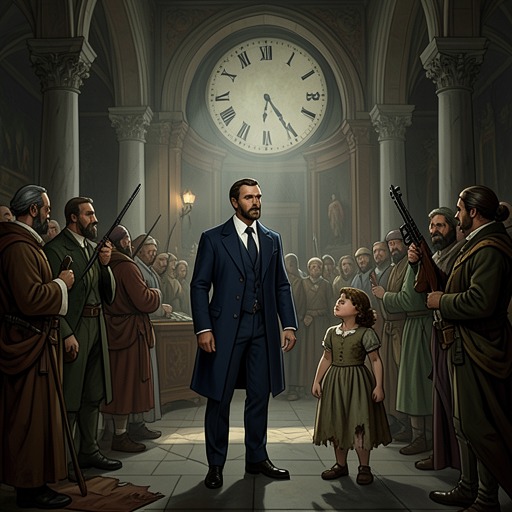
Gwynplaine’s awakening to his inheritance
The Man Who LaughsGwynplaine’s awakening to his inheritance is a sudden reversal that tests whether restored rank will alter the loyalties and moral vision formed by his earlier life. In a palace chamber he learns that he is a peer of England and begins imagining the authority his birthright affords; by dawn, remembering Dea, he rejects the distance that privilege has opened between them and resolves to return to her.
The palace and the disclosure
Gwynplaine comes to himself at night in a chamber lined from floor to ceiling with purple velvet. He is seated in an armchair, alone with Barkilphedro, the official who had appeared in the cell at Southwark. Two tables stand within reach: one holds papers and a casket, the other food and drink on a silver-gilt salver. The furnishings and abundance mark a sharp break from Gwynplaine’s former circumstances, but at first the scale of the change leaves him disoriented rather than secure.
Beyond a tall window lies a formal courtyard enclosed by pillars and entered through three iron gates. Marble, patterned paving, terraces, and the shadowed mass of the palace make the place seem both imposing and difficult to grasp in the night. Its magnificence weighs on Gwynplaine. The setting turns his new position into something he must confront physically: he has awakened not merely in different clothes, but inside a world whose authority and wealth had previously been beyond his reach.
When Gwynplaine asks where he is, Barkilphedro tells him that he is in his own house and addresses him as a lord. Barkilphedro then identifies himself as a clerk of the Admiralty and explains that he opened Hardquanonne’s flask, from which Gwynplaine’s destiny emerged. The explanation links the change in Gwynplaine’s fortunes to the recovered evidence carried by the sea. It also places Barkilphedro at the hinge of the reversal: he did not create Gwynplaine’s inheritance, but his discovery and disclosure have brought it into effect.
Reconstructing the past
The new clothes confirm the transformation in material terms. Gwynplaine discovers that his former jacket and leather garment are gone; in their place are a silver-cloth waistcoat, an embroidered satin coat, velvet hose, and shoes with high red heels. He also finds a heavy purse. These details make the change tangible, while sharpening the contrast between the itinerant performer he has been and the nobleman he is being told he has become.
Left alone, he paces and tries to make sense of what he has heard. The declaration of the shipwrecked men, read earlier in the Southwark cell, returns to him with a clarity it had not possessed at the time. He now connects those words with his infancy and recognizes that the document has disclosed a history of betrayal, abandonment, and dispossession. The sea, which had seemed to hold only the past’s disappearance, has delivered evidence that makes that past newly legible.
His recognition is not simply a discovery of title. Gwynplaine understands himself as the son of a noble family and imagines that the authority associated with his ancestors is now his to claim. He recalls the father he never knew and the brother he has just learned about. In his inward account, the child once cast into the lowest social condition rises into the place from which his family had been removed. His cry of being restored to what was his expresses both relief at the reversal and the temptation to regard it as a complete settlement of his losses.
The intoxication of rank
The revelation quickly becomes a vision of what he might possess and do. Gwynplaine imagines a scarlet robe and a coronet, attendance at royal ceremonies, judgment over princes and ministers, houses and estates, carriages, wealth, and the ability to give entertainments and make laws. He pictures himself moving from the bottom of society to its summit, no longer excluded from the privileges he had watched from below. The scale of his fantasy shows how powerfully the inheritance answers long-standing desires as well as how abruptly it has arrived.
He also imagines a public purpose for his new position. In the House of Lords, he expects to speak from direct knowledge of deprivation and hardship, confronting aristocrats with realities they have not experienced. He sees himself as a bearer of truth and justice, and expects that his testimony will command attention. This projected eloquence joins two different impulses: the wish to expose social distance and the excitement of finally occupying the elevated place from which he can address those who possess power.
The narrative marks this excitement as a moral danger, not an uncomplicated triumph. Gwynplaine’s former adversity had restrained ambition and material desire; now the sudden prospect of wealth and precedence unsettles that restraint. His transformation is presented as an inward shift as well as a change of station: the title threatens to displace the moral stature he had shown before it was restored. The chance arrival of the document has therefore become a test of character. In imagining himself as a lord, he risks allowing the visible rewards of rank to define what he is.
Dawn, Dea, and the turn back
Gwynplaine’s visions continue through the night. He moves restlessly around the room, examining its furnishings and the papers, reading names and titles, handling the seals, and looking out toward the courtyard. These actions register his effort to verify the new world by touch and inspection. Yet the discovery does not settle him: his mind continues to oscillate between the child in rags and the brilliant nobleman he imagines becoming.
Dawn interrupts that inward absorption with a reminder of Dea. The return of her name changes the direction of his thought. Gwynplaine recognizes that while he is at Windsor, she remains in Southwark, and that this is the first time they have been separated by such a distance. He recalls that he has changed because he has been made a lord, and questions the assumption that his new position must divide him from the people who formed his former life.
He rejects the suggestion that one opened door must mean that what lies behind him is lost. His inheritance, he insists to himself, does not require submission to the expectations attached to it, nor does being a peer make him a servant of the Queen. He names Dea as his wife and Ursus as his father, declaring that his palace belongs to Ursus and that his name belongs to Dea. These are his emphatic claims in the moment, expressing the bonds he chooses to place above the prestige he has just discovered.
The awakening thus ends not with a settled new identity but with an urgent decision. Gwynplaine leaves the chamber in search of Dea, determined to cross the distance between them. His inheritance has first made him imagine ascent as possession, power, and public recognition; remembering Dea makes him see that those gains cannot compensate for separation. The episode’s decisive movement is from dazzlement toward duty: the title remains, but he tries to reclaim his former loyalties as the measure of what that title should mean.