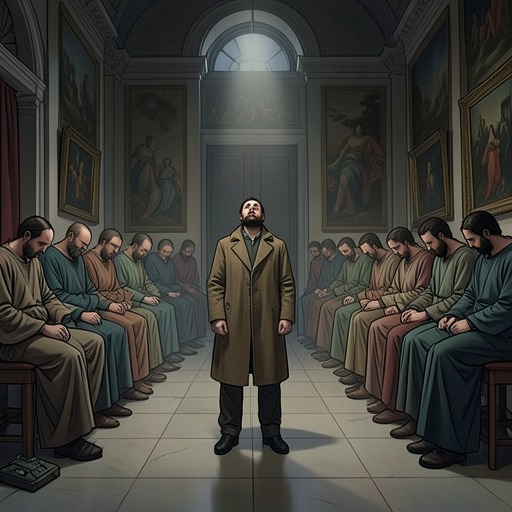
Gwynplaine’s introduction to the House of Lords
The Man Who LaughsGwynplaine’s introduction to the House of Lords made his restored identity as a peer visible through the rituals of the institution that had inherited his family’s rank. On the same day that carried him from Windsor to London, a royal escort and an elaborate procession brought him through successive chambers, greetings, and rules of precedence. The ceremony placed him among the hereditary elite; the parliamentary scene that followed exposed how little that formal recognition could do to change the way they regarded him.
Background and Stakes
Gwynplaine arrived at the ceremony after a day of abrupt social elevation. The narrative traces his passage from Windsor through Corleone Lodge to Westminster, each stage raising him in rank while increasing his bewilderment. His position was no longer merely a claim to inheritance: he was to enter the House as a peer of England, under the name and titles Lord Fermain Clancharlie, Baron Clancharlie and Hunkerville.
The scale of the arrangements emphasized both royal favor and the strangeness of his new status. Gwynplaine travelled from Windsor in a carriage accompanied by gentlemen pensioners of the Queen’s household. The Usher of the Black Rod rode at the head of the cavalcade, carrying a black portfolio stamped with the royal crown. At Brentford, the party changed to a gilt-fitted state coach drawn by four horses with silver harness. The procession could resemble an escort to imprisonment as readily as an honor guard, a contrast the narrative associates with the uncertain boundary between ceremony and constraint.
The House of Lords was sitting that evening. Its formal welcome was part of an older ceremonial order that Queen Anne had attempted to revive, with customs said to precede the time of Henry VIII. The ritual presented the institution as fixed and ancient, though the narrative complicates that impression: aristocratic titles endure while the families bearing them change. Gwynplaine’s entrance thus joined an individual change of fortune to a larger display of how inherited rank is maintained and represented.
The Procession to the House
As night fell, the coach stopped at the King’s Gate, the sunken entrance connecting Whitehall with Westminster. The gentlemen pensioners formed a circle around it. The Usher of the Black Rod and an accompanying officer alighted, and Gwynplaine was instructed to keep his hat on. Beneath his travelling cloak he still wore the black silk suit he had worn since the previous evening; he had no sword. He left the cloak in the carriage and followed the officials through a raised side door, with the ceremonial rule that the highest-ranking person must not walk first determining the order of entry.
They entered a circular, ground-floor room in one of the turrets. Narrow windows admitted little light. Thirteen officials stood in ranks: three in the front, six behind them, and four in the last row. Their velvet, satin, and silk garments, embroidered arms, wigs, and swords marked their offices, although the dimness made faces difficult to see. The ceremony was at once highly visible in its costumes and indistinct in the personal encounters it permitted.
The Usher formally handed Gwynplaine over to Garter King-at-Arms. Garter bowed and identified his office, its appointment by the Duke of Norfolk, and its duties, which included attending to the nobility and arranging peers’ funerals and armorial bearings. Other officers presented themselves by title. On a signal, Blue Mantle received the silver-cloth cushion and the crown-stamped portfolio from the Usher. These objects carried the signs of royal authority forward with the procession, even as the officials passed responsibility from one office to another.
Ceremonial Recognition
Garter directed Gwynplaine to follow and explained that he would be saluted; in returning the salute, he was to raise only the brim of his hat. The procession moved through rooms whose precise route could no longer be traced, including a Gothic state chamber associated with the last meeting of King James II and Monmouth. Portraits of former peers hung there in chronological order. The images made the past part of the passage, presenting aristocratic membership as a succession embodied in names, dates, and ceremonial spaces.
At the corridor connecting the Lower and Upper House, Sir Thomas Mansell greeted Gwynplaine. A deputation representing the Cinque Ports then saluted him, with eight representatives arranged four on each side. As Gwynplaine began to return the greeting, Garter quietly corrected him: only the brim of the hat was to be raised. Gwynplaine followed the instruction. The small gesture shows him learning the practical code of a status he has inherited but not yet inhabited.
In the Painted Chamber, three Secretaries of State stood beyond a wooden barrier. Their responsibilities were divided by regions: one oversaw affairs including the south of England and Ireland, another the north and northern European states, and a third Scotland. Robert Harley and Mungo Graham were among those present. They bowed without speaking, and Gwynplaine returned the salute by touching his hat. A barrier-keeper raised the hinged wooden arm to let him pass into the compartment reserved for peers, then closed it behind him. The sequence made privilege a matter of controlled access as well as title.
Inside stood two elderly men in red velvet robes, beneath the royal escutcheon; behind them, a mace-bearer held aloft the gold mace of the peers. The King-at-Arms identified the officers and accompanied Gwynplaine onward. At every threshold, recognition depended on a prescribed introduction, a salute, or permission to cross. The ceremony did not simply announce that Gwynplaine belonged: it enacted the rules by which the House defined belonging.
Entry and Its Consequences
That evening Gwynplaine sat in the House among men dressed in ermine and purple, on benches covered with fleurs-de-lis. Opposite him were kneeling men in black silk gowns, some writing; ahead stood the steps, dais, and gilded throne of Great Britain, with a royal escutcheon between a lion and a unicorn. The setting completed the transformation from claimant to publicly installed peer. The richly ordered chamber also placed his individual elevation within a hierarchy of offices, symbols, and inherited privilege.
The narrative gives the ceremony an immediate and painful sequel. When every face turned toward Gwynplaine, candlelight picked out his features against the dark chamber. By an extraordinary effort of will, he briefly suppressed the fixed grin that marked his face; the exertion could not last. During his address, emotion brought the grin back as uncontrollable laughter, and the House answered with laughter and insult. The movement from solemn introduction to public ridicule makes the event more than a ceremonial success: the institution recognizes his title while its members react to the body through which he must speak.
The contrast reaches back to Gwynplaine’s life as a performer. In the interlude Ursus wrote for him, Chaos Vanquished, darkness first concealed the man struggling beneath the wolf and bear; a ray of light then revealed his face, and the audience erupted into laughter and applause. The same face that had produced popular acclaim now became a spectacle in the chamber where Gwynplaine tried to address the powerful. His introduction therefore marks an official crossing into aristocratic society, but not an escape from the public identity imposed on him. The peers can place him among themselves by title and ceremony; they cannot, or do not, hear past the involuntary laughter that turns his appeal into entertainment.