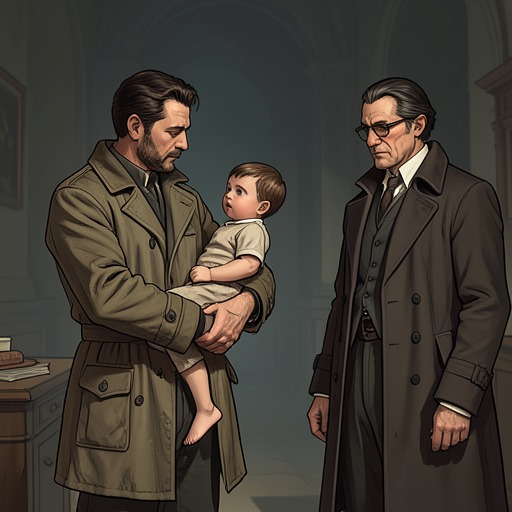
Gwynplaine’s restoration of the Clancharlie title and inheritance
The Man Who LaughsGwynplaine’s restoration of the Clancharlie title and inheritance transforms him, by a formal act of recognition, from a travelling performer into Fermain Clancharlie, a peer with estates and political standing. The ceremony resolves his disputed identity through official documents and a confrontation with Hardquanonne; its consequences expose the gulf between inherited rank and the life Gwynplaine has actually lived. His title changes at once. The face by which the public knows him does not.
The proclamation and its legal authority
The recognition is delivered by the sheriff of Surrey while Gwynplaine is still seated. Holding a nosegay in one hand and a white wand in the other, the sheriff bows before him and announces that the investigation has reached its conclusion. He identifies Gwynplaine as Fermain Clancharlie, Baron Clancharlie and Hunkerville, Marquis de Corleone in Sicily, and a peer of England. The declaration invokes the Queen’s direct commands, the sheriff’s commission, the Lord Chancellor’s authority, and the records and attestations transmitted from the Admiralty.
The speech presents the title not as a courtesy or an uncertain claim, but as the outcome of completed formalities: affidavits have been recorded, signatures checked, statements heard, and the required confrontation carried out. After the sheriff’s salute, the assembled officials bow in turn. The executioner is the sole exception, a small but conspicuous limit to the otherwise unanimous ritual of deference. The ceremony makes a legal change visible through a reversal of posture: the man who had been treated as a public spectacle is now the person before whom officers bow.
Evidence, confrontation, and the succession claim
Barkilphedro explains how the claim was established. A flask associated with Hardquanonne had been found on the shore and brought to the Admiralty’s Jetsam Office, where Barkilphedro opened it in the presence of two sworn jurors. William Brathwait, representing Bath, and Thomas Jervois, representing Southampton, deciphered and attested its contents; Barkilphedro then reported the matter to Queen Anne. The discovery thus passes through a chain of official handling and verification rather than reaching the Queen as an unauthenticated private allegation.
The Lord Chancellor’s recommendation made the final recognition conditional on Hardquanonne identifying Gwynplaine. He regarded the identification as certain, but the legal requirement still had to be fulfilled. His advice also set out what should happen if Hardquanonne refused to answer: the prisoner could be subjected to peine forte et dure, with the confrontation required on the fourth day under the cited statute. The account treats this as a severe feature of the law, not as proof that the procedure was optional. In the event, the confrontation is declared complete, and the sheriff announces the result as settled.
The Chancellor’s argument is that the heir’s constrained, low-status occupation cannot cancel a legitimate hereditary right. Because Gwynplaine’s descent is direct and his legitimacy unquestioned, the case does not require the House of Lords to adjudicate a doubtful or collateral claim. The Queen, advised by the Chancellor, can recognize and admit him. Restoration therefore depends both on evidence establishing who he is and on a legal distinction between social condition and inherited status: a life spent outside the peerage does not, in this account, extinguish his claim to it.
Rank, wealth, and the shock of recognition
Barkilphedro spells out the scale of the reversal. Gwynplaine is told that he has been living under a mistaken understanding of himself: he is not merely a player but a senator, not poor but wealthy, and not without standing but among the highest ranks. His annual income is stated as forty thousand pounds. He is also described as a legislator and judge, with the authority attached to a peer of Great Britain. The new position is not only a title; it carries property and a public role in government.
The transformation overwhelms Gwynplaine, and he faints. The reaction marks the difference between having a claim recognized and being ready to inhabit the life that recognition confers. The legal announcement treats identity as something that can be resolved through lineage, documents, and procedure. For Gwynplaine, however, the announcement collides with the identity formed through years of poverty and public performance. He has been known as the man whose face appears to laugh, even when his thoughts and feelings do not. The heraldic and political recognition does not remove that visible history.
The royal marriage arrangement
The restoration also alters the position of Duchess Josiana. Queen Anne, aware of Gwynplaine’s appearance and unwilling to wrong her sister, whose portion had included the Clancharlie estates, decides that Josiana should marry the newly recognized lord. The marriage is therefore presented as part of the settlement surrounding the restored inheritance, linking Gwynplaine’s recovered title to a royal family arrangement.
That decision does not make the change a simple personal triumph. The terms of the settlement place Gwynplaine within a world of wealth, peerage, and dynastic expectation that he has not chosen through the life he has led. His new identity is legally affirmed before he can make sense of its implications. The proposed marriage makes the practical reach of recognition plain: the claim affects not only his name and estates, but also the future expected of him by the Crown.
Aftermath and the meaning of the reversal
The restoration’s sharpest consequence appears in the contrast between the formal deference of the recognition ceremony and Gwynplaine’s later reception in the House of Lords. At his introduction, candlelight sets his face against the chamber’s darkness. Through an extreme effort of will, he briefly suppresses his habitual grin; the effort cannot last. When emotion overtakes him during his address, laughter breaks out involuntarily, and the lords answer it with amusement and insult rather than attending to his appeal.
In that speech, Gwynplaine interprets his fixed smile as the mark of an imposed suffering and presents his own condition as a figure for the people whose distress is hidden beneath apparent rejoicing. The restoration has made him a peer and legislator, but it has not made the chamber receptive to the experience he brings into it. This is the event’s central irony: the same society that recognizes his hereditary rank can still reduce him to the face it finds entertaining. The legal reversal gives Gwynplaine a place among the powerful; it does not undo the difference between formal inclusion and being heard.