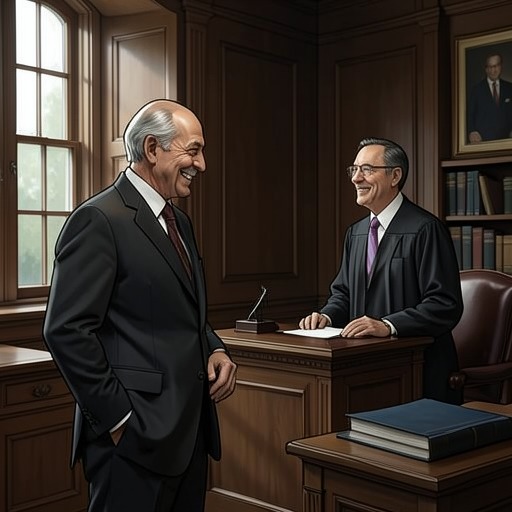
Gwynplaine’s restored peerage
The Man Who LaughsGwynplaine’s restored peerage is the official recovery of the identity and inheritance taken from him in childhood: he is recognized as Fermain Clancharlie, legitimate son of Linnæus, Lord Clancharlie, and a peer of England. The restoration reverses a political act of dispossession through a legal process, but it does not reconcile his inherited rank with the life he has lived or the meaning he gives that life.
Identity and dispossession
As a child, Gwynplaine was sold on the order of King James II, disfigured, and abandoned. The account presented in the inquiry identifies him as the only legitimate son of Linnæus, Lord Clancharlie, and Ann Bradshaw, both deceased, and therefore the heir to his father’s estates and titles. His sale was connected directly to that inheritance: removing the child was intended to put the successor out of the way. He was subsequently raised and trained as a mountebank, growing up under a name and social identity that concealed his birth.
The concealment was written onto a face that provoked laughter regardless of his feelings. His public appearance made him famous as a performer, but the crowd’s response did not reveal his inner state: the fixed expression persisted whether he felt distress, anger, pity, or any other emotion. The legal recognition thus restores a name and rank, not an unmarked body or a childhood returned. Gwynplaine’s ascent in law begins from a life shaped by the very act the law now acknowledges.
Inquiry and identification
The process of restoration depended on evidence linking Gwynplaine to the crime and to the identity claimed for him. A bottle bearing Hardquanonne’s name contained a parchment with the declaration of the accomplices. Hardquanonne recognized the bottle as his, but initially refused to answer questions about its contents. The sheriff’s account describes a process of repeated examination and confrontation, with the fourth day designated for bringing the abandoned child before the prisoner. When Gwynplaine was presented, Hardquanonne recognized him as the victim.
The Lord Chancellor’s recommendation made that identification decisive. He advised restoring Fermain Clancharlie to his estates and dignities on the condition that Hardquanonne identify him; the chancellor considered recognition established beyond doubt. The procedure joined documentary evidence, the prisoner’s recognition, recorded declarations, and official attestations. The report was communicated by the Admiralty, and the sheriff’s formal declaration followed verification of the records and completion of the confrontation.
This inquiry unfolds within a system in which arrest and legal authority could operate through practices markedly different from modern expectations. The narrative describes unexplained arrests as common in the period despite the Habeas Corpus Act, and presents silent arrest as an instrument of state policy in cases where matters remained undisclosed. It also places the sheriff within a hierarchy of royal commissions and local officers responsible for apprehending and holding people for trial. In Gwynplaine’s case, those powers form the institutional setting for a proceeding that identifies the person whom the earlier exercise of royal power had attempted to erase.
Formal restoration and its consequences
The sheriff, acting under the Queen’s commands and with authority from the Lord Chancellor, formally declared Gwynplaine to be Fermain Clancharlie: Baron Clancharlie and Hunkerville, Marquis of Corleone in Sicily, and a peer of England. The declaration did more than confirm descent. It publicly translated the hidden heir’s identity into a set of legally recognized titles and rights, ending his status as a nameless child whose inheritance had been suppressed.
The royal report then provided for Gwynplaine’s admission and installation in the House of Lords. It also named him in place of Lord David Dirry-Moir in connection with Duchess Josiana and directed that she marry the newly recognized lord. The Queen’s letter therefore made the consequences of restored inheritance reach beyond title and property: Gwynplaine’s new position altered the arrangement of an existing royal marriage plan and placed him within court and parliamentary life.
The restoration is a reversal in legal standing, not a gradual change in Gwynplaine’s self-understanding. He is told that he has mistaken himself for a commoner and performer when he is, in law, a wealthy peer and senator. That announcement exposes the distance between his official identity and the life through which he has learned to understand himself. The title is returned in a single proceeding; the years lived outside it cannot be undone.
Rank, public voice, and significance
Gwynplaine’s later appearance before the peers makes the tension within the restoration explicit. Addressed as a monster, he rejects the idea that he is merely an exception to the social order and presents himself as representative of the people whom that order oppresses. He interprets his forced smile not as evidence of happiness but as a sign of inflicted suffering, connecting his own history to a broader condition of human mutilation and enforced silence. The restored peer speaks from within the institution, yet uses that position to challenge its account of who counts as ordinary and who is treated as an anomaly.
The episode therefore makes hereditary status both a material recovery and a political irony. The law can return the titles and estates that belong to Gwynplaine, but the rank that elevates him does not erase the violence that created his false identity. Nor does it displace his identification with those beneath the aristocratic order. His restored peerage gives him formal access to power; his speech turns that access into an accusation against the hierarchy that has recognized him only after denying him his inheritance and shaping his life around exclusion.