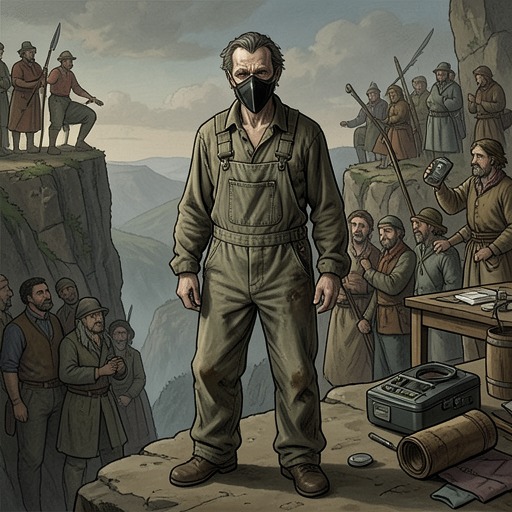
Hardquanonne identifies Gwynplaine and reveals his birthright
The Man Who LaughsHardquanonne identifies Gwynplaine and reveals his birthright in a judicial confrontation that reverses the identity by which Gwynplaine has lived: the travelling performer known as the Laughing Man is Lord Fermain Clancharlie, heir to his father’s title and estates. Hardquanonne’s recognition also exposes the king’s role in the child’s sale, mutilation, and removal from the succession. What had seemed a private history of bodily difference becomes evidence of a deliberate political crime.
Background and the Hidden Identity
Gwynplaine’s appearance has made him famous while concealing who he is. His face seems to laugh, with a mouth stretched towards his ears and features arranged into an unchanging comic expression. The novel distinguishes that appearance from his inner life: Gwynplaine does not choose the expression, cannot simply remove it, and does not share the laughter it provokes. Even suffering, anger, pity, or astonishment intensifies the visible grimace. His public identity is therefore produced by a face that others read as amusement, although it does not express his thoughts.
The recognition scene discloses the history behind that face. The sheriff’s formal account identifies the abandoned child as the only legitimate son of Linnæus, Lord Clancharlie and Ann Bradshaw, both deceased. The child inherited his father’s estates and titles; according to the accusation read aloud, he was sold at two years old on the authority of King James II, then mutilated and put out of the way. At ten, he was abandoned on the coast of Portland. He was subsequently brought up and trained as a mountebank, the occupation through which the adult Gwynplaine became known to the crowds who laughed at him. The revelation joins those apparently separate facts—his performance, his face, and his lost name—into one account of political dispossession.
The Judicial Confrontation
The encounter takes place within the procedures of an English criminal justice system that the novel presents as capable of operating through secrecy as well as formal examination. Gwynplaine has been seized without an explanation, a practice the narrative describes as a private or silent arrest, still used despite the Habeas Corpus Act in cases treated as matters of state. The sheriff’s officers, including the justice of the quorum and the wapentake, bring him into a torture chamber in Southwark Prison. The chamber is not presented as an isolated invention: the narrative observes that English prisons, including those of King John’s time, had such rooms.
For the identification, the justice of the quorum takes Gwynplaine’s hat and mantle, places him in the light beside the chained prisoner, and turns his face towards Hardquanonne. The wapentake lifts the prisoner’s closed eyelids so that he can see. Hardquanonne first remains inert; then he deliberately raises his head, opens his eyes, and recognizes Gwynplaine. His startled declaration is followed by a horrible laugh. The gesture makes the scene’s central contrast visible: Gwynplaine’s face carries an involuntary, lasting expression, while Hardquanonne’s laughter follows the shock of recognizing the person whose fate he helped determine.
Confession and the Birthright Revealed
The recognition completes a confrontation already prepared by the evidence. Hardquanonne had willingly acknowledged a bottle bearing his name, but after the parchment inside it was read he refused to answer. The sheriff states that the parchment contained the declaration and confession of Hardquanonne’s accomplices, and that a second reading had not broken his silence. The prisoner had undergone peine forte et dure for refusing to respond. On the fourth day, designated in the proceedings for confrontation, Gwynplaine is brought before him; the sight of the surviving child ends Hardquanonne’s silence.
Hardquanonne explains that he had sworn to keep the secret and had kept it as long as he could. He then confirms that Gwynplaine is the child they had sought to remove, and acknowledges that the act was shared: the king supplied the will and Hardquanonne supplied the craft. His confession makes the crime more than a charge against an unknown conspiracy. It identifies the monarch who ordered the deed and the man who participated in carrying it out. Hardquanonne then directs a final taunt at Gwynplaine, wishing the permanent grin on him forever. His own laughter, which follows, is described as close to a sob, an ending that makes no simple distinction between mockery and distress.
Consequences and Significance
The sheriff immediately gives the identification its legal and social consequence. When Gwynplaine pleads that he is a travelling mountebank without protection, the sheriff answers by naming him Lord Fermain Clancharlie, Baron Clancharlie and Hunkerville, Marquis of Corleone in Sicily, and a peer of England. He rises and offers Gwynplaine his chair. In a brief reversal of rank, the man who entered the room asking to be released as an unprotected performer is treated as a lord. The changed form of address does not undo the abandonment or the years lived under a false public identity; it establishes that the authority to name him has shifted from spectacle to law.
The revelation also changes the meaning of Gwynplaine’s face without changing its appearance. The crowd’s laughter had made his grimace a successful performance and a source of renown, while spectators turned away from him once their involuntary amusement passed. The confession identifies that expression as the result of a crime ordered by the crown. Later, addressing the House of Lords, Gwynplaine presents his grin as the king’s mark and as an image of the suffering imposed on the people. The recognition scene thus supplies the political history behind his later public protest: the face that society treated as entertainment is also a record of the power that mutilated him and deprived him of his inheritance.