Hardquanonne’s flask
The Man Who LaughsHardquanonne’s flask is both a physical container of evidence and the hinge on which Gwynplaine’s fortunes turn. Cast into the sea with a parchment recording the shipwrecked crew’s knowledge, it survives fifteen years before reaching Barkilphedro, who recognizes how its contents can expose Gwynplaine’s identity and unsettle Josiana’s position. The object brings a lost claim back into public view, but its delivery makes justice useful to a vindictive courtier as well as to the person it restores.
Recovery and route through official hands
One of the four gunners in the garrison of Castle Calshor found the flask on the sand at low water. It had been cast ashore by the tide and was covered in mould; a tarred bung sealed its wicker covering. The soldier carried this unclaimed object to the castle’s colonel, who sent it onward to the High Admiral of England. The narrative makes the administrative chain part of the flask’s history: for objects washed ashore, the Admiralty’s practical destination was Barkilphedro.
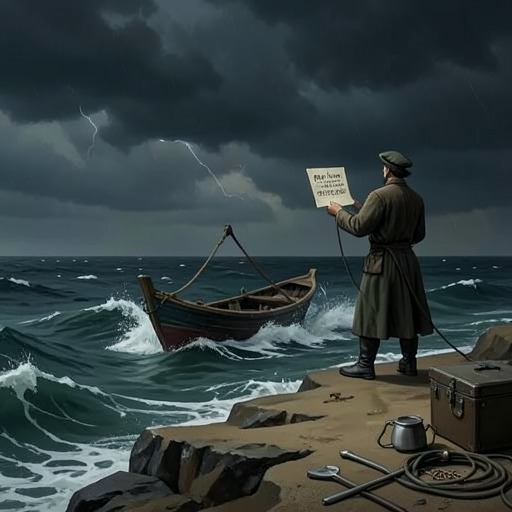
Barkilphedro uncorked the flask, emptied it, and carried it to Queen Anne, who immediately considered the matter. The inquiry then passed to officials whose responsibilities made the object consequential beyond the recovery of a lost message. The Lord Chancellor, William Cowper, was consulted alongside the Lord Marshal, whose office concerned heraldry and noble pedigrees. Cowper took a particular interest in the case as an occasion to apply his stated view that restoring a peer mattered more than restoring a king. The flask had become the starting point for an official examination of a claim to hereditary status.
The parchment and Gwynplaine’s identification
The flask’s decisive contents were a parchment connected to the shipwrecked crew. When Barkilphedro later opened it with two witnesses from the Admiralty, he unfolded and read the document. The evidence did not stand alone: he remembered having seen the name Gwynplaine and the account displayed outside the Tadcaster Inn, and compared that public notice with the parchment. The notice identified Gwynplaine as a child abandoned at the age of ten on the coast of Portland on 29 January 1690. Set beside the crew’s signed record, it gave the officials a way to connect the known performer with the lost heir.
The inquiry also reached beyond England. Information sought from Switzerland was found to agree with the account, while Hardquanonne, still imprisoned at Chatham, was transferred to London and made available for identification. Gwynplaine was soon located through the sign over his door. Thus the flask did not itself perform every part of the proof: its parchment set a chain of comparisons, searches, and official steps in motion. The recovered object made the scattered evidence legible as a single claim, and the claim restored Gwynplaine as Lord Clancharlie.
Fifteen years at sea
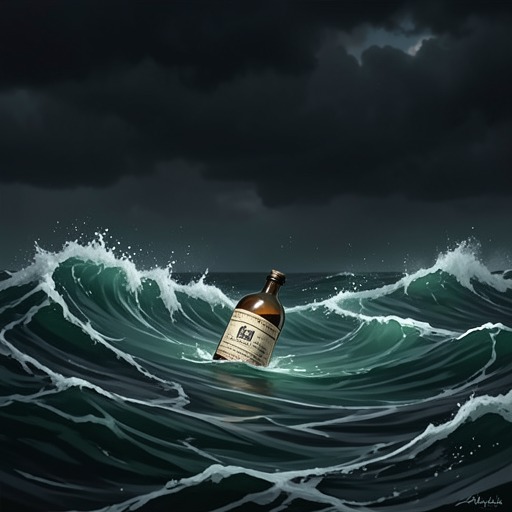
The flask’s survival is presented as an improbable material history rather than a simple delay in delivery. For fifteen years it passed from wave to wave without its glass cracking, its cork shifting, its wicker decaying, or water reaching the parchment and erasing its writing. Seaweed, shells, rocks, weather, and the movement of the tide are all made part of the account of what the object endured. The narrator compares this long passage with a Roman amphora found on the coast of Morbihan in 1867 after, it was said, fifteen hundred years afloat. Against that example, fifteen years becomes a span the sea could preserve.
This endurance gives the flask a peculiar double character. It is fragile enough that any break, leak, or loss of its seal could have destroyed the message, yet it reaches shore with the writing still usable. Its material survival is essential to the legal and dynastic consequences that follow. The object’s significance depends not only on what the parchment says, but on the intact condition in which it arrives and can be read.
Justice, revenge, and the meaning of its arrival
For Barkilphedro, the flask arrives at the moment when he has almost despaired of finding a way to injure Josiana. He sees the document as a means to bring about Gwynplaine’s restoration and, through that restoration, to displace Josiana and overturn the position of Lord David Dirry-Moir. The information gives him the pieces of a plan that seem ready to assemble: Gwynplaine’s identity, the inheritance, and the consequences for the people around him. Barkilphedro takes the coincidence as a triumph of his own design, although the narrator emphasizes that he has mistaken the event’s meaning.
The narrative instead presents the sea’s preservation of the flask as part of a larger reversal. The vessel that carried the crime is set against the fragile phial that carries reparation: the sea that swallowed the shipwrecked men’s pleas preserves the evidence that can restore the abandoned child. Gwynplaine has grown up unaware of this long passage, while the object has been crossing the ocean toward the revelation of his inheritance. Yet the restoration also gives Barkilphedro an opportunity to use justice against Josiana. The flask therefore joins repair to harm, and providential recovery to the malice of the person who exploits it. Its course delivers the truth, but does not ensure that those who handle the truth will act justly.