Isle of Portland
The Man Who LaughsThe Isle of Portland is a peninsula whose geography shapes two sharply different scenes: a coastal inlet used for clandestine embarkation, and the exposed ground across which an abandoned child struggles to find a way forward. The narrative presents the place both as a landscape altered by industry and as a setting where human isolation becomes difficult to escape.
Geography and Industrial Transformation
The Isle of Portland is described as a rugged mass rising from the sea. Seen geometrically, it resembles a bird’s head: its bill points toward the ocean, its head lies toward Weymouth, and the isthmus forms its neck. This outline gives the peninsula a recognizable structure, but its physical form is not presented as untouched. The narrative contrasts the force of the sea, which once wore the coast into cliffs, with the deliberate extraction that has reshaped it into a quarry landscape.
Portland stone became the basis of Roman cement, and quarrymen and plasterers began exploiting the coasts around the middle of the seventeenth century. The industry brought wealth to the district, while changing the bay’s appearance. Where waves had made broad, irregular incursions, the pick made measured cuts. The contrast is not simply between nature and human activity: it marks a change in the character of the landscape, from coast shaped by the sea to ground worked for trade. The peninsula is said to exist increasingly for that trade, at the cost of its former wildness.
The Vanished Creek
The effects of quarrying reach into the story’s account of a small anchorage on the eastern side of the peninsula. The inlet where a Biscay hooker had been moored was gradually worked away. By the time its location is described, the anchorage has been destroyed, and finding its former site requires searching beyond Folly Pier and Dirdle Pier, past Wakeham, between Church Hope and Southwell. These directions place the lost harbor within a specific stretch of coast even as they emphasize that the feature itself has disappeared.
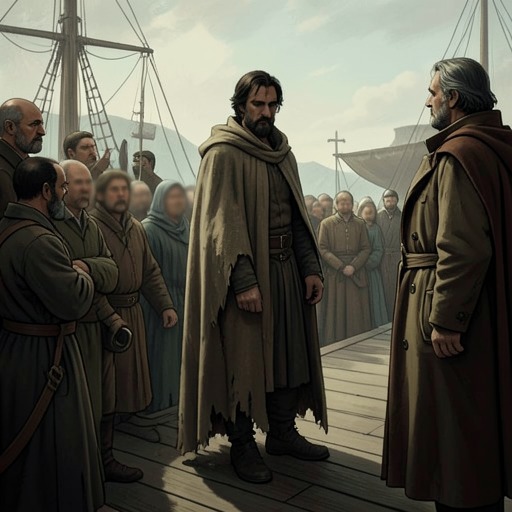
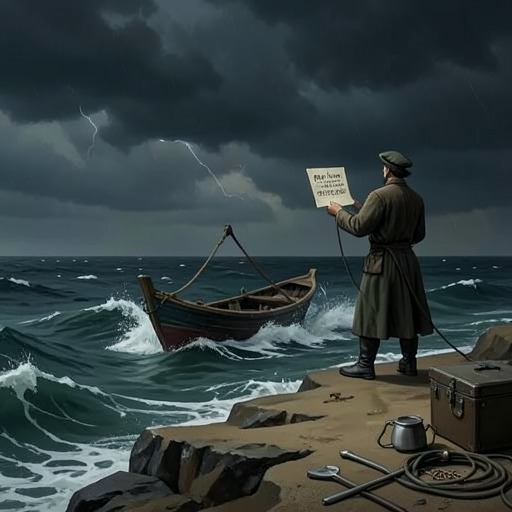
When the inlet served as a landing place, its narrowness and surrounding cliffs made it a concealed and difficult point of access. A plank from the vessel reached a low, level projection of rock—the only place where a landing could be made—and formed a precarious connection between ship and shore. People moved across it as others embarked. The creek therefore functions as more than a mark on a map: it is a temporary passage between sea and land, now erased by the same quarrying that transformed the coastline. The account of the harbor’s former use and its later disappearance makes industrial change part of the place’s history, not merely its scenery.
The Child’s Crossing
Later, the child is at the extreme southern point of the peninsula, at about seven in the evening. He does not know that the land is a peninsula and does not even know its name. His immediate experience is limited to the ground beneath him and the fact that he has been brought there and left. The surrounding country offers no familiar route or guidance; he walks onward without knowing what the place is or what direction will lead him to help.
He crosses the plain from south to north. Snow has hidden or obliterated tracks, and he recognizes none of the ground. The narrative suggests that the band which brought him to the peninsula had probably crossed it in a different direction, from east to west, after reaching Portland by boat and making for the waiting hooker. This is offered as a likelihood rather than as something the child could know. Its significance lies in the intersecting routes: the child’s solitary crossing cuts across the path associated with those who left him, but gives him no means to retrace it.
At a raised point, he searches the obscured distance for signs. Smoke appears beyond a fold of land toward the east, and the possibility of people turns him toward it. The landscape supplies a clue, but not a map: he must infer what the smoke means and choose a direction without understanding the terrain. On the evening when the wind is diminishing before another violent recurrence, the peninsula becomes the physical measure of his exposure—wide enough to make movement possible, yet unfamiliar enough to leave him without reliable bearings.
Narrative Significance
The Isle of Portland links changes to the land with the conditions of the people moving through it. The lost creek belongs to a history of coastal extraction, while the child’s passage across the plain makes the peninsula a setting of abandonment and uncertainty. The two scenes differ in scale and circumstance, but both depend on the difficulty of passage: a harbor once connected vessel and shore, and a child now crosses open ground in search of human presence.
The narrative’s close attention to directions, landforms, and vanished features grounds the child’s ordeal in a particular geography rather than in an abstract wilderness. Yet the place is also defined by what its inhabitants and visitors cannot rely on. The old anchorage no longer exists; the child has no knowledge of the peninsula’s name, routes, or shape. In this way, the Isle of Portland is at once a historically altered coast and an immediate landscape of isolation, where human industry has remade the terrain but offers no refuge to the abandoned child.