James II–Comprachicos alliance
The Man Who LaughsThe James II–Comprachicos alliance made a clandestine trade useful to royal government: James II tolerated the Comprachicos and employed them to suppress inconvenient heirs, while their secrecy helped conceal the consequences. Gwynplaine’s forced transformation and removal from his inheritance reveal the alliance’s personal cost and the political purpose behind it.
Political Use and Royal Protection
Under the House of Stuart, the Comprachicos were not simply left alone by the authorities: they were, to a degree, protected because James II found their services useful. The narrative presents the relationship as repeated rather than incidental, describing James II as having made use of them on more than one occasion. Their trade was permitted to persist in a precarious, marginal condition, with little surveillance and no sustained persecution. The contrast is pointed: the law appeared to look away while the king turned his attention toward them.
That tolerance had a political rationale. When a family or inheritance stood in the way of royal interests, a child could be made unrecognizable and disappear from public life. The Comprachicos’ skill in altering a child’s appearance offered a means of suppressing an heir without killing him. Such removal could ease confiscation or the transfer of titles and property to royal favourites. The alliance therefore connected bodily alteration to the redistribution of political inheritance: an apparently private fate could serve a state purpose.
Secrecy, Transactions, and Royal Authority
The Comprachicos’ discretion strengthened their value to James II. They were described as taciturn and bound to keep their clients’ secrets; the account stresses that they had scarcely betrayed the king’s confidences. Their silence was not presented as proof of loyalty alone, but as a condition of their usefulness—and of their continued safety. If royal confidence failed, the group itself could be placed in danger.
The narrative also describes a more explicit sign of royal involvement. In some cases, a fleur-de-lis was branded onto a child to register the royal origin of the new status imposed upon him. The example given is a child in the family of Jacob Astley who had been sold and marked in this way. The mark turns a concealed intervention into an assertion of authority: the child’s altered position bears the sign not merely of a dealer’s work but of the king’s claim upon it.
The Comprachicos also served religious purposes that made their work acceptable within the court’s confessional outlook. They supplied singers for the papal Miserere and were devoted to the Virgin; their production of eunuchs was treated as compatible with that devotion. Their political and religious usefulness together helped explain why James II could favor an association whose trade he might otherwise have despised.
Gwynplaine as the Consequence of the Alliance
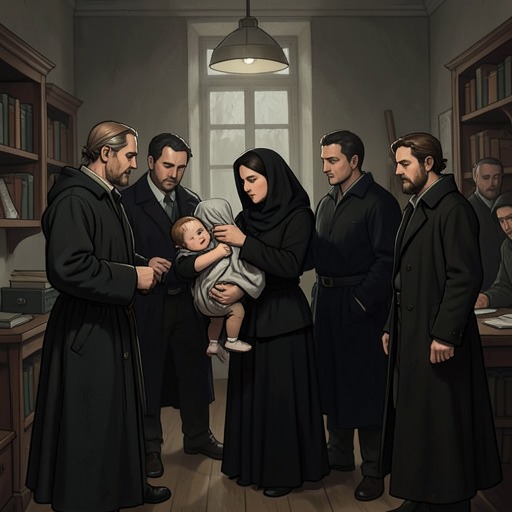
Gwynplaine’s history gives the political arrangement a specific human subject. A royal declaration identifies him as the legitimate son and heir of Lord Linnæus Clancharlie and states that he was sold at two years old, after his father’s death, by order of James II. The declaration connects the sale, his alteration, and his removal from the way with the king’s desire to prevent him from inheriting his father’s estates and titles. Ten pounds sterling was paid to the king as purchase money, alongside concessions, tolerations, and immunities.
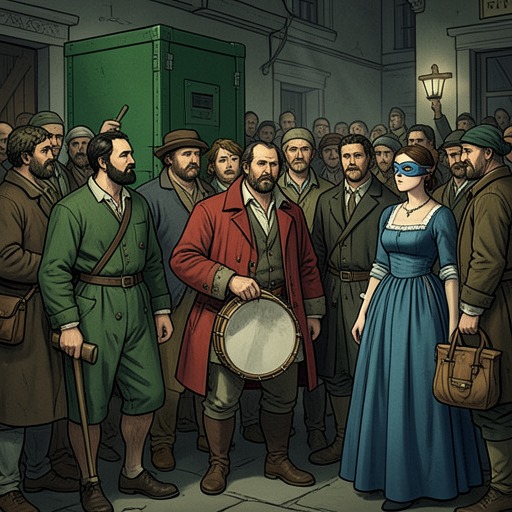
The child was subsequently brought up and trained as a mountebank at markets and fairs. His face, unlike the rest of his figure, carried the imposed, permanent appearance of laughter. The narrative distinguishes that expression from his inward feelings: whatever he thought or felt, his face presented the crowd with laughter. The contrast makes his condition more than a sign of lost status. It shows how the alliance’s political act continued to shape the adult’s public identity and livelihood.
When Gwynplaine later speaks before the peers, he interprets his face as the work of royal power and makes his own imposed laughter an accusation against those who govern. He presents himself not as an isolated exception but as a figure for a people whose suffering is concealed beneath an appearance of public cheer. The episode does not undo the alliance’s effects, but it reverses their intended meaning: a method used to silence and remove an heir becomes the basis of a public challenge to aristocratic power.
The Change of Dynasty
The alliance depended on the priorities of the reigning monarch, not on lasting institutional protection. In 1688, William III replaced James II, and the narrative contrasts the new king’s policies with those of his predecessor. William III was severe toward the Comprachicos and sought to suppress them. The change of dynasty thus marks the end of the protection that had allowed the association to serve royal purposes under James II.
The relationship’s significance lies in this conjunction of private trade and public power. The Comprachicos’ secrecy, practical skill, and ability to make a child disappear served a system concerned with succession and property; royal tolerance, in turn, gave their work political shelter. Gwynplaine’s case exposes the result in an individual life, while his later speech converts that history into an indictment of the order that had made it possible.