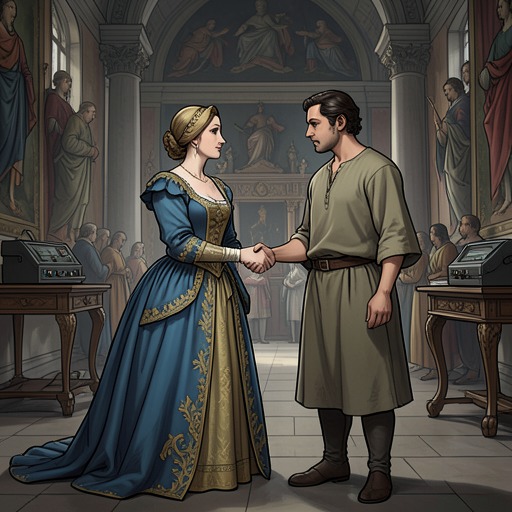
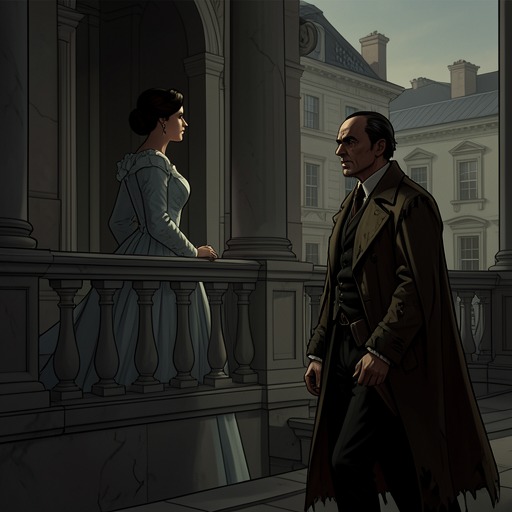
Josiana rejects Gwynplaine after learning of their betrothal
The Man Who LaughsJosiana’s rejection of Gwynplaine turns his sudden restoration to rank into an immediate personal defeat. A royal letter declares him the legitimate heir to Lord Clancharlie, orders his admission to the House of Lords, and commands his marriage to Josiana; she accepts the decree but refuses him, insisting that the place of a husband is already occupied by her lover, Lord David Dirry-Moir.
The royal order and the evidence
The scene pivots on two documents. Gwynplaine unfolds and reads Queen Anne’s letter aloud, his voice trembling as he reaches the announcement that the legitimate son of Linnæus, Lord Clancharlie, has been discovered under the name Gwynplaine. The letter recasts his past as a false position imposed from childhood and presents hereditary right as the basis for his new public status. It states that he is to be admitted and installed in the House of Lords that day.
The same instrument joins recognition to command. In the name of the Queen’s authority and her relationship to Josiana, it orders Josiana to marry Gwynplaine. It also says that the estates of Lord Clancharlie of Hunkerville are to be preserved for her use, with Gwynplaine substituted for Lord David Dirry-Moir. The document therefore does more than announce an heir: it rearranges the intended marriage and the use of the family property at the same moment.
As Gwynplaine finishes reading, Josiana, who has half risen from the couch, snatches the letter from his hands. She murmurs the royal signature, then retrieves from the floor a separate parchment she had thrown down. That document is the confession of the shipwrecked crew of the Matutina, incorporated into a report signed by the sheriff of Southwark and the lord chancellor. She reads the report and then reads the Queen’s letter again. The juxtaposition makes the change in Gwynplaine’s identity both a royal declaration and a claim supported by the crew’s testimony.
Recognition followed by refusal
Josiana’s answer is brief: she accepts the order. Her calm response does not, however, become consent to a relationship with Gwynplaine. She points him toward the gallery door and tells him to leave. The contrast is immediate: the Queen’s words make him Josiana’s husband in law, while Josiana’s words deny him the welcome or intimacy that the title might seem to promise.
Gwynplaine cannot move. Josiana repeats the command in colder terms and tells him that, since he is her husband, he must go. He remains speechless, with his eyes lowered like a criminal. She then names the obstacle directly: he has no right to be there because the place belongs to her lover. The scene thus distinguishes formal marriage from personal attachment without suggesting that the royal command has changed Josiana’s feelings.
The scene’s reversal
The encounter begins with Gwynplaine performing the role the royal letter assigns him: he reads the decree that elevates him and makes him Josiana’s husband. It ends with Josiana leaving the room and Gwynplaine left behind, motionless. Her final dismissal reverses the apparent promise of the announcement. He has been raised from the lowest rank of a wandering life to hereditary standing, yet that new status gives him no welcome from the woman whom he is ordered to marry.
Josiana’s conduct remains controlled throughout. She studies the documents, accepts the Queen’s decision, and then rejects Gwynplaine with a haughty farewell. The order’s authority governs the legal and dynastic arrangement; it does not erase the distinction Josiana draws between a husband imposed by royal pleasure and the lover whose place she says Gwynplaine cannot occupy. The scene’s decisive consequence is therefore not a marriage celebrated, but a marriage commanded and immediately refused as a personal bond.