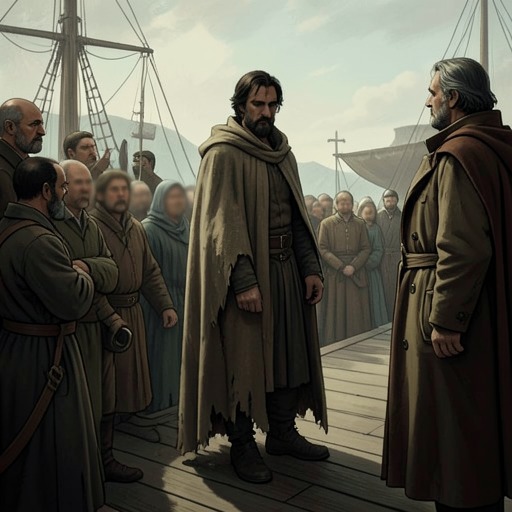
King James II
The Man Who LaughsKing James II is depicted as a monarch who made private political use of the Comprachicos, protecting them because their trade could help him eliminate inconvenient heirs. His order concerning Gwynplaine gives that policy a personal consequence: the child was sold, disfigured, and abandoned, but records of the crime later helped establish his identity and inheritance. James’s significance lies in this collision between royal command and the recovery of a right the king had tried to suppress.
Identity and Political Character
The narrative presents James as a devout Stuart ruler whose religious and political conduct does not prevent him from exploiting an association he otherwise might despise. The Comprachicos’ child-buying trade is described as useful to state policy, and James tolerates it for that reason. Their activities are not wholly without official attention, but the law is represented as looking away while the king remains aware of what they do. The arrangement makes royal protection neither an open endorsement in every case nor a neutral failure to act: the text frames it as calculated tolerance of a useful instrument.
James’s manner is set against his brutality. He is characterized as having a gay, open countenance, unlike the sullen Philip II, yet the narrator insists that the two rulers were equally ferocious. James is rendered as an easy-minded tiger: a man whose crimes weigh lightly on his conscience, and whose confidence in royal prerogative leaves little impulse to conceal or excuse them. This contrast between genial appearance and political violence echoes the book’s wider concern with appearances that mislead, though James’s power makes the contrast more than a private contradiction.
The Comprachicos and the Uses of Secrecy
The Comprachicos are described as buyers and handlers of children, and James’s connection to them is presented as reciprocal. They could make a young heir disappear from public life by changing his appearance, thereby making confiscation and the transfer of titles to royal favourites easier. They were also valued for discretion: the narrative says they pledged silence and rarely betrayed royal secrets. Their secrecy, in this account, is a political service, not merely a feature of their trade.
The arrangement is also tied to the religious world of the Stuarts. The Comprachicos are depicted as fervent Catholics, particularly devoted to the Virgin Mary, and as suppliers of singers for the Pope’s performance of Allegri’s Miserere. Their religious observance pleased the Stuart court. The narrator pointedly sets this piety beside their manufacture of eunuchs and their dealings in children, exposing the distance between professed devotion and the uses to which royal policy puts it. James’s protection of them is thus described as both expedient and compatible, in his court’s eyes, with religious allegiance.
The account extends beyond Gwynplaine to show how royal complicity could leave a mark on a victim. It recounts the case of a child in the family of Jacob Astley, whose forehead bore a fleur-de-lis branded by a dealer. The mark could serve to register the royal origin of a changed position imposed on a child. The image turns a sign associated with the monarchy into evidence of the monarchy’s involvement: the king’s emblem is made to stand where protection should have been. The episode broadens the charge from a single concealed succession to a system in which royal authority could make its intervention legible on the very people it harmed.
The Change of Dynasty
The narrative places this compact within the Stuart reigns and marks its political reversal in 1688, when William III replaced James. James went into exile and later died there. The account observes, with its characteristic irony, that miracles were performed at his tomb and that his relics were said to have cured the Bishop of Autun of a fistula. That posthumous devotional reputation is set beside the political violence attributed to his rule, sharpening the contrast between sanctified memory and the record of his actions.
William III is described as having different principles and practices and as acting severely against the Comprachicos. A statute early in the reign of William and Mary struck hard at the child-buying association. Those convicted faced branding and other penalties; the stated provisions also targeted leaders through pillory, branding, and confiscation, while failure to inform could bring confiscation and imprisonment for life. The text’s account therefore connects the change of dynasty to the destruction of the network James had found useful. The association’s former protection gives way to a legal campaign against it, though that reversal does not undo the injuries already inflicted.
Gwynplaine and the Royal Record
The case that most directly defines James’s role concerns Gwynplaine, identified in a written declaration as the legitimate son and heir of Lord Linnæus Clancharlie and Ann Bradshaw. The document states that James ordered the child’s sale at the age of two, after his father’s death, and that ten pounds sterling was paid to the king as purchase money, along with concessions, tolerations, and immunities. It further says that Gwynplaine was sold, disfigured, and put out of the way because of his inheritance, then raised and trained as a mountebank for markets and fairs. These details make the monarch’s policy concrete: an heir’s displacement is not abstract statecraft but the cause of a child’s imposed life beyond the rank to which he was born.
The declaration names Hardquanonne as the person who bought and disfigured Gwynplaine, and the accompanying royal order bears the signature of Jeffreys. When the sheriff turns the parchment toward the light, the words and signature supply documentary evidence of royal authorization. The text treats this surviving record as especially revealing because James’s authority appears not only in the consequences of the act but on the order associated with it. Its presence makes the crime harder to separate from the machinery of government.
The later inquiry into Gwynplaine’s inheritance is conducted in secrecy and with what the narrative calls royal promptitude. Records are gathered in Switzerland: certificates of Lord Linnæus Clancharlie’s marriage in exile, his child’s birth, and the deaths of both parents. The royal order and Jeffreys’s signature are authenticated. These steps establish the documentary basis on which Gwynplaine can be recognized as heir; they also bring the earlier royal intervention back into view. The account interprets the signature as an instance of a ruler attaching his authority to wrongdoing rather than escaping the historical record.
Royal Power and Narrative Judgment
Queen Anne requests a confidential report from William Cowper, the Lord Chancellor. Cowper does not condemn James, who was Anne’s father, and the narrative says he even justifies the king by invoking inherited monarchical maxims and a supposed royal right to mutilate. Yet Cowper distinguishes that claim from the question of the heir’s restoration: one law, the report reasons, does not cancel another. If the heir is found, his coronet should be returned. Cowper therefore advises reinstating Gwynplaine in his estates and dignities, subject to his being confronted with Hardquanonne and identified by him. The procedure exposes the tension between an authority invoked to excuse the original act and the legal process required to repair its consequences.
James also remains present in the story through his daughter Josiana’s account of her family and faith. She says that her father died in France surrounded by Jesuits and identifies herself as a Papist. Her words locate him within a continuing dynastic and religious inheritance, even as the earlier account of his dealings with the Comprachicos makes that inheritance morally compromised. Across these episodes, James is less a continuously present character than the absent ruler whose orders shape other lives: his protection gives the Comprachicos room to act, his command destroys Gwynplaine’s childhood, and the surviving record of that command helps make restoration possible. The narrative’s judgment is severe because royal power here does not merely fail to protect a vulnerable heir; it is represented as the force that arranged his removal.