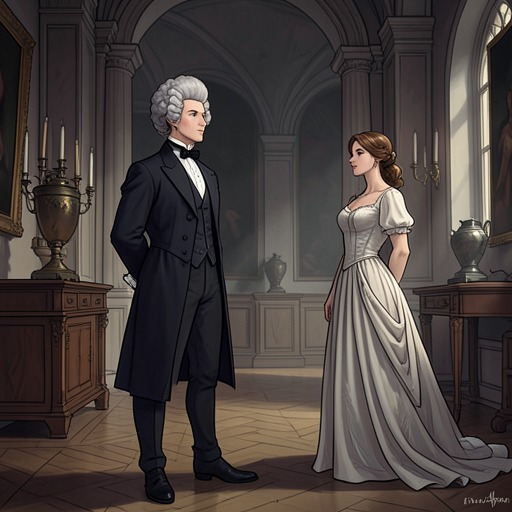
Lord David Dirry-Moir and Duchess Josiana
The Man Who LaughsLord David Dirry-Moir and Duchess Josiana are bound by a royal marriage arrangement, but their relationship is defined less by movement toward a wedding than by their mutual willingness to defer it. The match links personal attraction to the inheritance of Lord Linnæus Clancharlie, while their prolonged flirtation lets each enjoy the other without accepting the obligations marriage would impose.
The Royal Arrangement
King James II established the marriage as a condition of David’s succession to the titles, rights, and prerogatives of Lord Linnæus Clancharlie. The king named David sole heir in the absence of legitimate issue, then required him to marry Josiana when she reached a marriageable age. At the time, Josiana was an infant only a few months old; the king had already made her a duchess. The arrangement thus preceded any personal attachment between the two and placed their future marriage inside a settlement of rank and inheritance.
The titles were not simply David’s to assume independently of the match. Josiana held the peerage until there should be a peer, and that peer was to be her husband. The union therefore gave the prospective couple complementary positions within the succession: David was designated heir, while Josiana’s status was tied to the eventual husband who would hold the peerage. The arrangement converted marriage into a dynastic instrument, even though the two later approached their engagement through flirtation rather than urgency.
A Betrothal Kept in Suspension
By about 1705, Josiana was twenty-three and David forty-four, yet they had not married. Their delay is presented as a choice that suited them both. Josiana wanted to remain free; David wanted to remain young, and postponement offered him what seemed a prolonged youth. The text places their hesitation in a courtly world where age did not prevent men from presenting themselves as young gallants, but the immediate explanation remains personal: neither hurried toward the tie that had been arranged for them.
Their attachment is described as a flirtation in which they pleased one another without being in love. Being together was enough; neither needed to bring the engagement to its conclusion. Josiana fancied David and thought well of his fashionable standing. His good looks were an additional advantage, not the principal basis of her regard. David, for his part, admired Josiana and addressed sonnets to her, declaring in them that possessing her would be an ascent to the stars. Yet he repeatedly put that ascent off until the following year. His professions of admiration and his delay coexist, making postponement part of the relationship rather than a temporary obstacle to it.
Unequal Terms and Mutual Display
The engagement did not make the pair equal in how they conducted their intimacy. Josiana knew herself to be a bastard but felt herself a princess, and she carried authority over David in their arrangements. She appreciated him and showed him off; he, meanwhile, waited outside the guarded interior of her affections. The narrator’s image of him waiting in her antechamber captures a courtship in which access remains suspended and Josiana retains the power to set its pace.
Their mutual admiration also rests on different kinds of display. David’s fashionable life appealed to Josiana: she valued his horses, dogs, gambling losses, and mistresses, along with his betting and boxing. These details present him as a man whose public style and dissipations were part of his attraction to her, rather than evidence that she expected him to adopt a sober or conventional courtship. David’s sonnets flatter Josiana’s elevated self-image, while her attention to his fashionable reputation confirms that each takes pleasure in the other’s social persona.
Marriage Deferred
Josiana’s resistance to marriage is given a broader rationale than simple reluctance to wed David. The narrator invokes an old English conception in which a maiden was sovereign and a wife became a subject, and presents Josiana as deferring the hour of that subjection for as long as she could. She was expected eventually to marry David because that was the royal pleasure, but the expectation did not erase her preference for remaining free. Her complaint that she was obliged to marry him even though she would like nothing better than to be in love with him crystallizes the distinction: she can desire the possibility of love while resenting marriage as an imposed conclusion.
The narrative compares their approach to a dance in which each moves one step forward and two back, naming the minuet and gavotte as its equivalents. That comparison makes delay an active pattern of courtship: they neither break the engagement nor fulfil it, but continue to elude one another. The marriage remains the prescribed outcome, while their shared satisfaction lies in keeping the relationship unfinished. In this way, their bond joins attraction to evasion, and exposes the gap between a royal contract designed to settle inheritance and the private freedom Josiana and David preserve by refusing to complete it.