Mass poverty among England's lower classes
The Man Who LaughsMass poverty among England’s lower classes is depicted not as an isolated misfortune but as a social order that presses on work, family life, health, and dignity. Its force lies in the contrast between the poor, whose basic needs go unmet, and the privileged, whose wealth and political power depend on a system that leaves others with little. Gwynplaine first encounters this suffering as a performer looking out over a changing crowd; later, as a peer in the House of Lords, he tries to make its dispersed hardships impossible to ignore.
Wealth and deprivation
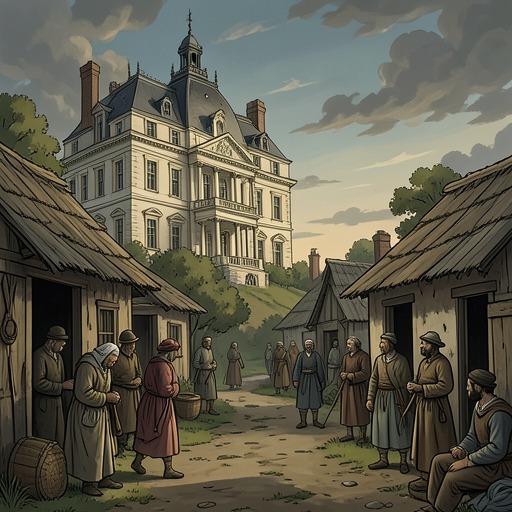
The contrast is made visible even in a document framed as a substitute for satisfaction to those who have nothing. It sets the Earl of Grantham’s hundred-thousand-a-year income and marble palace against the deprivation of ordinary people. The palace’s many corridors, distinguished by expensive marbles and stones in an array of colors, turn elite abundance into a catalogue. Set beside that catalogue, poverty is not merely an absence of luxury: it is the lack of the resources required to live securely.
The Green Box’s popularity brings a different measure of deprivation into view. Its low prices draw poor and vulnerable spectators seeking a brief escape from their circumstances. They come, in the narrator’s account, to purchase a pennyworth of forgetfulness. Their presence makes the fairground both a place of entertainment and a gathering point for people whose hardships remain in the world outside the performance. The laughter they find there offers temporary relief, not a remedy for the conditions that brought them.
A crowd marked by hardship
From the platform, Gwynplaine sees the audience as a succession of individual lives joined by recurring forms of distress. Some children appear unfed; parents face the prospect of their families’ ruin; and faces bear the effects of ignorance and indigence. He recognizes goodness worn down into bitterness, old age marked by hunger, and young women driven toward prostitution. The details vary from face to face, but the crowd repeatedly reveals the same broad pattern: people are shaped by pressures they have little power to escape.
Unemployment is especially clear in the image of workers with arms but no tools, asking for work that is unavailable. Soldiers and wounded pensioners make the costs of war part of the same landscape of want. Gwynplaine also sees what the narrative calls the farming of people: forms of dependence and exploitation that reduce the poor to instruments of others’ comfort. The poor appear to be pushed toward deprivation and even a diminished, animal-like existence by the weight of privilege above them. His view is not that every sufferer has the same story, but that their varied miseries are connected by a structure that leaves the powerful free to prosper while the disinherited bear its burdens.
The language of social pressure extends beyond hunger and wages. Families are consumed by society; laws torment morals; penalties deepen wounds; taxes gnaw at poverty; and ignorance swallows intelligence. These images gather separate hardships into a cumulative condition. Misery is not presented as one dramatic episode that can be set aside when it ends. It recurs in families, workplaces, communities, and institutions, forming the everyday setting against which the fortunate measure their own security.
From witness to advocate
Gwynplaine’s response begins in an uneasy recognition of his own happiness with Dea. Their private refuge makes him feel compassion for people living amid the crowd’s suffering, but he initially thinks himself powerless to help them. He once rescued an infant, and from that act grows what the narrator calls a disproportionate wish to succour the whole world. His question about what can be done for the poor is not a settled program of reform; it is the first expression of a conscience disturbed by what he has seen.
The novel gives this concern a practical, limited counterpoint. Gwynplaine can make his audience laugh, and the narrative treats that gift as a real form of relief: laughter lets people forget, if only briefly. That benefit does not erase poverty or change its causes. The distinction matters. The performance offers respite to those who come seeking it, while Gwynplaine’s growing awareness presses beyond the platform toward the conditions that make such respite necessary.
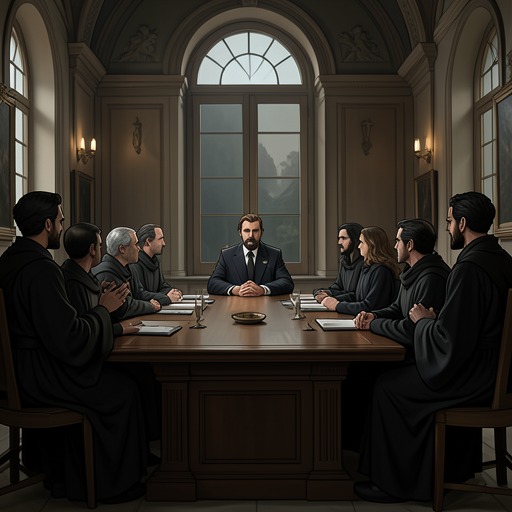
When he speaks in the House of Lords, he turns his observations into a public accusation. He argues that the poor live without hope or the conditions needed to flourish, and that social arrangements place one level of society’s building on top of another until the lower bears the weight of the upper. His appeal asks powerful men to act as brothers rather than masters. It also insists that their own security is bound up with the lives of those they oppress: the social body cannot treat the suffering of its lower ranks as irrelevant to its upper ones.
Poverty as a political indictment
Gwynplaine grounds his address in examples from named places. He describes miners in Newcastle-upon-Tyne deceiving hunger by chewing coal, poverty reducing Ribblechester in Lancashire from a town to a village, and shut manufactories producing forced idleness across Lancashire. He points to herring fishers at Harlech eating grass when the fishery fails, and to chronic destitution at Ailesbury. At Penkridge, he contrasts the endowment of a cathedral and the enrichment of a bishop with families who lack beds and make holes in the earth for their children to lie in. These examples give geographical reach to his claim: deprivation is not confined to the crowd before him or to a single trade or district.
He also challenges the distribution of public resources. In his account, taxation weighs on people already near death, while the poor’s needs remain unmet; he questions whether Prince George of Denmark needs an additional hundred thousand pounds when a sick person can be denied hospital care unless funeral expenses are paid in advance. He condemns a system that takes from workers and the poorly clothed to benefit the idle, the prince, and the throne. Poverty thus becomes a test of political responsibility: the question is not only why people lack necessities, but who is asked to pay and who receives the proceeds.
The speech is received with laughter, and that response reproduces the very division it condemns. Gwynplaine’s face provokes amusement while his words plead for the poor, setting his outward appearance against the seriousness of his appeal. He identifies himself as both an exception and a representative, insisting that the king-made mark on his face makes him a symbol of a people whose rights, reason, and public voice have been distorted. The image does not make deprivation identical to his personal condition; it gives the speech a way to connect an imposed bodily difference with a society that has likewise been deformed by power.
The novel’s presentation of mass poverty therefore moves from spectacle to argument. A poor audience first appears as a multitude seeking momentary forgetfulness; Gwynplaine gradually learns to read distinct hardships within that crowd, then carries their claims into the chamber where privilege is exercised. The laughter that briefly eases misery becomes, in the House of Lords, a barrier to being heard. Against it, his appeal makes poverty a shared political danger and a demand for responsibility, not a private failing of those who endure it.