Mutual redemption through affliction
The Man Who LaughsMutual redemption through affliction is the bond through which Gwynplaine and Dea make companionship out of conditions that leave each isolated from the wider world. Gwynplaine’s face provokes involuntary laughter and rejection; Dea is blind. Their love does not remove either condition. Instead, each becomes a source of recognition and care for the other, so that what society treats as deficiency becomes, within their relationship, the ground of an intimate refuge.
The conditions of isolation
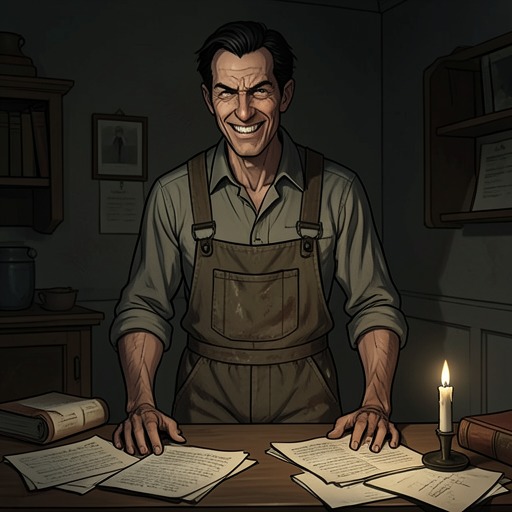
Gwynplaine’s altered face appears to express laughter whatever he feels. The narrative distinguishes his outward expression from his inward life: the face is fixed, while his thoughts and emotions are his own. Even grief, anger, pity, or astonishment can intensify the appearance of mirth. He can briefly restrain the expression, but doing so demands painful effort, and a distraction or emotion brings it back. His appearance therefore does more than attract attention; it misrepresents him at the very moment others encounter him.
The public response reinforces that separation. Spectators laugh when they see Gwynplaine, then turn away; women, in particular, recoil from him. His face can bring him renown as a performer, but the response is not intimacy or acceptance. He is tall, well made, and agile, with the alteration confined to his face, yet observers treat that face as if it defined the whole person. The narrative suggests that the alteration was deliberately produced when he was very young, contrasting his intact body with the face made to provoke laughter. The origin is presented as a terrible uncertainty for Gwynplaine, not as something he can remember or explain.
Dea’s blindness gives her a different relation to the surrounding world. The narrative contrasts her limited access to what can be seen with Gwynplaine’s exposure to the crowd and its gaze. Both are isolated, but in opposite ways: she cannot see the face by which others judge him, while he cannot escape being seen through it. Their circumstances are not interchangeable, and their bond does not depend on pretending that they are. It grows through the different forms of vulnerability each brings to their shared life.
Love as reciprocal refuge
The two are described as being in a paradise and as loving one another completely: Gwynplaine adores Dea, and Dea idolizes him. Their attachment changes the meaning of their solitude. Each finds in the other a presence that the outside world does not provide, and their shared happiness forms a private refuge amid circumstances the narrative otherwise presents as profoundly unjust.
Their relation is reciprocal rather than a simple story of one person rescuing another. Gwynplaine saves Dea, while Dea saves Gwynplaine; he can guide her, and her love answers the rejection his appearance invites. The narrative stresses that each possesses what the other lacks. Dea’s blindness means that she does not encounter him through the visual judgment that turns his face into a spectacle. Gwynplaine, in turn, gives her a beloved presence and companionship. Neither is merely an instrument in the other’s recovery: each is loved as a person, and each provides care as well as receiving it.
The story frames this union as an unexpected meeting of two forms of misfortune. The conditions that might have kept them apart instead help make their attachment possible: Dea can love Gwynplaine without seeing the face that repels other observers, and Gwynplaine finds in Dea a love that answers his imposed isolation. Their bond makes no claim that suffering is desirable in itself. Rather, the narrative locates consolation in what they create together despite the injuries and exclusions that preceded their meeting.
The limits of redemption
The image of an Eden formed by two outcasts captures both the force and the limits of their happiness. Their refuge is real: they are described as inexpressibly happy, finding joy in their companionship while the wider world remains hostile or inaccessible. But the language of paradise does not mean that either person’s condition has been cured, nor that society has ceased to exclude them. Their redemption is relational and emotional, not a restoration of the bodies or circumstances that have marked them.
That distinction matters to the concept. The narrative gives Gwynplaine’s altered expression a specific effect in ordinary encounters: it makes other people laugh, misread him, and turn away. His interior life remains distinct from the fixed appearance imposed on him. Dea’s blindness, meanwhile, shapes how she knows and trusts him. The two are not reduced to matching symbols of suffering; their different experiences help form the practical and emotional terms of their closeness. Their love challenges the crowd’s judgment, although it cannot by itself undo the conditions that produced that judgment.
From private affliction to public meaning
Gwynplaine’s later speech in the House of Lords extends the conflict between appearance and inward reality from personal life to politics. Addressing the peers, he presents his face as a sign of suffering imposed by royal power and argues that the people, too, have been deformed by their rulers. He connects the visible smile with enforced silence, rage, and despair, turning the expression others have treated as entertainment into an accusation against the institutions that made it possible.
The speech does not erase the earlier intimacy with Dea; it changes the scale on which Gwynplaine’s affliction is interpreted. In their private life, love allows him to be more than the face others see. Before the lords, he makes that face speak publicly about the people whose suffering is hidden beneath apparent celebration. The contrast is central: the same smile that elicits laughter from spectators becomes, in Gwynplaine’s account, evidence of torment. Mutual redemption through affliction thus joins personal care to social criticism. Love offers the two outcasts a real refuge, while Gwynplaine’s public appeal insists that compassion between individuals cannot substitute for confronting the power and indifference that create suffering.