Peine forte et dure
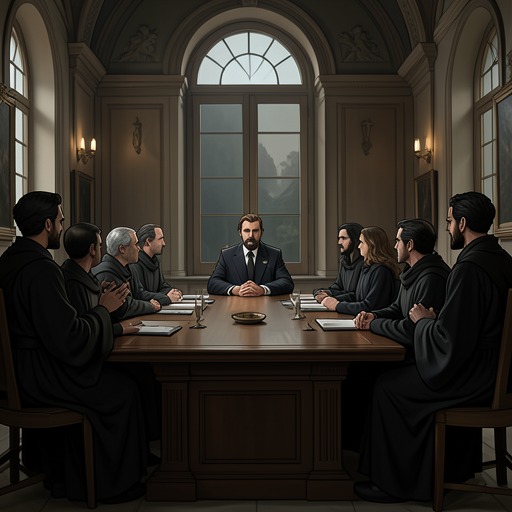
The Man Who LaughsPeine forte et dure is the novel’s procedure for forcing a prisoner who refuses to answer a judge to speak. Its formal rationale treats silence as resistance to justice; its operation turns that principle into a timed ordeal of deprivation and restraint. In Hardquanonne’s case, the procedure is made to serve a specific evidentiary purpose: to secure his recognition of Gwynplaine and establish the truth of the prisoner’s identity. The scene presents law as both a system of prescribed steps and an instrument of coercion, with the ritual precision of the former lending an unsettling authority to the latter.
Purpose and legal rationale
The sheriff explains the procedure as a response to a prisoner who, though considered sound of mind and informed about the matter under inquiry, declines to answer. In the law’s account, silence is not a neutral choice: it is represented as defiance, rebellion against justice, and an attempt to withhold the truth. The rule therefore converts refusal to speak into grounds for further punishment. The sheriff’s language insists that the law must answer the prisoner’s obstinacy with its own, making reciprocal stubbornness the stated logic of the process.
The procedure is described as legally prescribed rather than improvised by the officials conducting it. The sheriff invokes the criminal statutes and the law’s established rights of restraint and punishment; the serjeant supplies Latin formulations and references to older laws. His citations make the proceeding sound learned and inherited, while the sheriff’s address repeatedly casts the prisoner as a wrongdoer for maintaining silence. This division of labor gives the hearing the air of a formal service: one official announces each step, the other ratifies it with legal language. The ritual does not soften the punishment; it shows how institutional form can organize and legitimize it.
The prescribed ordeal
The procedure unfolds over successive days. The sheriff recounts that the prisoner was summoned again to answer before the ordeal was prolonged, then restrained under a heavy burden. The first day brought no food or drink. On the second day, the prisoner received food but nothing to drink; on the third, water but no food. These alternating deprivations are presented as stages in a legal proof, not as an incidental hardship. The account makes the timetable itself central: the punishment proceeds according to a schedule, and each day brings the prisoner closer to the point at which the law demands a decision.
The fourth day is identified as decisive. The sheriff says that the law sets it aside for confrontation, a procedure the narrative associates with the Statute of King Athelstane. After seventy-two hours of the proof, the prisoner is brought face to face with the person whose identity must be tested. The rule thus does more than punish silence: it creates a deadline for producing testimony and coordinates the prisoner’s suffering with an evidentiary encounter. Its procedure depends on a stark contrast between the slow passage of the prescribed days and the sudden demand for recognition at their end.
Hardquanonne’s confrontation
The application of the rule arises from the inquiry into the bottle bearing Hardquanonne’s name and the parchment found inside it. Hardquanonne has recognized the bottle, but, after the parchment is read, refuses to answer. The sheriff presents that refusal as an attempt to avoid punishment and prevent the lost child from being recovered. A second reading of the accomplices’ declarations has also failed to produce an answer, so the officials proceed under peine forte et dure and arrange the confrontation required on the fourth day.
When Gwynplaine is brought before him, the sheriff says that the prisoner’s hope of remaining silent has ended and that he has recognized his victim. Hardquanonne then speaks from beneath the burden and gives the testimony that is recorded. The scene makes recognition the procedural hinge: the earlier bottle and parchment connect him to the inquiry, while his identification of Gwynplaine supplies the confirmation the officials have sought. The rule’s intended result is therefore achieved not by a voluntary answer at the outset, but by forcing the question of identity to a decisive encounter.
After the confrontation, identification, and repeated reading of the accomplices’ declarations, the sheriff declares that Hardquanonne will be released from the restraints and placed at the Queen’s pleasure to be hanged as a buyer and seller of children. The serjeant supports the classification with references to other legal traditions. The rule itself is not the sentence of death: it is the procedure that extracts the recognition and confession used in the case against Hardquanonne. The distinction matters to the scene’s legal logic, even as the proceeding makes punishment and proof inseparable in practice.
Legal form and moral tension
The novel places the rule’s official vocabulary beside the prisoner’s enforced silence and the physical conditions imposed on him. The sheriff describes each stage in a measured, impersonal register; the serjeant answers with short citations. Their alternating speech gives the procedure an almost ceremonial regularity, while the narration stresses the monotony of their delivery. That contrast sharpens the scene’s central tension: the officials treat the ordeal as orderly because it follows law, yet the orderliness does not make its coercion less real.
The procedure also has consequences beyond Hardquanonne’s examination. The Lord Chancellor advises that Gwynplaine be restored to his estates and dignities on the condition that Hardquanonne confront and identify him. The royal decision consequently makes the fourth-day procedure a condition in the resolution of Gwynplaine’s disputed inheritance. The Chancellor recognizes that the prisoner might die before the confrontation could take place, but treats this danger as an inconvenience that does not excuse departure from the law. The episode thereby shows how a prescribed rule can shape not only a prisoner’s treatment but also the timing and terms of a political and familial restoration.
Later, in the House of Lords, Lord Cholmondeley rejects the description of the practice as torture, insisting that it is only peine forte et dure and that torture is not practised in England. His intervention exposes the distinction on which the procedure’s public legitimacy rests: the name of a legally authorized practice is used to separate it from a condemned category of punishment. The novel’s earlier account has already shown what that distinction conceals. Peine forte et dure is presented as a rule with a defined rationale, timetable, and evidentiary purpose, but its formal legality does not remove the pressure through which it obtains an answer.