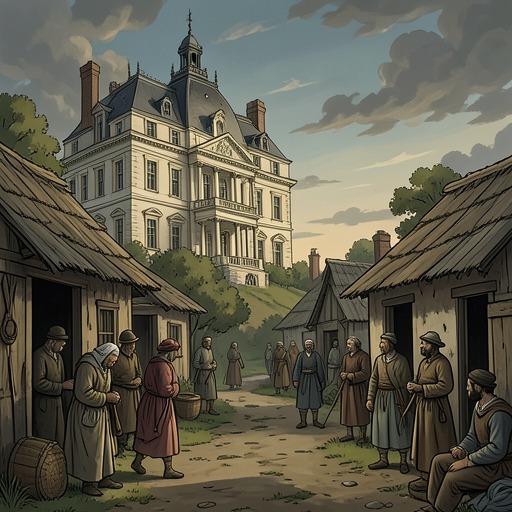
Political allegory of monarchy and the people
The Man Who LaughsThe political allegory of monarchy and the people reverses the customary image of royal power: the sovereign appears elevated, but the people bear the weight and supply the strength. The king receives credit for what the people do and generosity for what they pay; the same collective force that sustains the crown may cast off its rider, only to resume submission. The allegory’s central tension is therefore not simply ruler against subjects, but the people’s capacity to recognize—or mistake—the source of their own power.
The people beneath the crown
The narrator describes a familiar transfer of credit: the people fight, but the glory is assigned to the king; they pay, but the generosity is attributed to him. The poor give the king a crown and receive only a small return, while admiring his apparent wealth. The image of a colossus carrying a pygmy turns this political arrangement into a physical absurdity: the giant supports the dwarf, who seems taller only because he has climbed onto the giant’s shoulders. The wonder is that the people permit the arrangement, and the folly that they admire the ruler’s borrowed height.
The equestrian statue condenses the argument into a single emblem. The king is the rider, while the people are the horse: royal authority is visible above, but depends on the body beneath it. The metaphor also makes the people more than passive support. The horse changes over time, beginning as a donkey and becoming a lion; it can throw its rider and, in more violent reversals, devour him. The allegory thus treats political power as something the people lend, sustain, and can reclaim.
Revolution and renewed submission
The horse’s revolt is associated with 1642 in England and 1789 in France, when it throws the rider, and with 1649 in England and 1793 in France, when it devours him. These reversals do not settle the political question. The lion can relapse into the donkey, and the narrator presents that return as the condition then prevailing in England: the people have resumed the pack-saddle and the idolatry of the crown. Popular force is therefore unstable in its political meaning. It may become revolutionary strength, but it may also return to obedience and reproduce the very hierarchy it once overturned.
The discussion of Queen Anne makes the contrast between royal appearance and popular action concrete. She is described as popular, while the narrator’s answer to what she did to deserve that standing is that she did nothing; the sovereign’s apparent merit consists in occupying the throne. The account sets that passivity against the activity and expense of the state. In 1705 England had a fleet of 150 warships, three armies deployed in Catalonia, Portugal, and Flanders, and was paying £1,666,666 a year to European monarchies and diplomatic interests. Parliament had also approved a patriotic loan of thirty-four million francs, and the Exchequer was crowded with subscribers. The people’s resources and exertions fill the scene, while the sovereign receives the symbolic credit and an annual income of £1,250,000.
The wider catalogue of military reach sharpens the same point: England was sending squadrons abroad, maintaining a reserve fleet, annexing Scotland, and expanding its influence across Europe and overseas. The narrator presents these achievements not as the isolated work of a monarch but as the labor of a nation whose power is then personified in its ruler. The allegory asks the reader to distinguish the visible figure on the throne from the collective force that makes royal grandeur possible.
Visible authority and hidden force
The political metaphor belongs to a book attentive to the difference between appearances and underlying causes. In its account of the sea, wind and waves are visible impulses, while an invisible current called effluvium is proposed as a force capable of explaining otherwise puzzling movements. The snowstorm, too, is described as a dangerous magnetic phenomenon. These passages do not state that political life obeys the same laws; rather, they establish a recurring way of looking: what seems to act openly may depend on a less visible force. In the equestrian image, the king is the conspicuous rider, while the people are the power underneath him.
That interest in the limits of visible explanation also informs the novel’s treatment of knowledge and authority. In a public address, Ursus presents himself as both a teacher and a seller of ideas, claiming the task of correcting popular errors while acknowledging that people must receive wisdom as they can. Elsewhere, he answers a theological objection about orpiment by appealing to arsenic’s poisonous nature. These scenes are not direct extensions of the royal allegory, but they echo its concern with who gets to define truth and how authority is established. The political image makes the corresponding claim about government: the ruler’s apparent supremacy can conceal the people’s more fundamental power.
The allegory’s political warning
The images do not offer a simple celebration of revolution. The people can throw down a monarch, but the horse’s return to the pack-saddle shows that overthrow alone does not guarantee lasting independence. The movement from support to revolt and back to submission makes popular sovereignty a continuing possibility, not a completed historical achievement. The crown’s apparent height depends on the people, yet that dependence can remain obscured so long as they attribute their own strength, sacrifice, and wealth to the ruler who occupies their shoulders.