Political opportunism and conscience
The Man Who LaughsPolitical opportunism and conscience form the central tension in the account of Linnæus, Lord Clancharlie: after the republic falls, he chooses fidelity to it over a return to rank under the restored monarchy. The narrative presents this choice through a hostile public verdict that calls it foolishness, then lets the very confidence of that verdict reveal its moral logic. Success becomes evidence of righteousness, conformity is redescribed as civic duty, and conscience appears not as a virtue but as a dangerous refusal to accept the settlement imposed by power.
The test of the Restoration
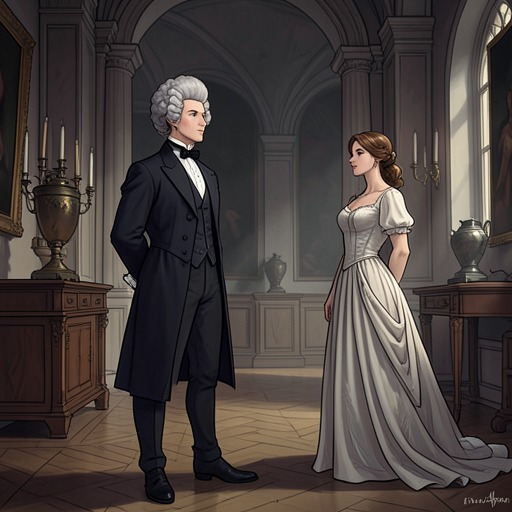
Linnæus, Lord Clancharlie had been one of the few English peers to accept the republic. The narrator allows that his initial adherence may have reflected the republic’s temporary ascendancy, but distinguishes that possible opportunism from his later conduct: after the parliamentary government fell, he remained faithful to the cause it had represented. The decisive test, then, is not whether his first allegiance was pure, but whether he would change sides when the balance of power changed.
He could have returned to the reconstituted upper house. The restored king, Charles II, is described as welcoming those who returned to their allegiance, making political reconciliation both available and advantageous to the exile. Instead, Linnæus, Lord Clancharlie turned away from the public celebration of the monarchy and voluntarily left his country. He lost political privileges, his domestic hearth, his title, and his country; the account says he gained no advantage beyond ridicule and exile. The costs make his persistence legible as something other than a convenient bid for office, even as the public interpretation refuses to grant it that moral weight.
His exile gives this conflict a precise setting. He grows old in Switzerland, in a dwelling on the banks of Lake Geneva, in a rugged region between Chillon and Vevay. Hidden among the mountains, he is described as almost outside his country and his century. The distance is at once physical and political: while England celebrates restored order, the exile remains apart from its consensus, embodying a past allegiance that the triumphant present wants to declare obsolete.
The winning side as public morality
The passage’s public argument treats political reversal as ordinary prudence. Its speakers ridicule people who remain obstinate after events have settled, comparing principled resistance to an ostentatious imitation of heroic self-denial. They insist that the sensible citizen should adapt, serve public functions, and not mistake personal scruple for a claim to superiority. In this reasoning, the common good is identified with the order that has prevailed, while refusal to participate in that order is made to look like vanity or irresponsibility.
The example of Monk gives this reasoning its practical model. Monk first commands the republican army, then, after receiving a letter from Charles II, dissolves the rebel parliament at the head of his troops and restores the king. The account lists the rewards that follow: a dukedom, wealth, the Order of the Garter, public glory, and the prospect of burial in Westminster Abbey. His change of allegiance is presented as tact joined to virtue, and its benefits appear to confirm its righteousness. Against him, Linnæus, Lord Clancharlie is made to represent fidelity without reward. The contrast exposes a standard under which successful political adaptation is celebrated as service, while costly adherence to a defeated cause is dismissed as stupidity.
This reasoning does more than recommend caution. It makes the outcome of political struggle a measure of truth: the victorious side is treated as the side to which an honest person must rally. The moral language of duty thus shields self-interest from scrutiny. The public voice claims that officeholders must remain in place for the state to function, yet its example of exemplary service is also the man whose conformity brings wealth, status, and honour. Political usefulness and personal advancement become difficult to separate.
Conscience against conformity
The 1650 declaration supplies a concrete ground for Linnæus, Lord Clancharlie’s continued allegiance. The English Parliament had drawn up a promise to remain faithful to the republic without king, sovereign, or lord; the narrative says that he lived outside the kingdom under the pretext of having taken this oath. What the public calls an excuse, however, marks the binding force that an earlier political commitment still has for him. He esteems what has disappeared and remains attached to what has been, even when that attachment excludes him from the restored nation’s celebration.
The social response progressively narrows the terms in which his choice can be understood. Friends had hoped he was merely concealing loyalty to the king while waiting for a convenient chance to strike the republic. When his persistence defeats that explanation, indulgent observers call it childish stubbornness or senile obstinacy; stricter judges call him a traitor. The charge rests on a reversal of political allegiance: he has deserted the aristocratic camp for the people, and has remained faithful to the weaker side. The narrator emphasizes the asymmetry—he is said to have betrayed the powerful while losing everything himself—but the public verdict converts that loss into proof of folly rather than evidence of conviction.
The account’s treatment of conscience is correspondingly double-edged. The public voice warns that scruples can lead their possessor too far from political opportunity, and regards excessive delicacy as an inability to govern. Yet its contempt reveals how little space its morality leaves for independent judgment: if success settles what is true, conscience can only obstruct the winning side. Linnæus, Lord Clancharlie is mocked for examining an act before committing himself to it, as though such attention were a defect in a statesman. The tension is not simply between action and inaction, but between a principle that imposes limits and a politics that treats limits as liabilities.
Satire and the precipice
The condemnations are not a neutral account of the novel’s moral position. Their piling sequence—fool, deserter, traitor, affront to his country—shows public opinion manufacturing certainty by repetition. Its praise of restored order is likewise sharpened by extravagant confidence: Charles II on the throne and Oliver Cromwell on the gibbet are presented as proof that everything has returned to its proper place. The narrative’s irony lies in allowing this self-satisfied voice to make its case at length, so that the reader can see how readily conformity calls itself virtue and dissent becomes an offence against the nation.
The aphorism “Principles terminate in a precipice.” condenses the public warning into an image of descent: fidelity is imagined as a ladder leading away from political safety, with the stubborn person unable to climb back. But the image also exposes the perilous assumption beneath the warning. If every principle must yield when circumstances turn against it, then prudence has no stable boundary separating public service from opportunism. Linnæus, Lord Clancharlie’s exile gives that contradiction a human and political cost. The passage does not erase the ridicule directed at him; instead, it makes ridicule itself part of the evidence, showing how a victorious society polices the meaning of duty and treats an uncompromising conscience as a threat to its settled account of success.