Premiere of Chaos Vanquished
The Man Who LaughsUrsus’s premiere of “Chaos Vanquished” is both a theatrical triumph and a reversal of its intended effect. The interlude presents a poetic victory of spirit over matter, but its climax is Gwynplaine’s suddenly illuminated face: the crowd laughs at the very figure whose struggle the play has framed as humanity’s resistance to chaos. The performance makes that contradiction its public spectacle, while Dea sees in Gwynplaine a beloved soul rather than a grotesque face.
Composition and Dramatic Design
Ursus composed the interlude expressly for Gwynplaine, took unusual care polishing it, and regarded it as his best work. He had invested his whole soul in the production. The narrator frames this devotion as the highest kind of artistic achievement: giving the full measure of one’s talent to a work. Ursus’s own modest comparison was to Shakespeare, but the play’s immediate success would come through a response he had not intended.
The action begins in near-total darkness before the crowd gathered around the Green Box. Three indistinct figures move in a bestial, reptilian state: a wolf, a bear played by Ursus, and a man played by Gwynplaine. The animals embody the ferocious forces of Nature, described as unreasoning hunger and savage ignorance; together they assail the man in a contest between chaos and humanity. With Gwynplaine wrapped in a winding-sheet and his face hidden by his falling hair, the scene initially makes him difficult to distinguish from the beasts that overwhelm him.
The man falls and cries out for aid, appealing to an unknown power as the wolf and bear appear close to victory. The struggle ends not with a visible rescue but with sudden silence. Music then rises from the shadows, and Dea appears in luminous mist as a figure of light. Her song makes the hidden presence visible; the man rises beneath her influence and overthrows the beasts. The sequence gives the drama its governing movement: from darkness and apparent defeat to light, recognition, and victory.
The Climax and the Audience’s Response
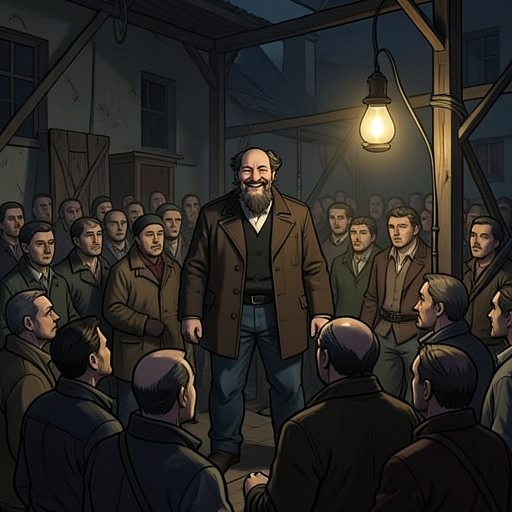
The concluding revelation overturns the scene’s expected emotional register. A ray of light falls on Gwynplaine, exposing the face the darkness had concealed. The crowd’s response is immediate and immense: laughter spreads through the audience, and even passers-by outside join in after hearing it, though they cannot see the stage. Laughter gives way to applause and stamping feet; the curtain falls, and Gwynplaine is recalled in a frenzy.
That response makes the ending both a comic sensation and a disturbing spectacle. The play has staged a human being nearly swallowed by brute forces, then shown him triumph through the arrival of Dea’s light. Yet the sudden exposure of Gwynplaine’s face redirects the audience from the allegory to his appearance. Their laughter is not the gentle, literary appreciation Ursus wanted. It is an overwhelming reaction to the contrast between the drama’s elevated movement and the face revealed at its culmination. The event’s success therefore depends on a shock that Ursus did not design as the work’s central effect.
Dea and the Double Meaning of the Scene
Dea’s place in the performance intensifies that contrast. To the crowd she appears as a radiant, almost supernatural presence, at once gentle and formidable. The audience recognizes that she is blind, yet reads her as possessing a kind of sight beyond ordinary vision. Her appearance beside Gwynplaine seems to join earthly and heavenly light, while her role in the drama gives visible form to the power that awakens the defeated man and helps him conquer the beasts.
Her understanding of the pair differs from the spectators’ interpretation. Dea believes Gwynplaine is her saviour and touches his hair with tenderness; the public, watching from outside her inward knowledge, imagines that she is the saviour and he the one being loved. She knows the beloved as a person, while the audience is transfixed by the contrast between her apparent beauty and his disfigurement. The same tableau thus contains two incompatible readings: Dea’s trust in Gwynplaine and the crowd’s fascination with the visible monster.
The distinction continues through the performance’s reception. Dea experiences the scene as renewed tenderness night after night, even while the spectators laugh. The audience’s gaiety does not cancel her happiness, because the meaning of Gwynplaine’s face to her is not the meaning it has to them. The play’s public effect and Dea’s private response coexist without becoming the same experience.
Success, Class, and the Work’s Afterlife
“Chaos Vanquished” becomes an immense popular success. People come specifically to laugh, and the effect is described as nearly epidemic, a contagious joy from which spectators do not flee. Yet the reach of that success is socially bounded. Admission costs a penny, and the fashionable classes do not attend places at that price. The crowds who acclaim Gwynplaine are numerous, but their enthusiasm does not confer fashionable recognition on the performance.
Ursus accepts the laughter as the price of a triumph that is larger, and cruder, than the one he hoped to achieve. Each evening he counts the farthings into shillings and the shillings into pounds, allowing the receipts to console him for the audience’s uncontrolled gaiety. He also believes that the play will leave something behind after the laughter has passed. Its spectators may respond only confusedly, but they follow the wolf, the bear, the man, the music, and the movement from night into dawn. The performance’s underlying argument—that spirit can overcome matter—settles into their minds even when they cannot articulate it.
The premiere consequently establishes a double measure of theatrical success. The crowd’s laughter and applause make the show popular, while Ursus’s hopes for a more reflective, literary response remain only partly fulfilled. Its allegory survives within the sensation: the people who laugh at Gwynplaine also witness a drama of human struggle and spiritual rescue. The spectacle that exposes his face to public ridicule is, at the same time, the work through which Dea’s vision of him becomes most clearly distinct from theirs.