Providence and Chance
The Man Who LaughsProvidence and Chance describes a conflict between apparent accident and moral purpose. Hardquanonne’s flask, carried across the sea for fifteen years, reaches Barkilphedro at the moment when he has nearly abandoned hope of harming Josiana. The discovery advances justice for Gwynplaine while giving Barkilphedro the means to injure Josiana. The narrator presents this coincidence as more than a lucky turn: it is a test of whether events are understood as serving private ambition or as belonging to a providential restoration beyond the ambitions of any one person.
The Flask and the Appearance of Chance
The turning point is material and contingent. A flask comes into Barkilphedro’s hands; with two witnesses associated with the Admiralty present, he uncorks it, finds the parchment, and reads it. Its survival makes a concealed history available to those who can act upon it. Nothing in the immediate circumstances makes Barkilphedro its intended recipient, yet the timing seems almost tailored to his frustration. He had been convinced that Josiana’s life offered no vulnerable point, and the message abruptly gives him a means to act against her.
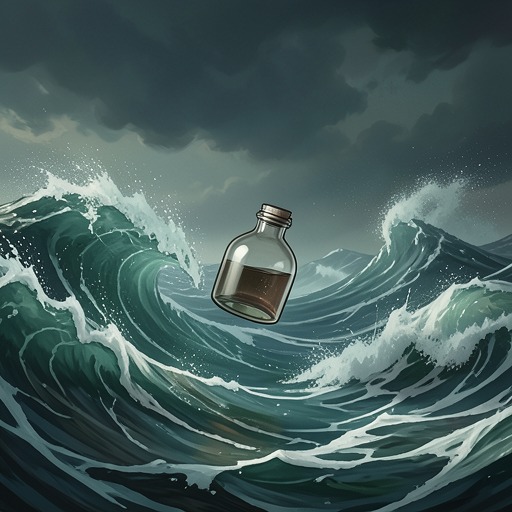
The narration dwells on how unlikely the message’s survival appears. For fifteen years, waves passed the floating bottle onward; rocks did not break it, the cork remained in place, and water and damp did not destroy the writing. The flask’s fragile construction stands against the duration and violence of the sea, while the parchment preserves the knowledge that can change Gwynplaine’s position. The account thus makes chance legible through a chain of physical contingencies: the message had to remain intact, travel, and arrive where it could be read. Its arrival looks like fortune to Barkilphedro because it coincides with his desire, but the coincidence alone does not establish that his desire is the purpose of its journey.
Barkilphedro’s Misreading
Barkilphedro interprets the flask’s arrival as confirmation that events have conspired for him. The narrator describes his response as a surge of pride: he imagines himself at once the object and the instrument of a vast design. This is not simply a mistaken estimate of luck. It is a moral misreading in which a chance advantage becomes proof of personal importance. He sees the event according to what it lets him do, not according to the history and consequences it carries for others.
That mistake sharpens the contrast between the message’s effects. The information helps restore Gwynplaine to his inheritance, but the same restoration crushes Josiana and gives Barkilphedro an opportunity for a malicious victory. Justice and injury arrive through one chain of events; the righting of one wrong does not prevent a different person from exploiting the result. The narration refuses to make the coincidence morally simple. Its irony lies in the fact that an outcome serving reparation can also serve spite, without making spite the reason the reparation occurred.
The Sea as a Preserver of the Past
The narrator corrects Barkilphedro’s self-importance by widening the frame from the recipient to the orphan whose history the flask carries. The sea has already figured in Gwynplaine’s story as a force that wrecked the vessel associated with the crime against him. Now, in the narrator’s account, the ocean preserves the fragile record that can help repair that crime. The contrast is between a strong vessel that contained wrongdoing and a delicate phial that bears evidence of restitution. The sea’s role changes from destructive power to guardian of a future consequence.
This protection is described as a long, distributed labor: currents direct the waif, while seaweed, swells, and rocks fail to destroy it. The child himself grows up without knowing what the depths are doing for him. That separation matters. Providence, in this passage, is not Gwynplaine’s conscious plan or a reward he can claim; it is an order whose work remains hidden from the person it benefits. The preserved message joins a past containing the original wrong to a future in which the heir can be restored. Darkness, in the narrator’s image, becomes the means through which truth eventually comes to light.
Providence, Fortune, and Moral Judgment
The concept becomes explicit when the narrator asks whether fortune is Providence or Fatality and cautions that a gleam may deceive rather than illuminate. This uncertainty is essential to the contrast. An event can appear beneficial while setting its recipient on a destructive course, just as Barkilphedro’s discovery brings him pleasure and power while placing him in service of a larger consequence he does not understand. The novel therefore distinguishes between the appearance of good fortune and the moral meaning assigned to it.
The narrator does not treat every coincidence as proof of an uncomplicated, visible plan. Instead, the episode places two readings side by side: Barkilphedro sees the flask as an instrument prepared for his intentions; the narration asks the reader to see its preservation as part of a history centered on Gwynplaine, the deserted child and rightful heir. Chance describes the route by which the message arrives; Providence describes the reparative significance the narrator draws from that route. Their uneasy conjunction makes the flask more than a plot device: its fragile survival exposes how private malice can borrow the force of justice, and how a person’s apparent luck may be only one moment in a design whose consequences exceed him.