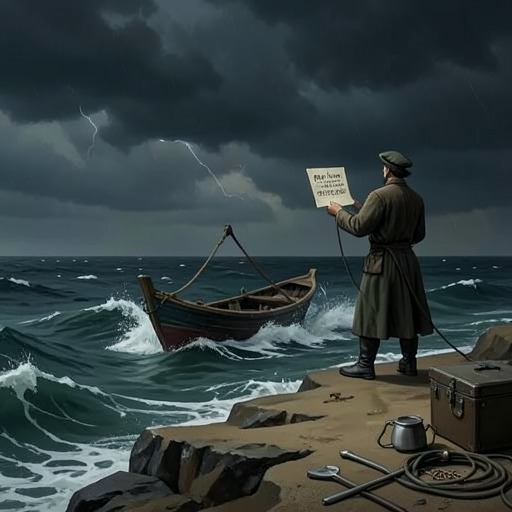
Repentance and salvation of the soul
The Man Who LaughsRepentance and salvation of the soul become the doctor’s answer to a group of men trapped aboard a sinking ship: unable to secure their bodily survival, they are urged to acknowledge their crime against a child and seek spiritual deliverance. The episode turns the threat of death into a reckoning with responsibility. The men’s prospects on land seem no safer than at sea, but the doctor insists that a last effort toward remorse and repair remains possible.
The crime and the crisis
The doctor names the group’s shared burden as their crime. His appeal focuses on the wrong they have just completed against a child, which he treats as more than one offense among many: it is the deed now weighing on them as the ship founders. He argues that harming a child is also a sin against God, binding the men’s immediate peril to a moral responsibility they cannot leave behind by changing their course.
The men had put to sea because they had to, but the doctor now rejects any hope that reaching shore would amount to safety. France lies in the darkness near the sands of Vauville and Cape la Hogue; Spain had been their only possible refuge, while France is no less dangerous to them than England. On land, he tells them, they would face the gibbet; at sea, drowning. The choice between hanging and drowning makes worldly escape appear closed, and he recasts their remaining time not as an opportunity to survive but as a respite in which they may confront what they have done.
From survival to repentance
The doctor’s appeal changes the meaning of the storm. He interprets it as a warning cast by the crime, but does not present regret as a means of reversing the weather or guaranteeing rescue. Instead, he asks the men to stop thinking only of safety and to think of salvation. Their bodies may be lost, he says, while the more terrible shipwreck would be the loss of their souls. Repentance is thus presented as a different kind of deliverance, one that remains possible even when physical escape does not.
His instructions move from confession toward responsibility. If the child survives, the men should come to his aid; if the child is dead, they should seek forgiveness. The alternatives preserve the child’s importance whether or not he lives, and make repentance more than fear of punishment: it requires an effort to repair, as far as possible, the harm already done. The doctor urges the group to cast off the burden of the crime and ease their consciences, not by denying it but by acknowledging it and turning toward the victim.
The men first waver when told to kneel, a hesitation the narration marks as the threshold of submission. Later, after the torch is extinguished and the ship is surrounded by darkness, the doctor again calls them to prayer. All kneel, now in the water rather than on snow. The repeated gesture gives the appeal a visible progression: words of accusation and hope lead first to hesitation, then to collective prayer amid the very danger from which the men had hoped to escape.
Death, fear, and belief
The narrative places the doctor’s exhortation within a broader reflection on dying. At the last extremity, the men are described as turning from their exhausted hope of life toward the prospect beyond it. The past returns with the weight of responsibility, while what follows death remains an abyss of anticipation. The account presents this mixture of remembered fault and uncertainty as a source of terror, helping explain why the doctor’s religious appeal can reach men who had been driven by fear of immediate destruction.
The narration also distinguishes the flash of a final intuition from lasting certainty. A dying person may glimpse what lies beyond, then lose that moment of understanding; only after death, the passage suggests, will the glimpse become clear. This image does not establish that the men are saved. Rather, it frames their prayer as an act undertaken without assurance, when fear has made the question of spiritual consequence impossible to dismiss.
The meaning of salvation
The episode defines repentance as the remaining form of action when worldly choices have narrowed to death at sea or execution on land. The doctor does not promise that prayer will keep the ship afloat or spare the men the consequences of their crime. His appeal instead joins confession to a practical obligation toward the child and places both within a hope of spiritual forgiveness.
The transition from snow to water sharpens the scene’s central contrast. The men have moved from an earlier setting into the sea, but the moral issue follows them: the crime cannot be abandoned with the shore or drowned with the ship. Kneeling together, they acknowledge a responsibility that survival alone could not erase. In this moment, salvation is neither escape from judgment nor proof of innocence; it is the possibility of remorse and a final attempt to answer for harm before life ends.