Shipwreck Survivors’ Signed Parchment
The Man Who LaughsThe Shipwreck Survivors’ Signed Parchment is a record composed and signed in the last moments aboard a sinking wreck. It begins as a document carried in the doctor’s pocket-book and becomes a collective testimony: read aloud to the survivors, marked by their signatures or crosses, and sealed in a flask that alone floats away after the ship and its people disappear. Its passage from paper to message-in-a-bottle gives the survivors’ final act a material form, even as the text leaves the contents of the parchment largely unreproduced.
Origin and Composition
The doctor takes the parchment from his pocket-book and lays it on the low hood of a companion, using the wreck’s makeshift surface as a table. The sheet already bears roughly twenty cramped, crooked lines that he had written a few hours earlier. The account is therefore not composed all at once at the end: the surviving passage joins an earlier writing to the signatures and note added as the danger becomes immediate.
The scene offers no full transcription of those earlier lines. Instead, it identifies the parchment through its circumstances of use: a document prepared in advance, brought out amid the storm, and completed when the remaining people gather around the doctor. That distinction matters. The object preserves a record, but the reader learns its existence and handling more fully than its written account.
Reading and Witnessing
With the wreck sinking and the torches extinguished one after another by the snow, only one torch remains. Ave Maria brings it to the doctor, who unfolds the parchment and reads from it in English. The other survivors bow their heads around him; the torchlight falls on their pale faces, and the ship continues to sink beneath them.
The reading is made accessible across the group’s different languages. When a listener appears to need an explanation, the doctor stops and repeats the passage in French, Spanish, Basque, or Italian. The scene thus presents the parchment not merely as writing for a later reader, but as something communicated to the assembled survivors before they sign. Their stifled sobs and hollow blows to the breast register the gravity of the moment, while the worsening wreck makes the act of hearing and responding urgently finite.
Signatures and the Record of Those Present
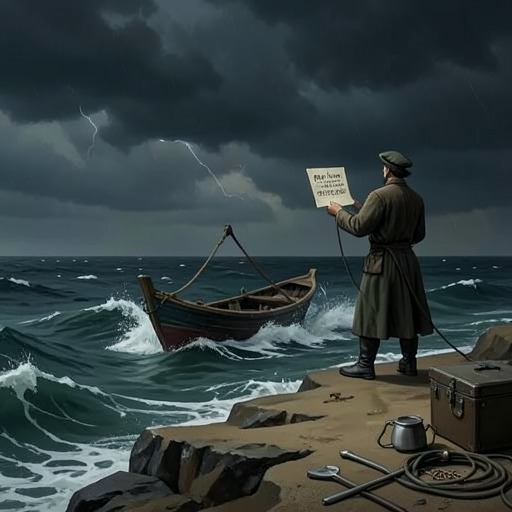
After the reading, the doctor lays the parchment flat again and signs himself as Gernardus Geestemunde, Doctor. He invites the others to sign. Asuncion, identified as the Basque woman, writes her name; an Irish woman who cannot write makes a cross, and the doctor writes beside it that she is Barbara Fermoy, of Tyrrif Island, in the Hebrides. The contrast between a written signature and a mark accompanied by an identifying inscription shows how the document accommodates different capacities without excluding the woman who cannot write.
Other survivors add their names: the Languedocian signs as Jacques Quartourze, alias the Narbonnais, and the Provençal as Luc-Pierre Capgaroupe, of the Galleys of Mahon. Beneath those signatures the doctor adds a note about the crew: of three men, the skipper has been washed overboard, leaving two who remain and have signed. The note records absence as well as presence. It gives a specific reason the skipper cannot attest to the parchment, while the sailors’ signatures are placed beneath the doctor’s account of the surviving crew. The northern Basque signs as Galdeazun.
Sealing and Survival
The parchment is not left exposed on the failing deck. The doctor dries the ink by the heat of the torch, folds the sheet until it is narrower than the flask’s neck, and puts it inside. With no cork available, he closes the flask using a piece of rope. Galdeazun brings a vessel half full of burning tar after extinguishing the signal light; the flask containing the signed parchment is then tarred over. Each step adapts the document to its new purpose: drying the ink protects the marks, folding allows the sheet to enter the container, and the improvised closure secures it.
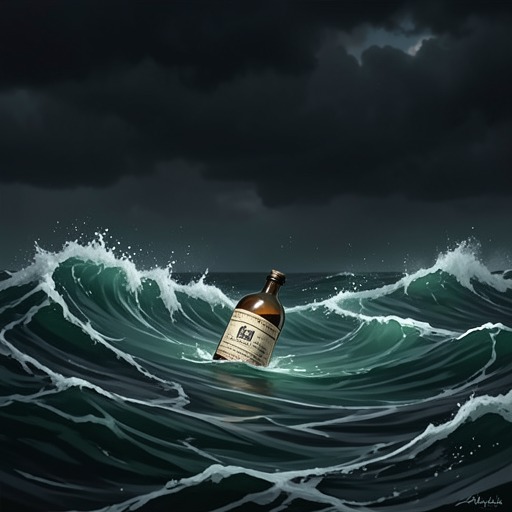
As the water rises in the hold and the survivors crowd onto the centre of the deck, the ship goes under. One man briefly remains visible above the water, holding up the flask; then he disappears. The sea shows no lasting disturbance, but the tarred flask, kept afloat by its osier cover, remains on the surface and is carried into the darkness. The parchment’s survival is therefore not a rescue of its writers. The record separates from them at the moment of their disappearance, turning the final collective act aboard the wreck into a surviving object.
Narrative Significance
The parchment’s significance lies in the tension between precise inscription and threatened loss. Names, a cross, the doctor’s note about the skipper, and the number of remaining crew members fix individual details on a sheet surrounded by a catastrophe that is erasing the people and the ship. The doctor’s multilingual reading and the varied forms of signing make the document a shared act, not simply his private account.
At the same time, the narrative withholds the document’s full contents. It gives the reader the procedure of its creation and preservation—the torch, the signatures, the rope, the tar, and the osier-covered flask—then follows the flask into the dark. The parchment thus functions as testimony whose material survival is clear, while what its earlier lines say remains outside the passage. Its final image is a fragile reversal: the people sink, but the signed record floats.