Southwark
The Man Who LaughsSouthwark is both a densely built riverside settlement and a place where the novel’s central contrasts become physical: a makeshift theatre stands in a busy inn yard, while a feared alley runs between a jail and a churchyard. Connected to London by London Bridge, it gives the Green Box troupe a place to perform and frames the oppressive setting around Gwynplaine’s imprisonment.
Setting and Urban Character
At the period described, London had only one bridge, London Bridge, whose houses linked the city to Southwark. The suburb’s streets and alleys were paved with flint pebbles taken from the Thames. Buildings, dwellings, and wooden huts crowded together in a disorderly mass of combustible material, a danger made vivid by the Great Fire of 1666. The narrator also notes that Southwark’s name had changed in pronunciation: it was then spoken as Soudric, an example in a comic aside on the difficulty of pronouncing English names.
The settlement’s scale is presented through a sharp contrast between past and present: the Southwark of the story was a village, whereas the Southwark of the narrator’s day was a city. Yet it already carried considerable trade. Along the Thames stood an old, massive wall fitted with rings to which river barges were anchored, joining the suburb’s crowded streets to its working riverfront. Southwark is therefore neither simply rural nor fully metropolitan: it is a busy threshold between London and the river.
The Green Box and the Tadcaster Inn
When the Green Box troupe arrives in London, it establishes itself in Southwark. Ursus is drawn to a bowling-green that remains a fairground even in winter, a practical attraction for itinerant performers seeking a place to work. The troupe’s more specific home is the yard of the Tadcaster Inn, whose layout lends itself to performance.
The yard is square, enclosed on three sides by the inn and on the fourth by a wall. Because its gate is high enough, the troupe can draw the Green Box up against that wall and make it the stage. The inn’s wooden balcony, roofed and supported on posts, runs around the interior on three sides; the ground-floor windows serve as boxes, the yard pavement as the pit, and the balcony as the gallery. The arrangement turns an inn courtyard into a ready-made theatre, with the Green Box facing its improvised audience space. Its resemblance to the Globe, associated with plays including Othello, King Lear, and The Tempest, places this precarious touring venue beside a celebrated theatrical model without making it anything more than an adapted yard.
A stable occupies a corner behind the Green Box. The innkeeper, Master Nicless, has made arrangements with Ursus, but his respect for the law leads him to charge extra for admitting the wolf. Even the troupe’s home thus combines practical accommodation with the restrictions and costs imposed by ordinary commercial life.
Civic and Legal Geography
Southwark’s place in the county’s legal order comes into view when the sheriff of Surrey formally declares Gwynplaine to be Fermain Clancharlie, Baron Clancharlie and Hunkerville, Marquis de Corleone in Sicily, and a peer of England. The declaration is presented as the culmination of an official process involving the sheriff, a clerk and registrar, other officers, authority from the Lord Chancellor, and documents communicated by the Admiralty. The recognition changes Gwynplaine’s status, but its formal machinery also locates the event within the institutions governing Southwark and the wider county.
The suburb’s geography consequently accommodates sharply different forms of public life. The inn yard offers an improvised stage on which the troupe can perform; the sheriff’s declaration makes a person’s rank legible through legal procedure. In both settings, Southwark is a place where people are assembled and assigned positions, though one arrangement is theatrical and makeshift while the other is official and consequential.
The Jail, the Alley, and Ursus’s Vigil
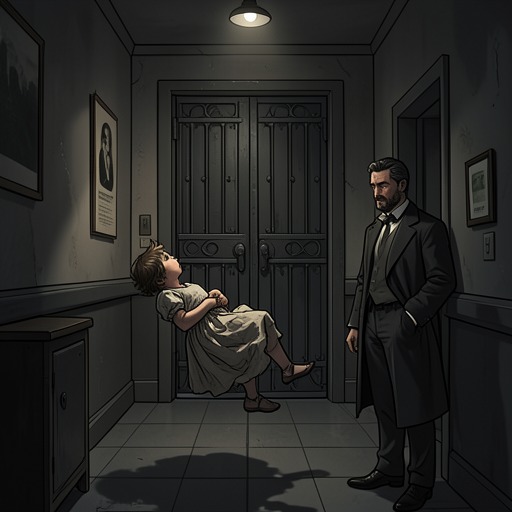
After Ursus sees Gwynplaine thrust through the gates of Southwark Jail, he remains nearby, watching. The grinding of bolts and bars continues to haunt him; the narration likens the sound to a cry of satisfaction at the enclosure of another wretched person. Ursus knows that such doors admit prisoners more readily than they release them, yet he cannot bring himself to leave his post. His vigil becomes an image of helpless attachment: the event that has drawn him there has already passed, but he remains caught in the act of waiting.
The jail’s surroundings intensify that confinement. Ursus watches two black walls and the doors associated with the prison and the cemetery, in a street so deserted that no one observes him. Later, he runs to the jail’s back wicket, reached by a narrow alley described as lonely by day and threatening at night. The passage lies between a prison and a churchyard, and local people avoid it by instinct. It had once been barricaded at night with an iron chain, but the chain proved unnecessary: the terror associated with the alley was a stronger barrier.
Ursus enters it resolutely. The detail gives Southwark’s built environment a role beyond providing a backdrop: the inn’s open yard can be reshaped into a theatre, while the alley’s walls, darkness, and adjacent institutions make movement feel dangerous and uncertain. The suburb holds the troupe’s temporary public life and the grim spaces surrounding Gwynplaine’s confinement within the same crowded urban landscape.