Thames
The Man Who LaughsThe Thames shapes the novel as both a working waterway and a boundary between confinement and departure. Its Southwark quays support regular trade, but the river also becomes the setting for Gwynplaine’s inward crisis and the route by which he, Dea, Ursus, and Homo leave London. From the old Effroc Stone to a departing vessel, the river connects the city’s material geography with the story’s final reversal.
Geography and the Southwark Waterfront
At the period described, London had only one bridge, London Bridge, lined with houses, joining the city to Southwark. Southwark was a tightly built suburb of small streets, alleys, dwellings, and wooden huts. Its pavements used flint pebbles taken from the Thames, while the density of its buildings made fire a constant danger, as the Great Fire of London had shown. The river was therefore not a distant landscape: its materials, banks, and crossings were woven into the construction and daily life of the settlement.
Southwark’s southern edge was marked by a long, old wall beside the Thames, known as the Effroc Wall or Effroc stone. Rings fixed into it held river barges, and an old ridge of stones at its base provided a passage to ships at different tides. Steps interrupted the wall at intervals; above it, an embankment offered passers-by a place to lean and look over the water. From there, London on the far bank dwindled into fields. The scene sets a crowded urban shore against a more open view across the river, while the quay itself remains a practical point of access to vessels.
Trade, Vessels, and Passage
The Effroc Stone offered deep water and a useful anchorage. The Vograat, an old Dutch vessel, called there on a regular weekly crossing between London and Rotterdam. Other barges made twice-daily trips to Deptford, Greenwich, or Gravesend, travelling downriver with one tide and back with the next. Even the twenty-mile passage to Gravesend took six hours. These routes make the Thames a channel of routine movement, connecting Southwark with destinations upriver and across the sea.
The Vograat’s construction gives the waterfront a distinct maritime character. It had a heavy, two-masted hull, divided into watertight sections, with a narrow hold between forward and aft decks. The decks had no bulwarks, leaving those aboard exposed to the risk of falling into the water; the losses associated with this design eventually caused the model to fall out of use. Elsewhere, the novel describes a wharf on piles, reached by a gangway, and a Dutch vessel with two decks and an open central hold. Ships moored at the river’s edge were not merely scenery: their arrangement, their crews’ schedules, and the tide determined when passage was possible.
Gwynplaine at the River
The Thames appears first as a view from within an unfamiliar world of wealth. In the palace where Gwynplaine searches for an exit, each window opens onto a different prospect: gardens, a statue-filled plot, a Spanish-style courtyard, or the river. He is disoriented by the building’s many rooms and keeps returning in thought to Dea as he tries to find his way out. The Thames is one element in this succession of views, present beyond the palace but not yet a route he can take.
Later, at the Effroc Stone, Gwynplaine stops at the parapet above the dark water. Though the quay is bordered by vessels and their landing places, the passage turns away from a literal survey of the river: his attention is on the shadow within himself and on destiny. Masts and spars are faintly discernible in the distance, and red lights punctuate the haze, but the ships’ crews are still asleep before the high-tide departures. The contrast is consequential. The river offers a way out, yet at this moment Gwynplaine is absorbed by his inward crisis rather than by the waiting vessels.
A Route Out of London
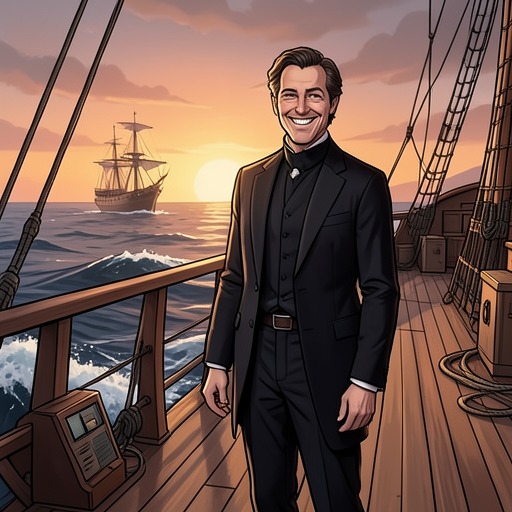
Homo leads Gwynplaine down the narrow strip of land beside the Thames without noise, and stops at a wooden platform projecting over the water. A vessel is moored there, its deck faintly lit. The scene brings together the wolf’s silent guidance, the wharf, and the river’s practical function as a passage. Earlier directions had identified the Vograat as one of the ships due to sail for the Continent at about one in the morning, when the tide was high.
Once aboard, Gwynplaine finds Dea and speaks of beginning again with her and Ursus. The ship slips away from the wharf and enters the current; carried by the tide, it moves through the Thames while London recedes behind it in the mist. The river thus completes a change of direction that the earlier quay scene had only made possible. It has served first as a boundary beside which Gwynplaine broods, and then as the route of departure for the surviving companions.
Narrative Significance
The Thames gives the story a physical geography of thresholds: London Bridge connects London and Southwark, the Effroc Stone joins the bank to moored ships, and the wharf connects the shore to a vessel bound outward. These are not interchangeable settings. Each marks a different relation between the city and the possibility of leaving it, from the crowded suburb’s dependence on river transport to the quiet departure at high tide.
The river also holds together two contrasting forms of movement. Its barges follow regular timetables and currents, while Gwynplaine’s attention at the parapet is caught in a vision of fate. When he finally boards the vessel, the tide carries him forward whether or not the future is settled. The last view of London fading behind the ship makes the Thames more than a backdrop: it is the material passage through which the narrative converts despair into departure, without erasing the uncertainty that has gathered at the water’s edge.