The Sea and Fate
The Man Who LaughsThe Sea and Fate is the novel’s governing conception of the ocean as more than scenery or a natural obstacle: it is an immense, changing power in which human plans meet forces they cannot fully perceive or control. In the storm at sea, weather seems to acquire intention, while apparent chance is treated as the partial disclosure of hidden law. The result is a sustained tension between physical explanation and metaphysical uncertainty: the sea can be observed and theorized about, but its movements still exceed the observer’s grasp.
The sea as power and presence
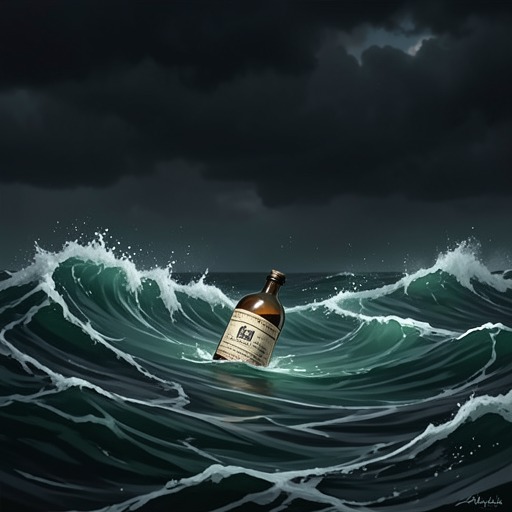
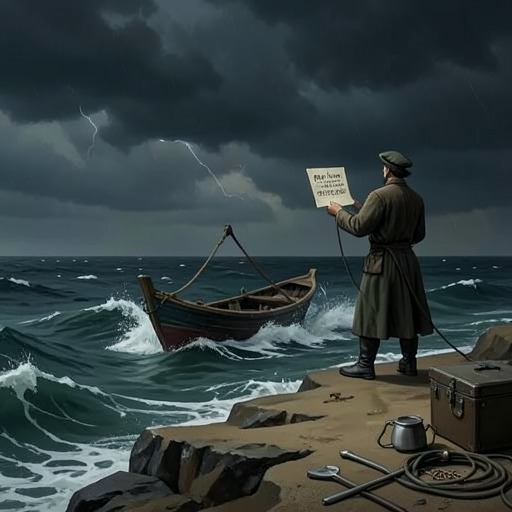
The idea is announced by the title of Book Fifth, which joins sea and fate under a shared breath. Its opening image makes that connection immediate. The Matutina moves away across the water as darkness gathers, its lantern a small point of light against the vessel’s receding form. The approaching storm makes this departure more than a change of setting: the fugitives are escaping human pursuit, yet their chosen route carries them into the reach of an elemental danger. The ship’s progress therefore holds flight and exposure together.
As the weather gathers, the narrator describes a transformation in how the sea is perceived. It is no longer merely a visible surface of waves: its power seems to become a will, and the natural world approaches the condition of an acting presence. The storm is at once meteorological event and encounter with the unknown. That shift in register does not establish that nature literally has human intention; rather, it gives narrative form to the fear produced when impersonal forces appear capable of directing human fate.
The sea’s character is defined by contradiction. Its movements join attack with relief, formation with undoing, and visible structure with continuous change. The narrator treats this self-opposition as part of the ocean’s sovereignty: the sea does not offer a stable refuge simply because one wave or moment appears favorable. This vision complicates the fugitives’ first response to the Matutina’s rapid passage. When the wind turns favorably and the vessel races onward, those aboard celebrate their distance from England. Their temporary confidence is framed against the surrounding instability and the doctor’s continued attention to the sea.
The snowstorm and hidden forces
The snowstorm becomes the clearest case through which the book develops this conception. It is described as a mixture of fog and storm, a difficult atmospheric phenomenon associated with disaster. The narrator argues that wind and waves alone cannot account for everything in the behavior of air and water, and proposes an invisible current called effluvium. In this account, wind and wave are perceptible impulses, whereas effluvium is a current that normally remains unseen and makes itself evident through thunder. The explanation is presented as a theory within the narrative, not as a settled account that resolves the storm’s mystery.
The proposed theory gives the weather a language of concealed interaction. The snowstorm is called magnetic, associated with the pole and compared with the aurora borealis: fog and snow are treated as manifestations through which an otherwise invisible force becomes perceptible. The narrator also compares storms to illnesses of the sea, distinguishing between tempests that can be escaped and those that prove fatal. An old pilot’s reported description of the snow squall as emerging from the devil’s wounded side preserves the inherited, folkloric way of naming the same danger. Scientific speculation and maritime tradition thus coexist without making the phenomenon fully knowable.
The storm’s arrival is staged as a convergence of changing signs. The mist develops irregular bulges, and blue cloud advances from east and west despite the wind’s direction. The sea’s surface changes in the narrator’s imagery from a scaled hide to a heavier, wrinkled skin. These observations make the weather legible as a process, but not predictable in any reassuring sense. The developing storm appears to obey patterns while continually frustrating simple expectations.
Fate, chance, and the problem of explanation
The narrator explicitly resists treating nature’s apparent caprice as mere randomness. What people call caprice in the natural world and chance in human life are described as fragments of a law glimpsed only incompletely. This proposition connects the ocean’s movements with the novel’s treatment of human fortune: events may appear arbitrary from the limited perspective of those caught within them, without thereby being declared meaningless or fully governed by a visible design.
That distinction sustains an important uncertainty. The narrator imagines that an unknown power can shape the storm’s diffuse forces and that each moment may register some change of will, whether apparent or real. But the text does not settle whether this language describes supernatural agency or gives figurative shape to nature’s incomprehensibility. The reader is held between explanation and wonder. The storm can be approached through observation, yet the account repeatedly marks the distance between noticing a pattern and possessing its law.
The broader passage on navigation sharpens this limit. It imagines a future in which captains study meteorology and pilots chemistry, and in which better knowledge might prevent many catastrophes. At the same time, it characterizes the study of the ocean’s hidden forces as exceptionally difficult and close to empiricism. Knowledge is necessary for navigation but remains incomplete. The sea therefore tests both practical judgment and confidence in human mastery: understanding may reduce danger, but it does not abolish uncertainty.
Human knowledge within the novel
Elsewhere, the contrast between knowledge and credulity appears in Ursus’s public address. He presents himself as a corrector of popular errors and openly claims belief in Providence, while also making the limits and oddities of inherited explanations part of his performance. His speech places confident correction beside examples whose reliability he questions, making knowledge itself a subject of comic scrutiny rather than an uncomplicated authority.
A brief exchange about orpiment makes that tension especially clear. When a magistrate objects that the Bible contradicts Ursus’s classification of the substance as poisonous, Ursus answers that arsenic affirms it. The exchange does not directly explain the storm, but it echoes the book’s wider concern with competing grounds of belief: scriptural authority, learned assertion, observation, and the uncertainties of interpretation. Read alongside the narrator’s speculative account of effluvium, it shows that explaining the world is not the same as making it transparent.
The Sea and Fate thus binds maritime danger to an epistemological problem. People act on partial signs: a favorable wind can invite confidence, a changing sky can warn of disaster, and a theory can offer an account without ending doubt. The sea’s apparent contradictions make it an image of fortune, but not a simple allegory in which every event is explained in advance. Its force lies in the interval between law and chance, where the human need to understand meets a world whose governing patterns remain only partly visible.