The historical paradox of aristocratic government
The Man Who LaughsThe historical paradox of aristocratic government in the novel is that a hereditary order can defend the people against royal despotism while remaining a source of privilege and social coercion. The House of Lords is depicted as a counterweight to the Crown whose resistance helps make political rights possible; yet the same aristocratic power is neither democratic in origin nor free of self-interest. Its historic achievement is therefore also its undoing: in defending its own position against monarchy, it helps create a political order that exceeds the privileges it meant to protect.
The peerage as barrier and inheritance
The novel’s historical argument gives the peerage a double function. Aristocrats resist the concentration of power in the Crown, and the House of Lords becomes a barrier between royal authority and the people. The narrative credits that resistance with obstructing the kind of centralized despotism associated with Louis XI, Richelieu, and Louis XIV. It also insists that the Lords’ service to the people was involuntary: aristocratic opposition to royal power could protect society from absolutism without arising from a commitment to equality. The institution’s contribution and its arrogance belong to the same history.
The account traces this tension through conflict between monarchs and peers. Under James I, attempts to bind the peerage through courtly influence provoke resentment; under Charles I, the relationship breaks down more sharply. The novel describes forty-four peers siding with the King and twenty-two with the Republic during the Revolution. In its telling, the Lords’ participation in political conflict helps produce the Bill of Rights and makes the peerage an agent in changes it did not set out to bring about. The historical examples support the work’s central distinction: resistance by a privileged class can restrain a monarch, but it does not make that class itself equal to the people.
The Lords’ power is presented as more than ceremonial. The narrative recalls the deposition or weakening of several kings and portrays the peerage as a force capable of checking the Crown. It also contrasts the English Lords’ concern with state power, legislation, and war with the French peers’ attention to rank, precedence, and etiquette. In this comparison, English aristocratic authority acts politically, while French rank is depicted as more invested in its own distinctions. The contrast sharpens the novel’s argument about consequence: aristocratic power can become consequential beyond the elite when it contests royal power, though it remains power grounded in inherited status.
Rights produced by privilege
The paradox reaches its clearest formulation in the claim that the House of Lords believed it was establishing privileges for peers but helped produce the rights of citizens. The novel figures aristocracy as a force that unintentionally incubates liberty: the institution’s defense of its own standing against the Crown helps establish principles that can be claimed beyond the peerage. Once those rights become available to the people, their meaning cannot be confined to the Lords’ original purpose. The aristocratic order thus assists in creating the political conditions that challenge its own exclusiveness.
The narrative does not present this development as a clean or benevolent reform. It describes the peerage as a parasite even while recognizing its substantial, if unintended, services. Its final judgment holds both sides together: aristocracy checked royal despotism, but the rights and national unity associated with that resistance outlast the institution’s authority. The House of Lords is therefore a starting point rather than a final political ideal. The people’s recovery of rights transforms what began as a contest over privilege into a broader claim to citizenship, and the old order becomes an obstacle to the consequences it helped set in motion.
Law, administration, and coercive power
The book’s account of English law complicates any simple equation between resistance to the Crown and protection of individual liberty. Unexplained arrests, it says, remained common despite the Habeas Corpus Act and continued into the reign of George II. These captures were associated with older German and Norman customs and were treated as useful in delicate cases. Unlike the public Clameur de Haro, silent arrest withheld explanation and warned the person seized to remain silent while matters remained unresolved. The practice exposes a gap between legal protections and the power exercised through inherited custom and state necessity.
The administration of justice also rests on a layered hierarchy of royal and local authority. Sheriffs generally received their commissions from the Crown, though the sheriff of Westmoreland held office hereditarily, while the sheriffs of London and Middlesex were elected by the livery in the common hall. Under the sheriff, the under-sheriff accompanied and the justice of the quorum assisted; with the bailiff of the hundred, the latter’s duties included apprehending, examining, and imprisoning people for trial before circuit judges. This institutional detail shows governance operating through offices with different sources of authority, rather than through a single, uniform legal power.
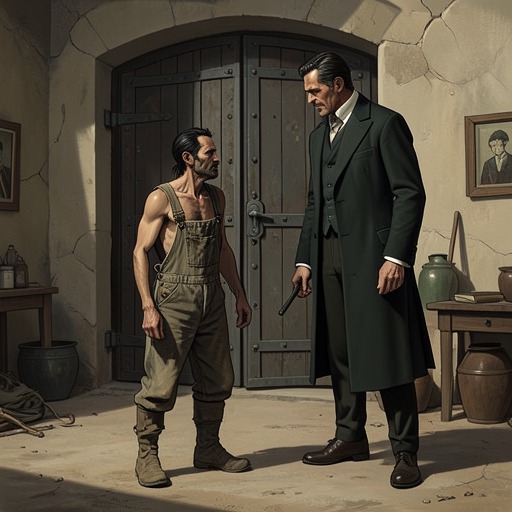
The contrast between political rights and coercive practice becomes concrete in the account of Gwynplaine. The torture chamber he sees is identified as one of many in England; the narrative names the crypt of Beauchamp Tower and the cell in the Lollards’ prison as places used for torture, and notes that Southwark Jail had such chambers. In the investigation of Gwynplaine’s identity, Hardquanonne recognizes a bottle bearing his name but refuses to speak after the enclosed parchment is read to him. The sheriff states that the peine forte et dure has been applied and that the fourth day is reserved for confrontation. When Gwynplaine is brought before him, Hardquanonne breaks silence and recognizes his victim. The legal procedure establishes the hidden identity, but its coercive setting makes visible the distance between the ideal of rights and the harsh means by which authorities seek a confession.
Authority and the limits of certainty
The novel extends its scrutiny of authority beyond aristocratic government and the courts. Its account of the ocean begins from the limits of explanation: the snowstorm is described as a meteorological mystery, and the narrator proposes magnetic effluvium as a force that might explain otherwise puzzling movements of wind and water. The proposed account is framed as an attempt to interpret an obscure natural phenomenon, not as settled knowledge. The snowstorm is further characterized as especially dangerous and magnetic, connecting scientific speculation with the hazards of navigation.
Ursus’s public lecture offers a different, comic scene of knowledge claims. He presents himself as a teacher who sells both remedies and ideas, claims the role of a corrector of popular errors, and distinguishes between what he knows and what he does not. Later, when challenged about classifying orpiment as an arsenic product and a poison, he answers that the Bible denies it but arsenic affirms it. The disagreement places scriptural authority beside a material claim about poison without making their conflict disappear. Together, these episodes broaden the book’s interest in how authority is asserted, tested, and limited. They do not collapse natural explanation, public learning, and political power into one subject; rather, they echo the central historical tension. Institutions and authorities may claim certainty or legitimacy, while the consequences of their claims reveal boundaries they cannot fully control.