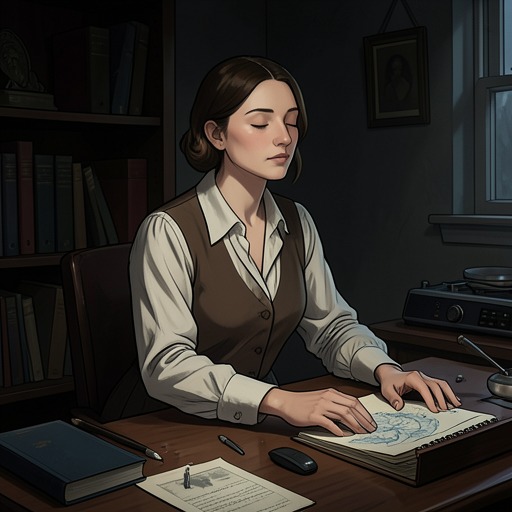
The infant girl's blindness
The Man Who LaughsThe infant girl's blindness is first recognized at sunrise, after a boy has found her alive in the snow and Ursus has taken responsibility for her immediate care. The revelation gives the rescue a second dimension: the child has survived the cold, but her eyes do not respond to the rising sun. The narrative identifies her as Dea, whose blindness is part of the story’s contrast between bodily appearance and inward life.
Discovery and Rescue
The boy discovers the infant beneath the snow, beside her dead mother. She is alive but close to death from the cold. He wraps her in his warm pilot jacket, takes her into his arms, and continues on through the snow with his own protection removed. When she feels herself held, she stops crying; seeking warmth, she presses her lips to his cheek and falls asleep. The scene establishes her survival through another child’s practical act of care, before anyone identifies her blindness.
The rescue does not explain why the infant is blind. The narrative gives no diagnosis or account of when the condition began, and it does not attribute it to the cold. That distinction matters: the infant’s exposure and near-fatal weakness are described, but blindness is disclosed separately, as an observed condition rather than a stated consequence of the ordeal.
Recognition at Sunrise
After the children come under Ursus’s care, he gives the infant a phial to suck. At sunrise, her face is turned toward the light. Her eyeballs remain fixed, reflecting the sun, while her eyes and eyelids do not move. Ursus recognizes what he is seeing and identifies her as blind. The moment makes the condition visible to the adults through the absence of a response: the sun is present, but the infant’s gaze does not follow it.
The timing gives the recognition a clear narrative sequence. First comes rescue and warmth; then feeding and shelter; only when daylight reaches the child does Ursus name her blindness. The scene therefore does not introduce her chiefly through a medical explanation. It shows the ordinary work of keeping her alive and places the recognition within that work. Her immediate needs remain care and sustenance, not a proposed cure.
Care and Embodied Difference
The infant is not left alone with the condition once it is recognized. The boy has already acted to protect her from the cold, and Ursus responds to her waking cry by feeding her. These actions are concrete and immediate. The text does not describe a treatment for blindness, nor does it show the child’s later capacities in this episode; its account stays with rescue, feeding, and the first recognition of her sightlessness.
That restraint distinguishes the blindness from Gwynplaine’s disfigurement. Gwynplaine’s face is described as permanently bearing a laughter-like expression that he cannot control, and other people’s reactions turn that visible difference into public spectacle. Dea’s blindness, by contrast, is disclosed in a brief scene of observation and care. The contrast does not make one condition more consequential than the other; it shows how differently bodily difference enters the narrative. Gwynplaine’s appearance governs how crowds respond to him, while Dea’s blindness is first registered through the limits of what she can see.
Narrative Significance
The sunrise scene establishes Dea’s blindness without treating it as a moral fault or offering an explanation unsupported by the narrative. Its placement beside the boy’s rescue connects physical vulnerability with responsibility: before the condition is named, he has already answered the infant’s need by sharing his warmth. Ursus then continues that practical care. The child is not reduced to a diagnosis in the scene; she is a person whose life has been preserved and whose condition becomes known within a network of protection.
In the wider contrast supplied by the novel’s treatment of bodily difference, Dea’s blindness also stands beside Gwynplaine’s involuntary grin. His face makes spectators laugh even when his thoughts and feelings do not; Dea’s eyes cannot answer the light before them. These are distinct conditions, not equivalent experiences, but together they unsettle the assumption that outward appearance fully discloses a person. The scene of Dea’s blindness begins with an act of recognition, yet its emphasis remains on care: the first response to her vulnerability is not judgment, but keeping her warm and alive.