The opposition between nature and society
The Man Who LaughsThe opposition between nature and society links the novel’s images of storm and sea to its critique of human power. Nature is both a force beyond human control and, in Gwynplaine’s reckoning, a source of spiritual care; society, by contrast, arranges status and authority in ways that injure the poor and isolate people from one another. The distinction is not a simple opposition between a benevolent landscape and a cruel civilization: the sea can be merciless, while nature’s compassion appears most clearly in the human bond that society threatens to break.
Nature as a force beyond human measure
The natural world repeatedly exceeds human explanation. Passing certain places or confronting certain objects can draw the mind toward speculation, as though the visible world opened onto uncertain, unseen depths. The image of a dead man left unburied extends that uncertainty into a moral register: his continued presence seems to testify against earthly law and to await a justice beyond it. Nature and the invisible thus unsettle the confidence that human institutions have the final word.
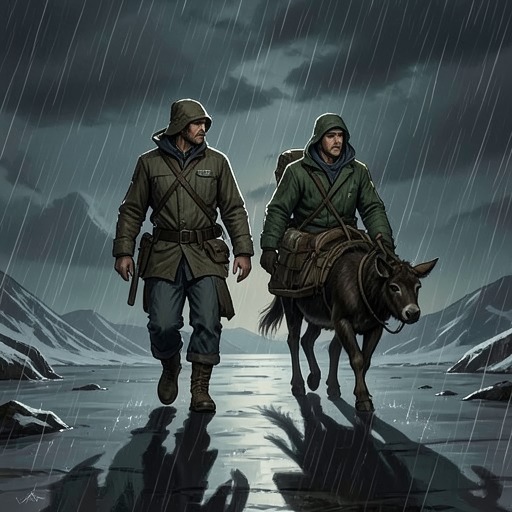
The hurricane gives this scale a more forceful expression. It is presented as the cry of a blind, immense cosmos, not as a voice carrying a human message. Its power is at once less than speech and more than thunder: an inarticulate force that exposes the limits of human understanding. Nature has a presence and agency in the narrative that cannot be reduced to scenery around human affairs.
The sea makes that agency unstable. A shipwreck leaves people near land yet unable to reach it, afloat without command of their direction, and confined between sky and ocean. The sea can move from violence to quiet and back again; its calm intervals do not promise safety, and the storm’s course may seem to linger over those in its power. These images make human helplessness concrete, while resisting the idea that nature’s power is arranged for human comfort or justice.
Society as an imposed order
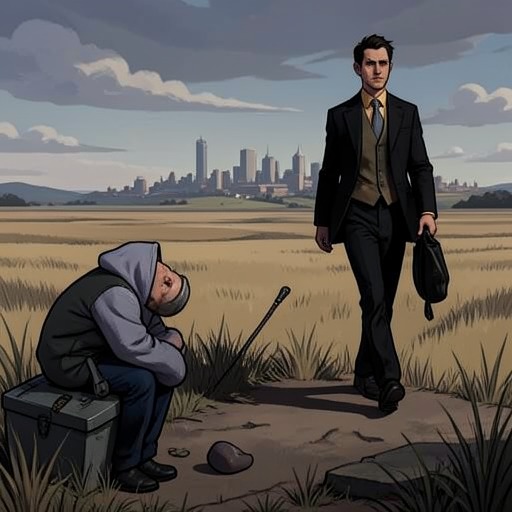
Against the elemental uncertainty of the sea, society appears as a human-made structure with identifiable beneficiaries and victims. In his final reflections on the world he has glimpsed, Gwynplaine sets paired appearances against their missing moral substance: marriage without love, riches without conscience, justice without equity, authority without right, and splendour without light. The repeated imbalance turns social criticism into an account of institutions that retain their names while failing to fulfill their promises.
Gwynplaine’s reckoning with his own situation is equally severe. He understands destiny as a snare, his position as despair, society as hatred, and himself as defeated. This is not merely private disappointment: the categories connect his personal reversal to the wider order that determines who may possess dignity and security. Where nature’s forces are immense and impersonal, society’s harms arise through arrangements of power that press especially heavily on the poor.
His face makes that contrast visible in social encounters. Nature has given him a body otherwise tall, well-made, and agile, but his face bears an unchangeable appearance of laughter. Others laugh when they see him, then turn away; women in particular recoil from him. The response is social as well as visual: the public treats his face as a spectacle, while the person behind it does not share the laughter others read there. His outward expression cannot disclose his inward state, and the crowd’s reaction converts bodily difference into isolation.
Gwynplaine’s face as social indictment
Gwynplaine later interprets his permanent smile as a mark imposed by royal power and as a sign of suffering beyond his own case. In his speech to the lords, he presents the laughing face as an accusation: what appears to be comic spectacle is, to him, evidence of enforced silence, rage, and despair. He insists that he is not an exception but a symbol of people deformed by their masters, extending the image from his features to the distortion of justice, truth, reason, and intelligence.
That argument reverses the audience’s customary way of seeing him. The people who have laughed at his face are made to confront what the laughter conceals: his visible expression is not consent or happiness, but a condition he cannot remove. The contrast between his inward distress and the face society reads as comic exposes the failure of public judgment. His body becomes a measure of a social order that mistakes its own violence for normality and the person harmed by it for an anomaly.
Nature, Dea, and the poor
Gwynplaine’s reflection gives nature a more intimate meaning through Dea. He reviews what each has done for him and concludes that, although he has lost even his features, the soul has returned what was taken in another form. Dea, who is blind, does not see his ugliness and instead sees his beauty. Nature’s kindness here does not erase his condition; it appears through a relationship in which the usual visual judgment has no authority over love.
The same bond informs his political regret. Gwynplaine remembers the poor as a lively, loving people who had sustained him, then wonders what became of them after their community disappeared. He thinks of the power that weighs on the poor and recognizes that his title and peerage did not make him their protector. More bitterly, he concludes that society had crushed them in order to separate his dignity as Lord Clancharlie from contact with them. His inherited elevation, rather than shielding those who had cared for him, had become part of the division that exposed them to persecution.
This recognition leads him to imagine that his own disappearance might allow them to remain in peace. He also regrets having been separated from Dea, whom he understands not only as the person he loves but as an orphaned, blind figure representing humanity. Nature’s maternal care is therefore neither abstract nor universal in its effects: it is encountered in a particular act of seeing beyond appearance, while society’s power has consequences for actual relationships and vulnerable people.
The contrast’s moral and narrative force
The contrast between nature and society remains deliberately unresolved. The sea and hurricane demonstrate that the natural world can overwhelm people without regard for their hopes; nature is not a reliable instrument of fairness. Yet the novel also associates nature with the soul’s capacity to succour Gwynplaine and with Dea’s vision of his beauty. Society, conversely, can offer the forms of family, justice, order, and authority while withholding their ethical substance.
The opposition therefore directs attention to the difference between suffering caused by forces no person commands and suffering reproduced by human arrangements. It also changes how Gwynplaine’s face is read: what society takes for an amusing abnormality becomes, in his account, a sign of collective injury. Through that reversal, the natural world supplies both an image of human vulnerability and a standard of care against which social conduct can be judged.