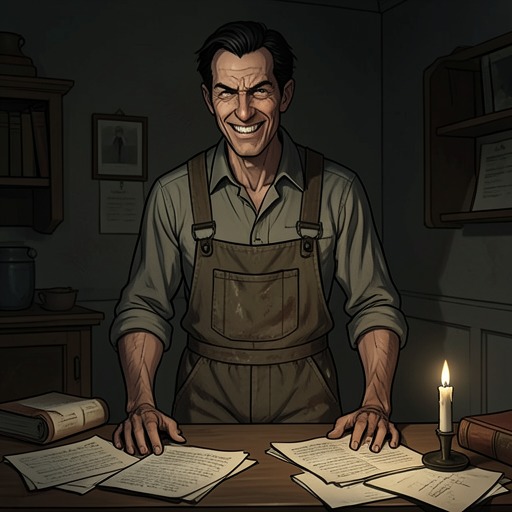
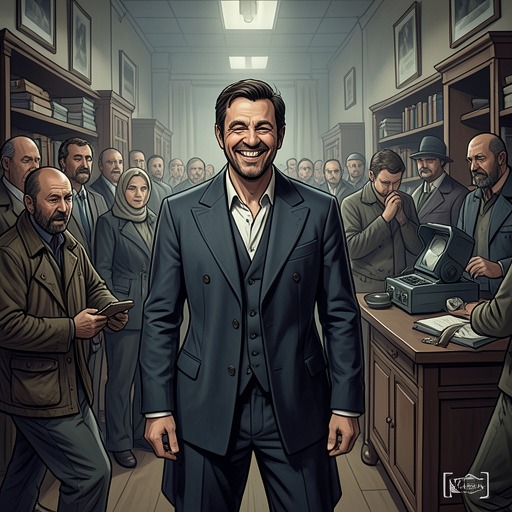
The oppressed kept silent and spoken for
The Man Who LaughsThe oppressed kept silent and spoken for is the political idea that drives Gwynplaine’s address to the House of Lords: people whose suffering has made their complaints unintelligible need an advocate who can carry those complaints into the hearing of power. The novel gives that mission a sharp irony. Gwynplaine believes his new position will let him speak for the poor, yet the privileged audience turns his attempt at witness into a spectacle and meets his grief with laughter.
The silence of the poor
In Gwynplaine’s account, the poor are not silent because they have nothing to say. Their complaints are many, scattered across suffering, and difficult for the powerful to understand. Hunger, ignorance, and oppression make their cries seem inarticulate; because those cries go unheard, their voicing can amount to silence, and silence becomes a kind of forced disarmament. The concept therefore names a political failure of hearing as much as a lack of speech: those with the least power cannot make their experience count in the language and institutions of those who rule.
Gwynplaine presents himself as the answer to that failure. He imagines himself as the advocate of a voiceless people, able to translate their murmurs, groans, complaints, and cries into a public denunciation. In his conception, representation is an act of conversion: what power treats as unintelligible noise becomes an account of injustice that can be heard. His aim is not simply to describe the poor from a distance, but to bring their experience into the chamber where privilege is discussed and defended.
A speaker formed by suffering
Gwynplaine’s claim to speak rests on the distance he has crossed between poverty and aristocratic status. Before the peers, he identifies his true name with poverty and recalls that he grew up hungry, endured winter, contempt, pestilence, and shame, and was cast into the social world as an abandoned child. He contrasts the comfortable view of the lords, who see the sunshine, with the shadows concealed from those living above the people. His authority, as he understands it, comes from having felt the pressure of the powerful rather than merely observing it.
That personal history gives his intervention a double force. The assembly knows him as Lord Fermain Clancharlie, newly raised from the life of a mountebank to a peer’s place; he insists that the title does not erase the identity made by poverty. The gulf between those positions is not presented as an abstract change of rank. For Gwynplaine, it imposes a duty: because he has been brought into the room of the powerful, he must carry into it the suffering that its occupants do not know.
The duty to represent
Gwynplaine’s decision to enter the Lords is framed as a struggle of conscience. He has duties elsewhere and says that his heart is not in the chamber, yet he obeys the summons because he believes his presence among the well-fed is bound to his earlier life among the famished. The movement from outsider to peer thus becomes, in his reasoning, a responsibility rather than a reward. His elevation matters only if it can be used to challenge the conditions that separate the privileged from the disinherited.
He also regards his history as carrying a purpose larger than personal advancement. The survival of Hardquanonne’s flask through fifteen years at sea appears to him to reveal a hidden design in his destiny. He interprets his own transformation into Lord Clancharlie as the means by which he has been placed where he can plead for the poor. The political representative is consequently both a man with a particular history and, in the novel’s terms, a symbolic figure burdened with speaking for people who cannot make themselves understood.
When the powerful do not hear
The Lords’ response exposes the limits of Gwynplaine’s hoped-for translation. He speaks of misery directly to those who have everything, but the speech does not produce recognition. The narrative describes the privileged as deaf on the side turned toward the disinherited: satisfaction has become a barrier to perceiving hunger. This is more than a failure of eloquence. Gwynplaine can make the accusation, but he cannot compel his audience to receive it as an accusation.
The scene’s most bitter reversal is bodily. At the height of his speech, emotion brings sobs into Gwynplaine’s throat, but his permanently laughing face turns the sobbing into uncontrollable laughter. The reaction confirms the assembly’s image of him as a clown at the very moment he is trying to act as an advocate. His suffering, meant to disclose the suffering of others, is converted into entertainment; the audience’s laughter completes the silencing his speech sought to break.
Political and narrative significance
The concept joins voice to access without pretending that access guarantees a hearing. Gwynplaine reaches the place where oppression can be discussed and resisted, and he sees his presence there as a chance to speak for the dumb. Yet the scene makes the distinction between being allowed to speak and being understood decisive. The people’s advocate may enter the chamber, address the peers, and state what poverty means, while the established order remains unmoved.
The novel sharpens that contradiction by making Gwynplaine at once a representative and a spectacle. His title grants him a place among the lords; his history supplies the testimony; his face, made to signify laughter, frustrates the serious meaning he tries to convey. His failure does not make the suffering he names unreal. Instead, it shows how a society can expose the oppressed to public view while refusing to hear their claims. The idea remains powerful precisely because its promised translation is left incomplete: the silenced have found a voice, but the powerful have not learned to listen.