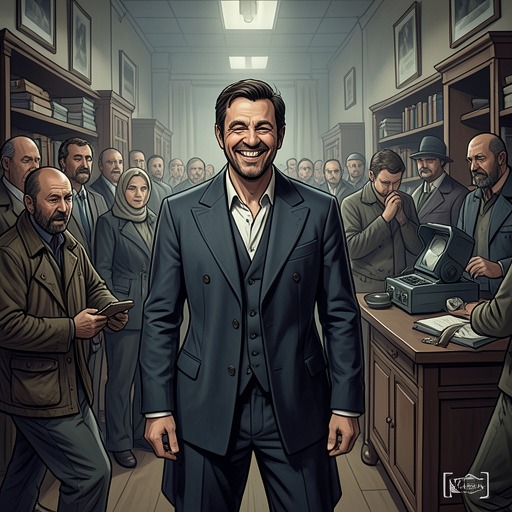
The smile as a mask for suffering
The Man Who LaughsThe smile as a mask for suffering is the defining contradiction of Gwynplaine’s public identity and the novel’s image of suffering made socially invisible. His face provokes laughter that he does not feel and cannot simply dismiss; when he attempts to speak for the poor, that same automatic expression turns his anguish into a spectacle. The smile is therefore both a personal consequence of violence and a public sign of a wider order that makes misery appear entertaining, tolerable, or unreal.
The Expression and Its Limits
Gwynplaine’s face appears to laugh regardless of what passes within him. The narrative distinguishes the expression from the person: his face produces other people’s laughter, but his thoughts do not share it. Whatever his emotion, the fixed arrangement of his features intensifies the appearance of hilarity. Suffering, astonishment, anger, and pity become outwardly legible only through the same smile. His face does not communicate a changing inner life; it presents a single, misleading expression in its place.
That separation is not merely a matter of appearance. Gwynplaine can briefly restrain the expression only through a severe effort, and even then a small distraction or emotion brings it back. The smile’s permanence makes it seem automatic and, to spectators, difficult to resist. A visible reaction that would ordinarily belong to a person’s shifting feelings has become an imposed public identity. The narrative thus places the social meaning of the smile in tension with Gwynplaine’s own experience: others read amusement where he may feel pain, while his actual feelings have little power to alter what they see.
The account suggests that the face was deliberately shaped in infancy, while presenting the precise history as an inference rather than something Gwynplaine remembers. His body is otherwise described as well made and agile, which sharpens the contrast between his appearance as a performer and his capacity as a person. The smile is not treated as evidence of a naturally cheerful disposition. It is an enduring outward mark whose origin lies in an act done to him, and whose public effects continue long after that act.
Laughter as Livelihood and Rejection
As a mountebank, Gwynplaine displays himself on a platform, and the effect of his appearance brings him rapid renown at fairs and crossroads. Spectators laugh; even people who arrive burdened by melancholy, or who would ordinarily be expected to maintain solemnity, are drawn into the response. His act can dispel sadness in others, but that success rests on a sharp inequality: the crowd receives amusement from an expression that does not express his own joy.
The audience’s laughter does not become acceptance. Once the novelty has passed, spectators turn away, and women in particular shrink from him in horror. His unusual face can command attention and make him a successful attraction, yet it also makes sustained ordinary regard difficult. The same feature that serves as his livelihood marks him for avoidance. Public visibility therefore offers no straightforward escape from stigma: Gwynplaine is watched intensely as an object of amusement and recoiled from as a person.
This double response gives the smile its social force. Laughter initially appears to be a shared pleasure, but it is not shared on equal terms. The crowd can enjoy the effect, then withdraw from the man who produces it. Gwynplaine’s face holds those reactions together: it makes him commercially useful to the audience while preserving the distance between their entertainment and his experience.
The Plea Before the House of Lords
The contradiction becomes politically explicit when Gwynplaine speaks before the House of Lords. He recounts his entrance into society as an abandoned child and describes the figures through which he first encountered law, wealth, the future, and kindness. His speech develops into an appeal for pity and an indictment of a system that increases the poverty of the poor for the benefit of the rich. He presents himself as someone who has known life beneath the weight of the powerful and asks the assembly to recognize the suffering concealed below its own elevated position.
At the moment when emotion rises within him, his face produces an uncontrollable fit of laughter. The response spreads through the chamber: a gathering that had been under the weight of his speech breaks into merriment, and the lords answer his appeal with laughter, applause, and taunts. His words and his expression seem to contradict one another in public. He speaks in grief and indignation, but the face the assembly can see appears to offer comic entertainment. His own body thereby interferes with the meaning he is trying to convey, and the audience treats the visible sign as more persuasive than the suffering behind it.
Gwynplaine makes that conflict the subject of his address. He identifies the smile as something imposed on his face by a king and presents it as a sign not of happiness but of hate, enforced silence, rage, and despair. He then extends the image beyond himself: his altered appearance becomes a symbol of a people whose suffering is hidden beneath a surface that seems content. The individual face and the social order mirror one another. In both, pain is present, but what observers see encourages them to mistake it for something else.
From Personal Mark to Social Image
The smile’s political meaning depends on a reversal. What seems to make Gwynplaine an exception—an expression unlike the feelings it appears to show—becomes, in his interpretation, an image of the ordinary condition of the oppressed. He argues that the people suffer while seeming to smile, and that those who enjoy power mistake this surface for evidence that nothing is wrong. The image connects his imposed expression to the wider distance between visible public order and concealed human cost.
The speech also links the face to historical conflict. Gwynplaine recalls that the Republic was destroyed but declares that its challenge to kingship will return; he invokes Oliver Cromwell as the figure who broke the royal line’s armed power. His prediction turns the laughter of the chamber into more than a personal insult: in his argument, the lords’ amusement demonstrates the blindness of a privileged group that cannot hear the danger contained in the suffering it mocks. The smile carries both the immediate humiliation of the speaker and the larger political accusation he makes.
The Reversal of the Smile
The speech does not overcome the expression’s power over its audience. The laughter intensifies, and Gwynplaine’s effort to awaken pity has instead awakened horror and ridicule. His own face appears to contradict his conscience, so the charge he directs at the powerful is turned back upon him: the audience treats the sufferer as the comic offender rather than recognizing the violence represented by his appearance. His rise into public prominence cannot undo that reversal.
In the account of his defeat, the smile becomes the mark through which an injustice is repeated. The harm done to Gwynplaine serves as the occasion for further harm when those listening condemn the visible sign rather than the person who bears it. The narrative extends the image once more, describing the poor, the beggar, the felon, the orphan, and others whose suffering is converted on the surface into a grin. Gwynplaine becomes the figure through whom that contradiction can be seen: not because his smile reveals that suffering has ended, but because it shows how easily society can mistake suffering for entertainment. The mask does not conceal pain from the reader; it exposes the habits of those who refuse to recognize it.