Ugly Club
The Man Who LaughsThe Ugly Club is a society of the peerage whose declared interest is deformity, making ugliness a social distinction to be exhibited and contested. Lord David Dirry-Moir belongs to it despite being handsome, a contrast that underscores the club’s deliberately perverse approach to beauty and status.
Membership and Purpose
The club is described among the fashionable societies frequented by Lord David. Its dedication to deformity sets it apart from an ordinary gathering of the young peerage: its members agree to fight not over a beautiful woman, but over an ugly man. The reversal turns the conventions of courtship and competition into a joke at the expense of conventional taste.
Lord David’s membership also sits beside his affiliations with several other clubs, including the Beefsteak Club, the Surly Club, the Splitfarthing Club, the Cross Club, the Scratchpenny Club, the Sealed Knot, and the Martinus Scribblerus. The account does not suggest that he founded or governed the Ugly Club; it identifies him as one of its members.
Images and Rituals
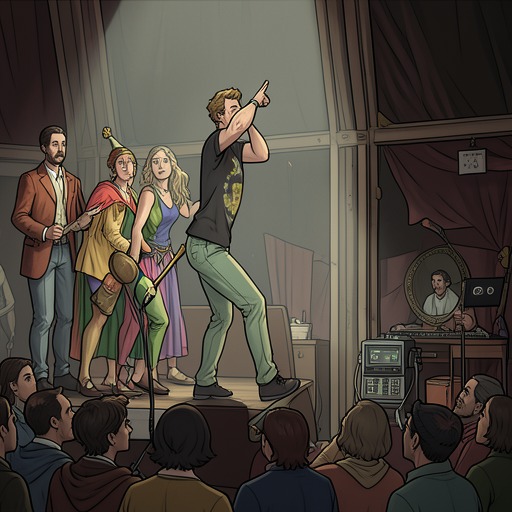
The club’s hall displays portraits of figures associated with grotesque or comic appearance: Thersites, Triboulet, Duns, Hudibras, and Scarron. Above the chimney, Aesop is placed between Cocles and Camoens, whose profiles are arranged so that their blind eyes face one another. The arrangement makes bodily difference part of the room’s visual wit, not merely a private membership criterion.
The club’s taste is sharpened by its response to an event outside its walls. When the beautiful Mrs. Visart caught smallpox, the members toasted her. The episode presents the club’s devotion to ugliness as a deliberately provocative inversion of fashionable admiration for beauty.
Reputation and Significance
Though handsome, Lord David belongs to a club dedicated to deformity. That incongruity captures the club’s governing joke: ugliness functions less as a description of its members than as the subject around which they perform exclusivity and amusement. Its contests and portraits make physical difference into entertainment for an elite audience.
The club was still in existence at the beginning of the nineteenth century, and Mirabeau was elected an honorary member. Its longevity suggests that the account treats it not as a passing private joke but as a durable feature of fashionable society. The Ugly Club’s comic rituals also provide a pointed contrast with Gwynplaine, whose altered face provokes involuntary laughter and social rejection rather than chosen participation in a club’s play with ugliness.