Ursus takes in the two children
The Man Who LaughsUrsus takes in the two children after the boy, carrying a sleeping infant, turns away from the caravan and tries to continue his journey. A call from inside draws him back. Within the cramped home of Ursus and Homo, the old philosopher warms and clothes the boy, feeds the infant, and finally declares that he will be their father and Homo their uncle. The adoption changes the children’s immediate prospects from exposure and abandonment to shelter, care, and belonging.
The Threshold and the Invitation
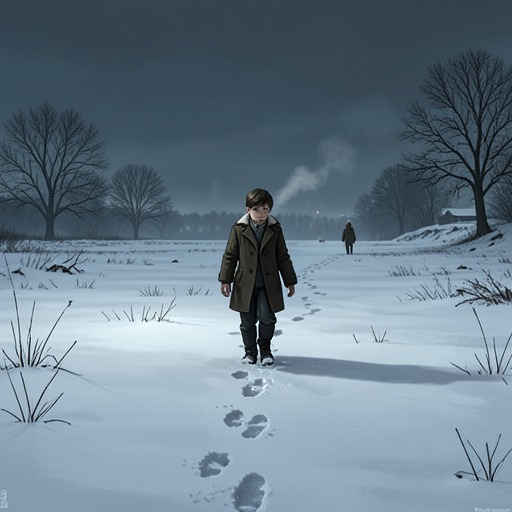
The boy has already taken a few steps away when the caravan’s door opens and a voice calls angrily for him to come in. He turns back. The invitation is not phrased as a tender welcome: the speaker rebukes him for standing outside hungry and cold instead of entering. Yet its impatience carries an offer of refuge. The boy accepts, bringing the sleeping infant with him across the threshold.
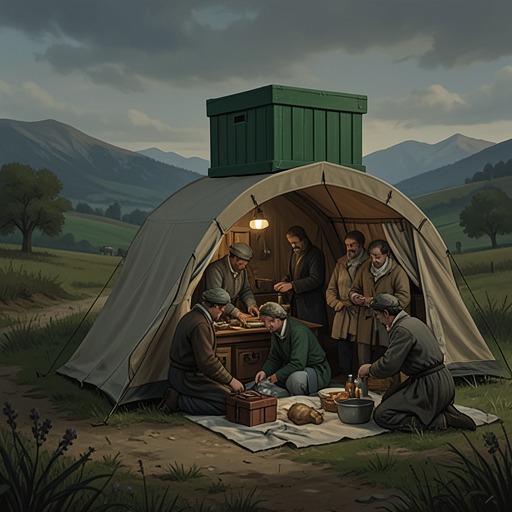
The interior is scarcely larger than a box, dim even beside the snow-bright world outside. A reflection from the stove makes out the sign identifying the place as Ursus, Philosopher. The narration then clarifies that this is the home shared by Ursus and Homo: Ursus is the speaker, while Homo is the presence whose growling the child has heard. The setting makes the scale of the decision concrete. Ursus has little room, but he opens it to two children who arrive without protection.
Care Before Questions
Ursus sees how wet and cold the boy is and pushes him toward the fire. He begins undressing him before asking who he is, then immediately forbids him to answer. The sequence gives practical need priority over explanation: the boy is not required to account for himself before being warmed. Ursus tears away the child’s rags, finds a man’s shirt and a knitted jacket, and dresses him. He rubs the exhausted boy’s limbs with a woollen cloth and wipes his feet beside the fire.
That care is energetic and rough in manner, but attentive in detail. The boy has brought the infant close, and Ursus notices how carefully he sets her down. His rebuke about the child’s worthless rags gives way to the more pressing fact that the boy is soaked and frozen. The encounter thus presents hospitality not as a formal welcome but as a series of bodily acts: removing wet clothes, supplying dry ones, warming the limbs, and making the stranger safe enough to remain.
Ursus then turns to the infant. He identifies her as a girl from her cry and finds that she too is drenched. He removes her tangled tatters and wraps her in clean, dry linen. When she continues crying, he makes a feeding bottle from a phial, sponge, linen, and thread. He fills it with milk warmed on the stove, tests its temperature against his cheeks, and offers it to her. The infant drinks greedily. What the small caravan can provide is modest, but Ursus puts its milk, fire, cloth, and improvised equipment to immediate use.
From Refuge to Adoption
The children’s arrival is tied to a death outside the caravan. Ursus recalls having searched for the woman beneath two feet of snow and says that Homo’s keen sense of smell helped him find her. He describes touching her hand and discovering that it was cold and still, then wonders how anyone could die and leave a child behind. His first response to the consequences is practical: three people will be difficult to fit into the little box. But the complaint does not become a refusal. The boy and girl are already inside, being cared for.
Homo’s response completes the change from temporary shelter to shared responsibility. While the infant sleeps, her hand hangs down between the stove and a chest, and Homo licks it so gently that he does not wake her. Ursus notices the gesture and names the new arrangement: he will be the father, and Homo the uncle. He then makes the decision explicit, treating the adoption as settled and Homo as willing. The wolf’s quiet contact with the child precedes the spoken family designation; acceptance is shown first as careful conduct and then given a name.
Significance of the Event
The adoption turns a scene of abandonment and death toward a fragile form of kinship. The dead woman cannot be restored, and the cramped caravan cannot erase the children’s exposure or loss. It can, however, offer warmth, food, clothing, and two guardians. Ursus’s repeated grumbling and abrupt manner remain part of the scene, but his actions contradict any impression that complaint means indifference: he searches for the woman, cares for the children, and takes responsibility for them.
The event also establishes Homo as more than a presence at the edge of Ursus’s household. He helps locate the woman, stays close to the stove, and treats the sleeping infant with gentleness; Ursus incorporates him into the adoption as a willing uncle. The new family is therefore formed through shared acts rather than through a claim of blood. In the narrow space of the caravan, a boy who had been preparing to go on alone is received with the baby he carries, and a temporary shelter becomes a household.