Ursus—Gwynplaine
The Man Who LaughsUrsus—Gwynplaine is a foster father–son relationship built through years of care rather than any stated formal adoption. Ursus takes Gwynplaine in as a foundling, raises him alongside Dea, and, when he believes Gwynplaine has died, mourns him as his child and son. The bond’s force lies partly in its contradictions: Ursus voices relief at being free of the young man, yet the supposed death brings him to passionate grief.
Taking in a foundling
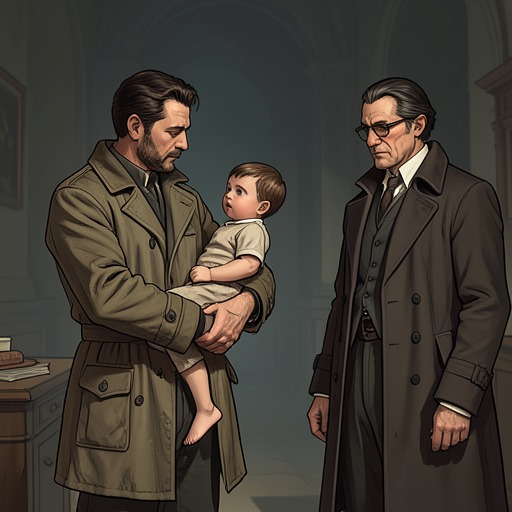
Ursus recalls taking in Gwynplaine and Dea when they were little, brooding over them as they grew and drawing them along with his travelling establishment. His account makes their upbringing a sustained responsibility, not a passing act of shelter. He remembers Gwynplaine as an ugly child and Dea as blind, but those descriptions do not undo the kinship his actions established. In time, he speaks of the young people’s attachment to one another with contempt; even in that disparaging recollection, however, they remain the children he brought up.
Gwynplaine’s face shapes the public life around that family bond. Its fixed expression makes onlookers laugh, while Gwynplaine himself cannot control or remove it; after the initial reaction, people often turn away from him. His appearance becomes a public spectacle, but it does not define the thoughts or feelings Ursus helped him grow into. The contrast between the face seen by a crowd and the child known within Ursus’s household gives their relationship particular weight.
Strain after Gwynplaine’s arrest
After Gwynplaine is taken into custody, Ursus voices a harsh account of the separation. He calls the arrest deserved, blames Gwynplaine’s political speech, and describes himself as fortunate to be rid of him. He also resents the trouble of raising the two foundlings and derides Gwynplaine’s attachment to Dea. The outburst presents a severe rupture in the relationship, but it does not settle Ursus’s feelings: the narrative soon places his claimed relief beside his response to the belief that Gwynplaine is dead.
A father’s grief
Ursus pieces together signs of Gwynplaine’s fate: the arrest, the secret circumstances of his capture, the return of his clothes, the prison death bell, and a coffin carried to burial. Treating these indications as confirmation, he concludes that Gwynplaine has been killed. He sinks onto a stone and breaks into sobs, naming Gwynplaine his child and son. The scene turns the earlier language of freedom into a measure of what the separation means to him: the man who had spoken as though he welcomed the loss cannot bear the thought of it as final.
The bond and Gwynplaine’s public identity
Gwynplaine later describes his permanent smile as imposed by a king and as an emblem of the suffering inflicted on ordinary people. That public interpretation supplies a wider context for Ursus’s parental bond: the child he raised is also a person whose visible identity was made into a spectacle and whose own account distinguishes that imposed face from the self within it. The relationship does not erase the violence or social rejection attached to Gwynplaine’s appearance. Instead, Ursus’s years of care and his grief establish a private recognition of kinship that stands against the crowd’s reduction of Gwynplaine to his face.