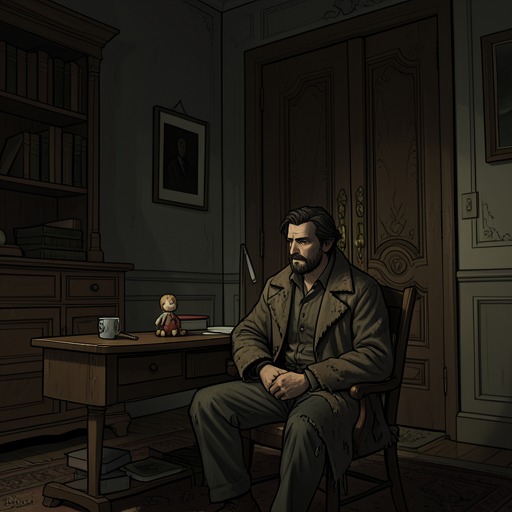
Ursus’s misanthropy
The Man Who LaughsUrsus’s misanthropy is less a settled rejection of other people than a bitter, theatrical way of judging the world: he denounces human existence while acting to preserve it. In him, contempt for humanity and practical compassion are not successive phases but simultaneous commitments. His recurring complaint against the world sharpens the novel’s distinction between a harsh view of life and indifference to the lives of those who suffer.
Identity and Public Persona
Ursus turns his hostility into part of his working identity. He travels as a juggler, doctor, and ventriloquist, imitating individual voices, the murmur of a crowd, and the cries of birds. The performance supports his livelihood, but it also gives a public form to his misanthropy: the man who distrusts people can reproduce their voices so convincingly that listeners believe they are hearing the speakers themselves. His art makes him both observer and imitator of the society he criticizes.
The inscription identifying Ursus as a philosopher, written inside his van so it could be read from outside, is a compact emblem of this persona. Philosophy is not set apart from performance or daily survival; it is displayed to passers-by as part of his traveling life. His jokes and fables similarly mix conviction with deliberate oddity. He presents himself as a dealer in superstitions and contrasts his own open admission of that identity with the moral pretensions of respectable authority. The misanthrope is therefore also a comic public speaker, turning distrust into a practiced style.
Contempt and Contradiction
Ursus’s view of existence is severe. He sees evils layered upon one another: political power weighs on ordinary people, war follows, disease and hunger compound suffering, and folly seems to extend across the whole arrangement. From this perspective, death can appear a release from punishment. Yet that conclusion does not make him a passive onlooker when someone is ill, hungry, or physically impaired. He treats the sick, keeps remedies to prolong the lives of the old, helps people with impaired mobility, and gives his own small supply of money to a starving poor person.
His acts of care are accompanied by sarcasm rather than tenderness of manner. He frames recovery as a return to the world’s troubles and giving food as a way of making a sufferer endure life longer. The rhetoric sounds hostile, but the actions answer immediate needs. Ursus’s claim that he does people all the harm he can is thus undercut by the very conduct surrounding it: he heals, assists, and gives away what he has. The contradiction is not resolved into a hidden cheerful faith in humanity. Instead, his care persists within, and partly because of, his bleak assessment of human conditions.
Solitude, Laughter, and Social Satire
Ursus prefers solitude and continual movement. Remaining in one place makes him feel tamed; the traveling life keeps him apart from settled society, even as it carries him through towns and crowds. He would prefer a cave on wheels to a house-like van, an image that joins his wish for withdrawal to the practical impossibility of escaping the human world altogether. His companionship with Homo is an exception that complicates, rather than erases, this preference: he admires the wolf and shares the road with him, while keeping a wary distance from people.
His laughter, unlike a smile, signals refusal. It is often bitter, a response that withholds agreement rather than offering welcome. Yet Ursus’s social criticism also works through irony directed at power. When James II gives a costly gold lamp to the Virgin in a Catholic chapel in Ireland, Ursus praises the gift by contrasting it with the barefoot children nearby who need shoes. The compliment exposes the distance between devotional display and material need. His satire is not simply contempt for humanity in general; it notices the choices and hierarchies that leave the poor without necessities.
Compassion and the Poor
The novel develops a related moral contradiction through Gwynplaine’s view of the crowds who come to the Green Box. From his platform he sees hunger, unemployment, families approaching ruin, and people whose original goodness has been worn down into bitterness. The poor attend for a cheap moment of forgetfulness, while their visible distress makes the inequality around them difficult to ignore. This episode gives concrete social contours to the suffering that Ursus approaches through aphorism and sarcasm: misery is not an abstraction but a crowd of particular needs and damaged prospects.
Gwynplaine’s impulse to help everyone grows from the fact that he once rescued an infant, but he doubts that a person without power can do much. His ability to make people laugh offers one limited relief: for a time, it lets them forget. The contrast recalls Ursus’s own conduct. Both men encounter a world that invites despair, but neither is permitted to make despair an excuse for doing nothing. Ursus’s medicine and coins answer individual need; Gwynplaine’s performance offers temporary respite while making him attentive to the people who seek it.
Meaning in the Novel
The concept reaches its sharpest political contrast in Gwynplaine’s appearance before the House of Lords. His face produces laughter in those who see him even as he speaks about poverty, harsh law, and the suffering of people beyond the chamber. He identifies that forced laughter with pain and enforced silence, turning his own disfigurement into an image of a society that presents a cheerful surface over suffering. The peers’ laughter at his plea makes the mismatch between what is said and what is seen part of the scene’s meaning.
Ursus’s misanthropy and Gwynplaine’s appeal are not interchangeable positions: one is a private, comic posture of opposition, while the other becomes a public indictment of privilege. Together they reveal why bitter speech in the novel cannot be measured apart from conduct or circumstance. Ursus may denounce humanity, but he tends the vulnerable; Gwynplaine may be made to look as if he laughs, but his attention turns toward the poor and his speech asks the powerful to recognize them. The novel uses that opposition to distinguish hostility toward human beings from resistance to the conditions that make their lives miserable.