Voting customs in the two Houses of Parliament
The Man Who LaughsVoting customs in the two Houses of Parliament make institutional rank visible in the act of voting itself: the House of Lords records peers individually, in order of seniority, while the House of Commons votes collectively. The contrast is part of a wider division of parliamentary roles, with the Commons accusing and the peers judging, and is demonstrated in the Lords’ vote on a bill concerning royal provision.
The two Houses and their voting forms
The procedure described for the House of Lords begins with the puisne, or junior, baron. Peers are called one at a time and rise to give an individual answer of Content or Non-content. By contrast, members of the House of Commons vote together, answering Aye or No as a body. The distinction is not merely a pair of different words: the Lords’ method proceeds by named members and separate responses, whereas the Commons’ method gathers its members into a collective division.
The narrative places these voting customs alongside a division of institutional responsibilities: the Commons accuse, while the peers judge. That arrangement gives the two Houses different parts in parliamentary business as well as different ways of registering a decision. The passage does not describe every stage of a vote in both chambers, but it makes the contrast explicit: individual answers in the Lords, a collective response in the Commons.
The Lords’ vote on royal provision
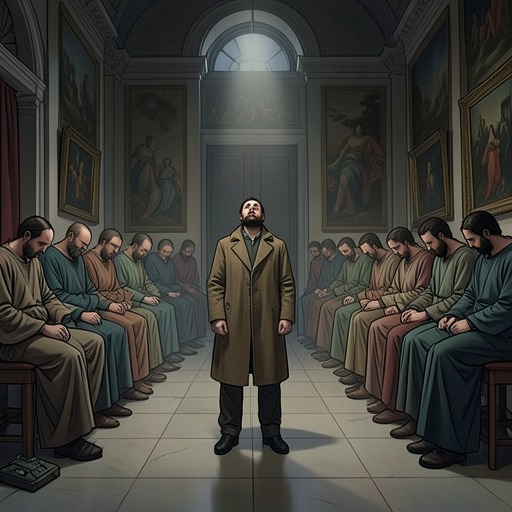
The procedure is shown during consideration of a bill that would increase by £100,000 sterling the annual provision for the Prince, the Queen’s Consort. The House had deliberated for several days, and the debate was declared exhausted and closed before voting began. The Lord Chancellor then announced that the division would follow custom, starting with the puisne baron. Each lord would rise when called and state Content or Non-content; a peer could also explain the grounds of his vote if he chose.
The staging emphasizes that the vote is conducted through a formal sequence rather than an undifferentiated show of hands. The Usher of the Black Rod re-enters, and the Lords Commissioners leave the bench of State for the top of the dukes’ benches. The Lord Chancellor addresses the House and directs the clerk to take the vote. These ceremonial movements frame the division, but the operative rule is the ordered call of each peer and the recording of each response.
The roll and the first response
The clerk opens a large folio on a gilded desk: the book containing the list of the Peerage. The puisne of the House at that time is John Hervey, who had been created Baron and Peer in 1703. When the clerk calls his name and title, Hervey rises, answers Content, and sits down; the clerk registers his vote. The account thus supplies a concrete instance of the rule: the junior peer is first, his answer is given individually, and it is entered on the parliamentary record.
Hervey’s response also clarifies how the procedure operates without making his individual choice stand for the whole House. His vote is one entry in an ordered roll call, not a collective answer on behalf of the peers. The Lord Chancellor’s announcement allows each peer to explain his reasons if he wishes, but Hervey’s recorded response is simply Content. The scene establishes the mechanism and its first vote without disclosing the final division or the bill’s outcome.
Constitutional and dramatic significance
The order of voting makes hierarchy part of procedure: the junior baron begins, and the roll proceeds through named peers. The method presents each lord as individually answerable for a position, while the Commons’ Aye-or-No division is described as a collective vote. The rules therefore give the reader a precise institutional contrast rather than treating Parliament as a single body speaking with one voice.
That contrast matters in the wider account of the Houses. The peers’ individual votes coexist with their judicial role, while the Commons’ collective form accompanies its role in accusation. In the bill scene, the procedure also turns an abstract account of parliamentary custom into observable action: a folio is opened, a name is called, a peer rises, an answer is spoken, and a clerk records it. The rule is presented both as a protocol for taking a vote and as a marker of how the two Houses differ in the conduct of public business.