Weymouth
The Man Who LaughsWeymouth is the first town the abandoned boy reaches while carrying the infant he has found, and its closed doors turn the promise of human shelter into another kind of desolation. Set amid the irregular lanes of an old coastal settlement, the episode makes Weymouth both a physical passage toward other people and a test of whether anyone will respond to need. The boy and infant receive no help there, but Weymouth becomes the place where he is taken into a poor caravan, beginning the life that will lead to his public identity as Gwynplaine.
Setting and historical character
The town the boy enters is not the orderly resort the narrator associates with a later Weymouth. That future place has a rectangular quay, an inn, and a statue commemorating George III; the narrator notes that such landmarks belong to a later time. The Weymouth of the episode, roughly a hundred and eighty years earlier than that imagined comparison, is irregular and crowded. Its wooden buildings lean together against the sea wind, while narrow, winding lanes and passages are liable to flooding from equinoctial tides. The Music Hall is identified as a surviving example of the old buildings. The narrator evokes a coastal village assembled without symmetry, with old houses pressed around a church, rather than a town arranged to welcome a visitor.
The details also establish the settlement’s modest scale and material life. A former tavern, later replaced by a hotel, stands in the narrator’s contrast between the town’s past and its more polished future. Its ordinary fare was a pennyworth of fish soup, rather than the costly meal a later traveller might expect. This local texture matters because the boy arrives not in an abstract wilderness but in a working settlement whose streets, houses, and public places should signify human presence.
The boy’s passage through the town
At the outskirts, the boy encounters two houses that embody sharply different circumstances: a poor thatched hovel and a substantial stone house belonging to a rich man. Both are shut, and neither shows a light. The contrast does not produce contrasting responses. The child and the infant receive no answer from either dwelling; poverty and wealth alike are inaccessible to them.
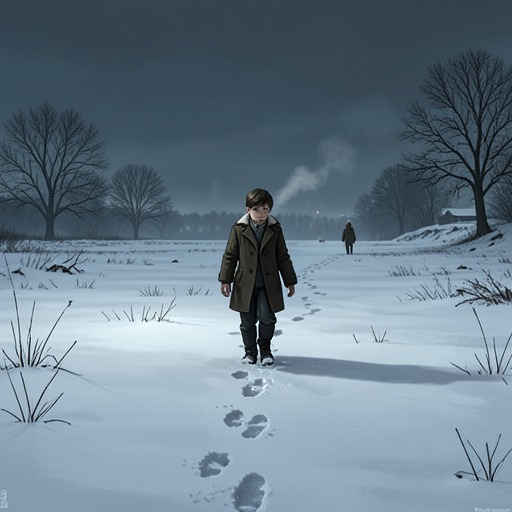
He continues through one street and then another, and then a third, repeatedly looking toward upper windows and roofs for a sign that someone is awake. At intervals he knocks, but no one comes to the door. The infant has awakened during the journey and sucks his cheek; she does not cry, believing him to be her mother. Her small, dependent presence accompanies the boy through streets that remain unresponsive. The scene thereby sets intimate care between the two children against the absence of care from the town around them.
The route nearly carries him into the lanes of Scrambridge, where cultivated plots and thorn hedges are more numerous than dwellings. Instead, he finds a passage near Trinity schools leading to the water’s edge. There is a roughly built quay with a parapet, and he makes out a bridge over the Wey. The bridge connects Weymouth with Melcombe Regis; beneath its arches, the Backwater joins the harbour. These features give the episode a definite geography: the boy is not simply wandering through anonymous darkness, but moving through a coastal town shaped by its river, harbour, and crossings.
Silence and its historical context
The passage emphasizes that the silence is not merely the boy’s impression. No voice answers, no step moves, and no candle is lit; at three o’clock the bells of the old belfry of St Nicholas sound, after which silence returns. The hour marks time passing without changing his prospects. In the narrative, the town is inhabited, yet the people remain out of reach.
The narrator supplies a historical explanation for the closed windows and doors. In January 1790, London had recently suffered a severe outbreak of plague, and fear of taking in sick vagabonds had reduced hospitality. Residents feared even opening windows in case they inhaled infection. That context explains the inhabitants’ conduct without making the boy’s experience less severe: public fear makes the refusal intelligible, but it still leaves two vulnerable children without assistance. Weymouth thus concentrates a conflict between self-protection and hospitality in a sequence of ordinary barriers: shut houses, dark windows, and unanswered knocks.
River crossing and narrative significance
Weymouth then stood as the suburb of Melcombe Regis, which was the city and port. The narrator reverses their later relationship: Melcombe Regis has since become a parish of Weymouth, as the village absorbed the city. The bridge is presented as the agent of that change, drawing population toward one bank at the expense of the other. This account turns the boy’s discovery of the bridge into more than a route description. It places his solitary movement within a landscape where crossings shape the growth and relation of communities, even as this particular child finds no welcome in the streets he crosses.
The town’s narrative role is defined by that contradiction. The boy has left the open country and believes he is approaching safety among living creatures; instead, the inhabited place becomes another desert, now made by human silence rather than distance or weather. Yet Weymouth is also where he is received into a poor caravan. The place therefore holds both abandonment and the beginning of shelter: first the closed town through which the children pass, then the setting in which the boy enters the itinerant life that will carry him toward his later identity as Gwynplaine.