Winter of 1689–1690
The Man Who LaughsWinter of 1689–1690 refers to the bitter months of December 1689 and January 1690, whose exceptional cold forms the opening historical and environmental frame of the novel. The frozen Thames turns a rarely frozen river into a public thoroughfare and fairground, while records of people dead from hunger and cold give the season a stark social cost. The period also introduces the novel’s recurring tension between observed natural forces and attempts to explain what remains beyond human understanding.
The winter and its human cost
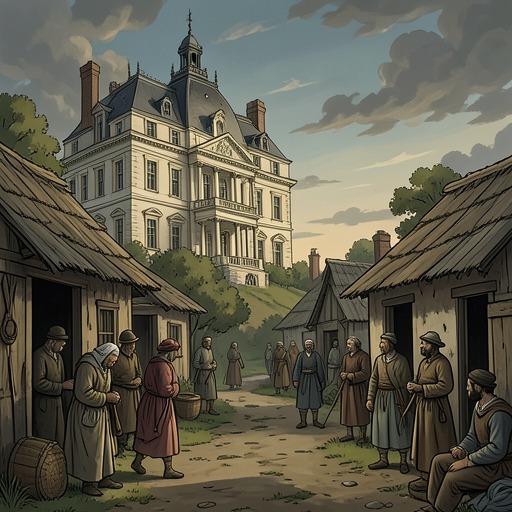
An obstinate north wind blew over continental Europe and more fiercely over England throughout December 1689 and January 1690. The resulting cold made the winter memorable for its suffering among the poor. Lists of people found dead from famine and exposure survived in local records, including those of Southwark and other courts. The season is thus presented not merely as extreme weather but as a crisis whose burdens fell visibly on people with few protections.
The Thames froze despite the sea’s influence, which normally makes ice formation difficult. Coaches crossed the river, and a fair—with booths and animal baiting—was held on its surface; an ox was roasted whole there. The ice persisted for two months. These scenes set public spectacle beside hardship: the frozen river became a temporary venue for ordinary travel and festivity even as the same winter was remembered for deaths among the poor.
The sea as an uncertain force
The cold season also supplies the setting for the novel’s treatment of maritime danger. On an evening near the end of a bitter January day, a small vessel lay moored close to a cliff in a creek on the Portland coast. The inlet was dangerous in certain winds and, for that reason, isolated enough to serve ships seeking concealment. The distinction between daylight above the cliff and darkness below it gives the scene a sharply divided setting, while the vessel’s position places the winter sea at the threshold of the unfolding story.
A later account of the snowstorm treats it as a phenomenon that combines fog and storm and resists easy explanation. The narrator distinguishes visible impulses, such as wind and waves, from an invisible current called effluvium, and proposes magnetic forces as part of an explanation for the storm and the irregular movement of ocean swells. These are presented as the novel’s speculative natural philosophy, not as settled modern meteorology. The account’s emphasis on incomplete knowledge makes the winter sea more than a backdrop: it is a force whose apparent surface does not disclose all that governs it.
Observation, theory, and authority
The winter’s weather is described through a mixture of historical observation and explanatory conjecture. The narrative invokes changes in wind speed and wave height, then turns to questions about why swells vary across different oceans and regions. It imagines navigation becoming safer if captains studied meteorology and pilots chemistry, while acknowledging how difficult and uncertain such knowledge remains. The passage therefore holds scientific aspiration and epistemic limitation together: closer study might avert some catastrophes, but the sea is not reduced to a fully mastered object.
This interest in competing explanations recurs in later scenes of learned argument. In a public address, Ursus presents himself as both a seller of remedies and ideas, claiming to correct popular errors while acknowledging that knowledge and folly may enter through the same open ear. Elsewhere, a theologian challenges his classification of orpiment as an arsenic product and a poison by appealing to the Bible; Ursus answers that scripture denies what arsenic affirms. These exchanges are not identified as taking place during the winter months. Their relevance lies instead in the book’s wider pattern: claims about nature, authority, and the limits of explanation remain in contention beyond the opening season.
Narrative significance
Winter of 1689–1690 establishes a world in which natural severity and social vulnerability meet. The frozen Thames is at once a remarkable physical condition, a setting for public activity, and a measure of how unusual the cold has become; the lists of the dead prevent that spectacle from becoming merely picturesque. The winter sea extends the same contrast between what can be observed and what remains hidden, introducing the novel’s sustained attention to danger, uncertainty, and the human effort to interpret forces that may exceed human control.