the blind girl
The Man Who LaughsThe blind girl, whom Ursus names Dea, is the foundling Gwynplaine rescues as a child and the person who sees him most truly. Blind since infancy, she depends on his guidance, yet understands his character more clearly than the sighted crowd does. Their companionship gives the novel a counter-image to public spectacle: where observers encounter Gwynplaine’s fixed grin, Dea recognizes the care and courage beneath it.
Identity and Origins
By 1705, Dea is sixteen, a tall, delicate young woman with brown hair and striking eyes. The winter disaster that killed her mother also left her blind; her condition is described as permanent. Her eyes appear bright to other people, although she cannot see with them. The contrast between their visible light and her darkness becomes part of the narration’s account of her inward perception, not a sign that her blindness has been cured.
Ursus gives her the name Dea, meaning goddess, as part of an imaginative ordering of the small household. After consulting his wolf, he assigns the foundling a place representing the divine, alongside himself as human and the wolf as animal. The naming makes her more than an object of pity within the group: she is its emblem of spiritual possibility. Gwynplaine, by contrast, already knows the name by which he is called, and Ursus accepts it. Their different beginnings thus converge in the same adopted family.
Gwynplaine’s Rescue and Her Knowledge of It
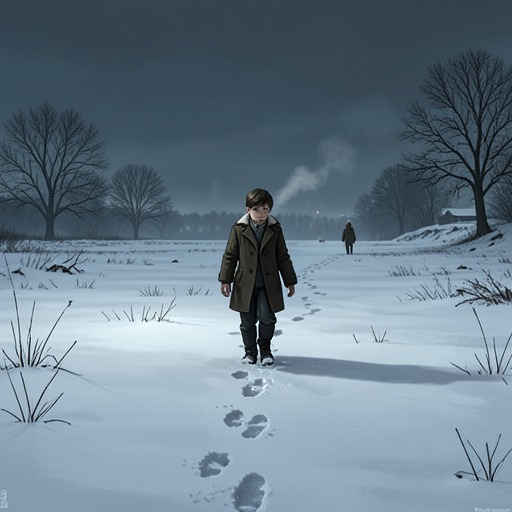
Dea learns from Ursus how Gwynplaine found her. He had been abandoned by the gang that had taken him from his home and was making his way from Portland to Weymouth when he heard her cry. Though himself a child without shelter or security, he took her from the snow, gave her his clothing for warmth, and tried to provide food and drink. His rescue of Dea was an act of care undertaken while he was himself in severe need.
Ursus’s account gives Dea the history behind the protection she experiences as a young woman. She understands that Gwynplaine, having been cast off, nevertheless responded to another child’s abandonment by taking responsibility for her. Her knowledge is not based on his appearance or on public reputation, but on the actions that began their life together. To her, the child who saved her has become the dependable companion who supports her weakness and guides her through a world she cannot see.
Companionship and Performance
Dea assists Gwynplaine in his performances. The pair are presented as wanderers whose lives have been marked by different forms of darkness: blindness in her case, and the appearance that separates him from other people in his. This parallel does not make their experiences identical. Gwynplaine can compare himself with the sighted crowd and is confronted by its response to his face; Dea cannot see that response, but knows his conduct through their daily bond.
In the interlude called “Chaos Vanquished,” Dea’s role becomes central to the action. In the staged darkness, a man is overwhelmed by a wolf and a bear, representing the forces of nature. After the struggle falls silent, Dea appears in a vision of light and sings. Her entrance gives Gwynplaine the impulse to rise and defeat the beasts. The performance turns her into a visible figure within the spectacle, while the story itself makes her blindness and her capacity to understand him essential to its meaning.
Sight, Recognition, and Public Judgment
The crowd treats Gwynplaine as a comic performer and reacts to the expression fixed on his face. People laugh when they see him, then turn away; women in particular shrink from looking at him. His appearance governs their first response, while Dea’s understanding comes from the story of his rescue and from his continued care for her. She regards him as savior, comforter, guide, and support. The contrast is not simply between sight and blindness: it is between judging a person by what can be seen and recognizing what his actions reveal.
The novel presents Dea’s blindness as a real and enduring condition, while also giving it a symbolic dimension. Her inability to see the external world does not mean that she is without knowledge; she perceives Gwynplaine’s devotion with confidence. At the same time, her reliance on him is concrete: his hand guides her through the difficulties of blindness, and his presence steadies her sense of safety. The relationship therefore joins spiritual insight to practical care rather than reducing their bond to metaphor alone.
Narrative Significance
Dea’s recognition of Gwynplaine prepares the contrast with his public identity. In the House of Lords, he describes his imposed smile as a sign of suffering and presents himself as a figure through whom the people’s condition can be understood. Dea’s earlier response supplies a personal counterpart to that political claim: she has never confused his outward grin with his inward feeling. The public sees the face and laughs; she knows the person who rescued her and continues to care for her.
Her place in the story is consequently both intimate and structural. She is the child Gwynplaine saves, the companion who shares his wandering life, and a performer whose appearance in “Chaos Vanquished” changes the action onstage. Most importantly, she embodies a kind of recognition unavailable to the crowd. Her blindness does not grant her supernatural sight; the narrative uses the difference between what others see and what she knows to expose the limits of appearance-based judgment, while grounding her insight in Gwynplaine’s sustained acts of kindness.