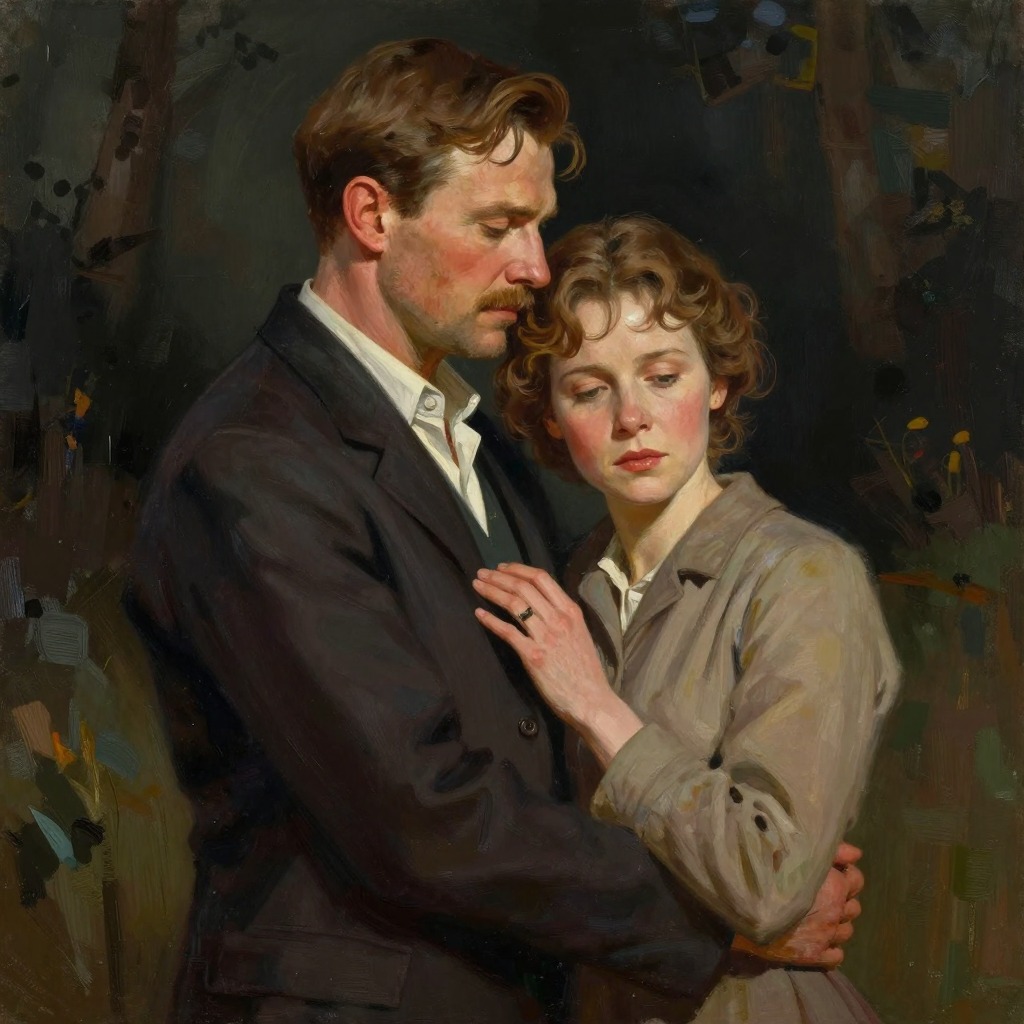
Frank Frink and Juliana Frink
The Man in the High CastleFrank Frink and Juliana Frink are a divorced couple whose fractured relationship forms a crucial emotional and thematic core of the novel. Frank, a Jewish man living under Japanese occupation in San Francisco, remains deeply in love with his ex-wife, while Juliana, a judo instructor in Canon City, Colorado, has embarked on a restless and perilous journey of her own. Their separation is not merely a personal tragedy but a lens through which the novel examines themes of loss, identity, and the search for meaning in a world shaped by totalitarian defeat.
Identity and Background
Frank Frink, originally Frank Fink, was born in New York and drafted into the U.S. Army in 1941 after the collapse of Russia. After the war ended, he found himself on the Japanese side of the settlement line, where he has remained for fifteen years. He is a Jew, a fact that places him in constant danger, as he reflects that leaving Japanese-controlled territory for the Reich would mean death. Juliana Frink is described as the best-looking woman Frank ever married, with soot-black eyebrows and hair, trace amounts of Spanish blood, and a distinctive, screwball expression that drew him to her. She wore dilapidated clothes and had a plantlike, silent way of coming and going that both annoyed and fascinated him. Their marriage was marked by poverty and conflict, and Juliana divorced Frank a year before the novel's present.
Arc Through the Plot
Frank's narrative arc is dominated by his longing for Juliana and his attempts to improve his life in the hope of winning her back. After being fired from his job at W-M Corporation for speaking out of line, he consults the I Ching, asking, "Will I ever see Juliana again?" The oracle gives him Hexagram Forty-Four, "Coming to Meet," with the sobering judgment that "the maiden is powerful" and "one should not marry such a maiden." Despite this, Frank cannot get over having lost her, seeing her as a direct invention of God dropped into his life for reasons he will never know. His subsequent partnership with Ed McCarthy in Edfrank Custom Jewelry is partly motivated by the desire to become a man who matters, someone Juliana would want to be with. He fantasizes about sending her pieces of their jewelry to fire her imagination and get her interested. Juliana's arc, meanwhile, takes her away from Frank entirely. She is living in Canon City, working as a judo instructor, and feeling a sense of purposelessness. She encounters Joe Cinnadella, a truck driver who is actually a Nazi assassin, and becomes entangled in his plot to kill Hawthorne Abendsen, the author of The Grasshopper Lies Heavy. Her journey with Joe is marked by fear, manipulation, and a growing awareness of his true nature, culminating in her slashing his throat in a Denver hotel room to prevent him from carrying out his mission.
Relationships and Conflict
The central conflict of their relationship is Frank's perceived inadequacy and Juliana's need for a man who matters. Frank believes that Juliana deserves to be married to an important person, and he sees his new business venture as a way to achieve that for her. He thinks, "No wonder she roams around from place to place, from man to man, seeking. And not even knowing what it is herself, what her biology needs. But I know, and through this big-time action with McCarthy—whatever it is—I'm going to achieve it for her." Juliana, however, is drawn to Joe Cinnadella, a man who embodies danger and a kind of brutal idealism, even as she recognizes his hatred of life. Her relationship with Joe is a dark mirror of her marriage to Frank, testing her capacity for self-defense and moral choice. When Joe threatens to kill her if she does not cooperate, she thinks of Frank, crying out, "Frank, she thought. Help me. I'm in something I don't understand." This moment reveals that despite their separation, Frank remains a touchstone for her in moments of crisis.
Change and Ending
The relationship undergoes a profound transformation through Juliana's violent act and her subsequent journey to Cheyenne. After killing Joe, she feels a sense of liberation and clarity. She tries to call Frank from a motel, but he does not answer. Later, when Caroline Abendsen asks where she is going, Juliana says, "Maybe I'll go back to my husband, Frank. I tried to phone him tonight; I might try again. I'll see how I feel later on." This tentative statement suggests a potential for reconciliation, but it is left unresolved. Frank, meanwhile, experiences his own transformation. After being arrested and nearly extradited to Germany for being a Jew, he is miraculously released. He returns to the workshop and resumes making jewelry, determined to keep busy and not think. The novel ends with both characters in a state of limbo, their future together uncertain but not impossible.
Thematic Significance
The relationship between Frank and Juliana Frink embodies the novel's exploration of love, loss, and the search for authenticity in a world of political oppression and moral ambiguity. Frank's love for Juliana is a constant, even as he is powerless to change their circumstances. His use of the I Ching to understand their relationship reflects a broader theme of seeking wisdom in a chaotic world. Juliana's journey, on the other hand, represents a more active, if dangerous, pursuit of meaning. Her final act of violence and her subsequent visit to Abendsen suggest a capacity for decisive action and a desire for truth that contrasts with Frank's more passive longing. Their story, ultimately, is one of two people shaped by the same traumatic history—the war, the occupation, the threat of genocide—who are trying to find their way back to each other and to themselves.