Frank Frink's Arrest
The Man in the High CastleFrank Frink's Arrest marks the moment when the novel's diffuse threats of racial persecution crystallize into direct, personal danger for one of its central characters. A Jewish man living under Japanese occupation in the Pacific States of America, Frink has spent years trying to survive by concealing his identity and working as a skilled metalworker. His arrest, ostensibly for a minor fraud complaint, rapidly transforms into a terrifying exposure of his true name and heritage, threatening him with deportation to the German Reich and almost certain death. The event lays bare the fragility of his carefully constructed life and the reach of Nazi racial law even into Japanese-administered territory, making it a turning point in his personal narrative and a stark illustration of the novel's alternate-world power structures.
The Arrest and Its Immediate Cause
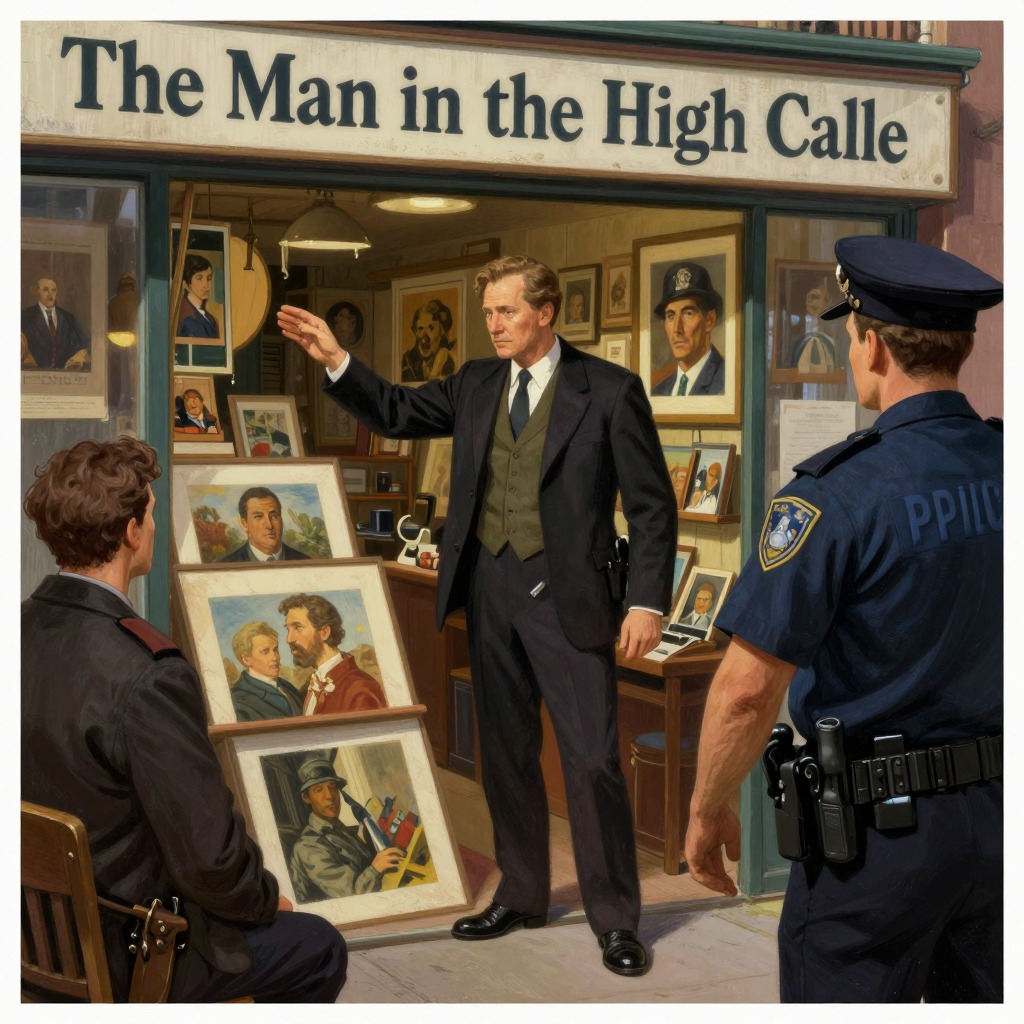
The arrest occurs without warning as Frank Frink stands outside his basement workshop, smoking a marijuana cigarette and reflecting on the failure of his new jewelry business with Ed McCarthy. An ordinary-looking, middle-aged white man approaches him, identifies himself as being with the San Francisco Police Department, and produces a warrant for Frink's arrest on charges of bunco. The complaint originates from Robert Childan of American Artistic Handcrafts Inc., the store where Frink's partner Ed McCarthy had recently left a large consignment of their handmade jewelry. The police officer immediately takes hold of Frink's arm, and a second plainclothes cop joins them, one on each side, as they hustle him toward a parked unmarked Toyopet. Frink is dumped onto the car seat between the two cops, with a third officer in uniform driving, and the car shoots out into traffic. The suddenness and efficiency of the arrest leave Frink no time to resist or even fully comprehend what is happening.
The Revelation of Identity and the Threat of Deportation
The arrest takes a far more sinister turn when the police begin questioning Frink about his identity. One of the cops asks if his real name is Fink, and when Frink feels terror, the cop repeats the name and declares, "You're a kike," exhibiting a large gray folder and labeling him a "Refugee from Europe." Frink protests that he was born in New York, but the cop responds, "You're an escapee from the Nazis," and asks if he knows what that means. Overcome by fear, Frink breaks away and runs across the garage, only to find himself facing a police car with uniformed armed police blocking his path. The police smile at him, and one of them, holding a gun, steps out and smacks a handcuff into place over his wrist. Jerking him by the wrist, the thin metal cutting into his flesh to the bone, the cop leads him back. As they take him upstairs, one of the cops says they will hold him for the German consul, who wants to try him under German law. Frink's protest that he is an American is met with the chilling response, "You're a Jew." The promise of a list of attorneys evaporates, and Frink realizes the full scope of his danger: he is to be handed over to the German authorities, who will likely send him to Germany for extermination.
The Context of Frink's Vulnerability
Frink's arrest is the culmination of a lifetime of precarious existence in a world where his Jewish identity is a death sentence. Born Frank Fink in New York, he was drafted into the Army of the United States of America in 1941 after the collapse of Russia, and after the Japanese took Hawaii, he was sent to the West Coast. When the war ended, he found himself on the Japanese side of the settlement line, and fifteen years later, he is still there, having changed his name to Frink in an attempt to hide his heritage. His earlier reflections reveal his deep awareness of the danger: he knows that leaving Japanese-controlled land and showing up in the South or in Europe would mean death, as the Reich's racial laws would target him. He has also contemplated the horrors of the Nazi regime, including the genocide in Africa, and the fact that the Germans have camps in New York where they gas people. His arrest thus activates a fear he has carried with him for years, the fear that his carefully maintained cover could be stripped away at any moment, exposing him to the machinery of Nazi persecution.
The Role of Robert Childan and the System of Racial Law
The arrest is directly connected to Robert Childan, the dealer who had earlier been visited by a man posing as Admiral Harusha's gentleman, who exposed a Colt .44 revolver as a fake. Childan, humiliated and fearing for his reputation, had signed a paper for the Kempeitai identifying the man as Frank Frink, born Frank Fink, and confirming that he was a Jew. The Kempeitai, the Japanese occupation police, had investigated the incident and identified Frink as the perpetrator of a racket. Childan's signature on the paper, which he gave without fully understanding its implications, set in motion the machinery that led to Frink's arrest. The arrest itself is carried out by the San Francisco Police Department, a pinoc institution under the Sacramento puppet government, but the ultimate authority is the German consul, who claims jurisdiction over Frink under Reichs law, retroactive to June 1960. This demonstrates how the Nazi racial laws extend their reach even into Japanese-controlled territory, and how the local authorities, both Japanese and American, are complicit in enforcing them.
The Aftermath and Frink's Release
Frink's arrest ends as abruptly as it began. That evening, just after the dinner meal, a police officer comes to his cell, unlocks the door, and tells him to pick up his possessions at the desk. He is released without explanation, given back his sack of clothes, wallet, watch, glasses, and personal articles, and turned out onto the sidewalk before the Kearny Street Station. Frink is stunned, unable to believe either the arrest or the release, and he reflects that by rights he should be on a plane heading for Germany, for extermination. He wanders through the darkening city, struggling to comprehend what has happened, and eventually makes his way back to the basement workshop where Ed McCarthy is eating his dinner. Ed, who had assumed Frink was dead, greets him with a simple "Good to see you back," and Frink, without explanation, collects a handful of half-completed silver segments and begins working at the arbor, removing fire scale from the pieces. The release is a miracle, a fluke, but Frink knows he will never understand why it happened, and he is left to simply be glad and keep moving, returning to the fixed, comprehensible work of making jewelry.
The Significance of the Arrest in the Novel's Structure
The arrest of Frank Frink is a crucial narrative event that exposes the brutal realities of the novel's alternate world. It demonstrates how the Nazi racial laws operate even in Japanese-controlled territory, and how the local authorities, both Japanese and American, are complicit in enforcing them. The event also highlights the precariousness of Frink's existence as a Jew, and the constant fear he lives with despite his attempts to conceal his identity. The arrest is a direct consequence of Robert Childan's earlier encounter with the fake admiral's gentleman, and it shows how the system of racial law can be triggered by the most mundane of circumstances, a complaint about a fraudulent sale. Frink's release, which is never explained, is a reminder of the arbitrary nature of power in this world, and it leaves him, and the reader, with a sense of profound uncertainty. The event also serves to deepen Frink's character, revealing his vulnerability and his resilience, and it sets the stage for his continued struggle to survive in a world that is fundamentally hostile to his very existence.