Reichs law
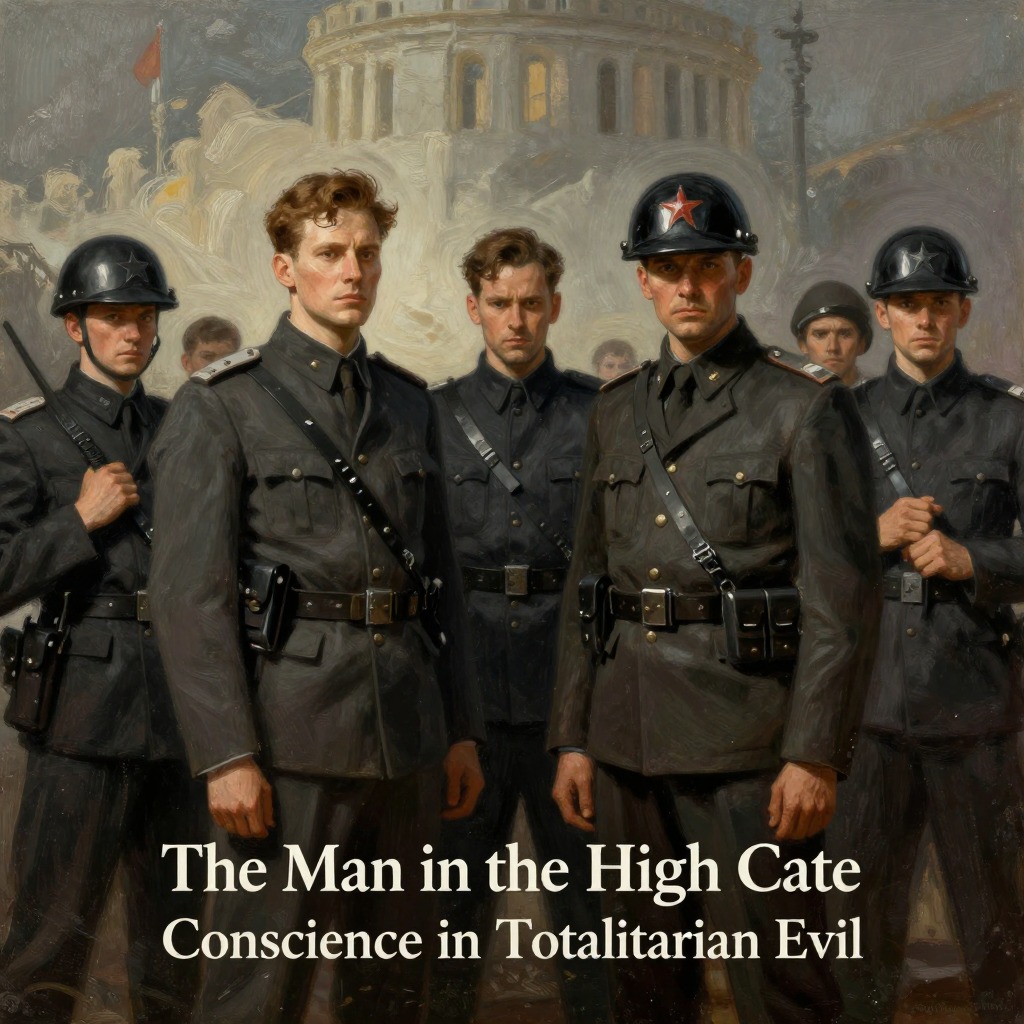
The Man in the High CastleReichs law is the legal order of the German Reich, a system of racial and political statutes that extends its reach across the globe, even into the Japanese-dominated Pacific States of America. In the world of the novel, it is a brutal instrument of control, defining who is a citizen, who is a criminal, and who is to be exterminated. It is the legal foundation for the Holocaust, the African genocide, and the suppression of all dissent, and it operates with a chilling efficiency that transcends national borders, as seen when the San Francisco police hold Frank Frink for the German consul under Reichs law, and when the SD attempts to seize Rudolf Wegener on the grounds that he is a German national subject to Reichs jurisdiction.
The Reach of Reichs Law into the Pacific States
Reichs law is not confined to the German homeland; it is a global force that follows German nationals and their designated enemies wherever they go. In San Francisco, the German consul, Hugo Reiss, is the local representative of this legal order, and he is prepared to invoke it to extradite Frank Frink, a Jew, back to Germany for 'protective custody' under Reichs law. The novel makes clear that this is not an abstract legal principle but a death sentence: Frink, who was born in New York and is an American citizen, is told by the police that he will be held for the German consul, who wants to try him under German law, and that he will be sent to an extermination camp. The reach of Reichs law is so pervasive that even in the Pacific States, where the Japanese are the nominal rulers, the local police cooperate with the German authorities in enforcing it, demonstrating the power of the Reich's legal machinery to operate extraterritorially.
The Racial Basis of Reichs Law
At its core, Reichs law is a racial law, designed to preserve the purity of the Aryan race and to eliminate those deemed inferior or threatening. The novel repeatedly shows how this legal system is used to target Jews, who are stripped of their citizenship and subjected to arbitrary arrest and deportation. When Frank Frink is arrested, the police immediately identify him as a Jew, using his original name, Fink, as evidence, and they taunt him with the prospect of being sent 'back to Germany' for extermination. The law is also used to justify the murder of millions in Africa, where the Nazis have implemented the 'Final Solution of the African Problem,' and to enforce the Nuremberg Law in the United States, which stripped Jews of their rights and led to their expulsion from New York. Reichs law is thus not a neutral system of justice but a weapon of racial warfare, and its application in the novel reveals the deep-seated racism that underpins the Nazi regime.
Reichs Law and the SD's Authority
The Sicherheitsdienst (SD), the Nazi security police, operates under the authority of Reichs law, and it uses this legal framework to pursue its enemies, including Rudolf Wegener, an Abwehr agent who has defected to warn the Japanese about Operation Dandelion. When the SD chief, Bruno Kreuz vom Meere, plans to seize Wegener, he insists that Wegener is a German national and therefore subject to Reichs law, regardless of his presence in Japanese territory. The SD's actions are not merely extrajudicial; they are presented as legally sanctioned, with the consul, Hugo Reiss, writing out an authorization for Wegener's forcible return to the Reich. This episode illustrates how Reichs law can be manipulated to serve the interests of the police state, and it highlights the tension between the SD and the Foreign Office, as Reiss resents being overridden by the SD's direct appeal to the Chancery. The law is thus a tool of power, and its interpretation is contested among the Nazi factions.
The Limits of Reichs Law: Japanese Resistance
Despite its power, Reichs law is not absolute, and the novel shows moments of resistance, particularly from the Japanese. When the SD attempts to raid the Nippon Times Building to capture Wegener, Mr. Tagomi, a ranking official of the Trade Mission, refuses to cooperate and instead shoots the SD men, declaring that he will not be bound by Reichs law. Later, when the German consul presents a form requesting the remand of Frank Frink under Reichs law, Mr. Tagomi scribbles 'Release' on the document, invoking the authority of the Ranking Trade Mission and Military Protocol 1947. This act of defiance saves Frink's life and demonstrates that Reichs law, while formidable, can be challenged by those who hold power in the Pacific States. The novel thus suggests that the legal order of the Reich is not monolithic, and that its enforcement depends on the cooperation of local authorities, which can be withheld.
The Moral Horror of Reichs Law
The novel portrays Reichs law as a source of profound moral horror, a system that dehumanizes its victims and corrupts those who enforce it. Mr. Tagomi, after being forced to kill the SD men, is haunted by the violence he has committed, and he reflects on the nature of evil in the world. He tells the German consul that his nation is 'about to descend into greater vileness than ever,' and he quotes the hexagram The Abyss, expressing his heart sickness at the coming bloodbath. The law, which is supposed to uphold justice, is shown to be a tool of mass murder, and the novel suggests that those who live under it are complicit in its crimes, whether they are willing or not. The character of Hugo Reiss, who reads The Grasshopper Lies Heavy and is moved by its depiction of a world where the Allies won, reveals the moral confusion of even those who serve the Reich, as he recognizes the grandeur of the fictional Allied victory and the emptiness of his own world. Reichs law, in this context, is not just a legal system but a symptom of a diseased civilization, one that has lost its moral compass and embraced evil as a matter of policy.