The Arousing
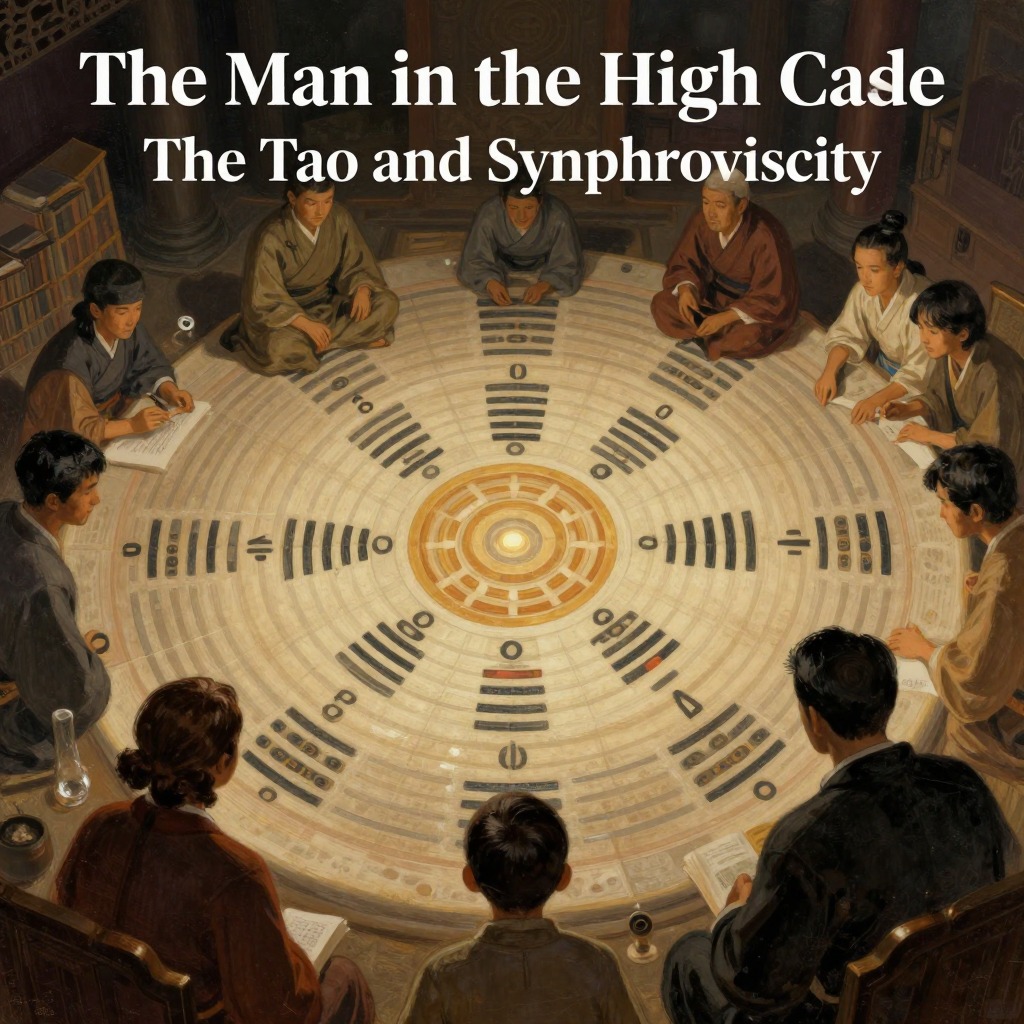
The Man in the High CastleThe Arousing (Hexagram Fifty-one) is one of the most dramatic and unsettling figures in the I Ching, the ancient Chinese oracle that permeates Philip K. Dick's novel. In the book's cosmology, the hexagram represents thunder and lightning, the sudden shock that rouses the world from complacency. Its appearance in the narrative is never casual: it signals a rupture in the ordinary flow of events, a moment when the hidden forces of the universe break through the surface of daily life. For Nobusuke Tagomi, the ranking official of the Pacific Trade Mission in San Francisco, the Arousing arrives at a moment of profound personal and political upheaval, and its meaning reverberates through the rest of his story.
The Oracle and Its First Appearance
The Arousing first surfaces in the novel during a quiet evening conversation between Tagomi and Mr. Baynes, the Swedish businessman who is secretly a German spy. As Tagomi serves tea and muses on the nature of the oracle, he murmurs, "'God speaks to man in the sign of the Arousing.'" The remark is almost an aside, a fragment of his habitual woolgathering, but it carries a weight that the reader only later understands. Tagomi is a man who lives by the I Ching, consulting it for guidance on business dealings and personal dilemmas alike. His invocation of the Arousing here is not a formal consultation but a spontaneous expression of his worldview—a belief that the divine communicates through the patterns of the hexagrams. The moment is charged with dramatic irony: Baynes, who is actually Rudolf Wegener, a captain in the Abwehr, has come to San Francisco to deliver a warning about a Nazi plot, and the Arousing's thunder is about to strike.
The Shock of Revelation
The hexagram's full significance emerges in Chapter 12, when Tagomi, driven by a deep sense of urgency, consults the oracle at dawn. He rises from bed, skips his usual routine, and goes directly to the yarrow stalks, working at a feverish pace until the six lines lie before him. The result is Hexagram Fifty-one, and the text's description of the Arousing is visceral: "God appears in the sign of the Arousing. Thunder and lightning. Sounds—he involuntarily put his fingers up to cover his ears. Ha-ha! Ho-ho! Great burst that made him wince and blink. Lizard scurries and tiger roars, and out comes God Himself!" The passage captures the hexagram's essence—a sudden, overwhelming force that disrupts all normalcy. Tagomi's body reacts before his mind can: his heart pounds, his throat tightens, his bowels loosen, all the autonomic responses to crisis surge through him. Yet there is nothing to see, no visible danger, only the premonition of something immense about to happen. The oracle has prepared him for a shock, and the shock arrives almost immediately: the telephone rings, and a faint, dry voice announces, "This is Shinjiro Yatabe. I have arrived in San Francisco." The name is a cover for General Tedeki, the former Imperial Chief of Staff, and his arrival sets in motion the meeting that will reveal Operation Dandelion—the Nazi plan to launch a nuclear attack on Japan.
The Arousing as a Turning Point
The Arousing functions as a narrative hinge, marking the transition from the novel's diffuse, character-driven opening to its climactic political confrontation. Before the hexagram appears, Tagomi is a minor figure, a fussy bureaucrat worried about pleasing his client and navigating the delicate etiquette of Japanese-American relations. After it, he is thrust into the center of a conspiracy that could determine the fate of nations. The shock of the Arousing is not merely personal; it is cosmic. The hexagram's thunder echoes the thunder of the SD raid on the Nippon Times Building, when Tagomi is forced to shoot and kill two German agents to protect Wegener and Tedeki. The violence of that moment—the jaw of one man bursting, the blood and bone flying—is the literal manifestation of the Arousing's destructive power. Tagomi, a man who has never killed before, is shattered by the act, and his subsequent breakdown, his heart attack, and his desperate attempt to find meaning in a silver triangle of jewelry all stem from this rupture. The Arousing, in this sense, is not just a hexagram but a force that unmakes and remakes the world.
The Arousing and the Novel's Themes
The Arousing resonates with the novel's broader meditation on history, chance, and the possibility of change. In a world where the Axis powers have won World War II, where the United States is divided into Japanese and German spheres of influence, and where the future seems fixed by the victors' designs, the Arousing represents the potential for sudden, unpredictable transformation. The hexagram's thunder is the sound of the status quo being shattered, whether by the death of a chancellor, the arrival of a spy, or the revelation of a secret plot. For Tagomi, the Arousing is a call to awaken from the comfortable illusions of his daily life—the rituals of business, the etiquette of place, the careful maintenance of face. It forces him to confront the evil that lurks beneath the surface of the world, the "madmen in power" that Wegener muses about on the Lufthansa flight. The Arousing, in this light, is the novel's own gesture toward the possibility of a different world, one where the Allies might have won, where the oracle might write a book that tells the truth. It is a moment of pure potential, a crack in the edifice of reality through which the light of another history shines.
The Arousing, then, is more than a divinatory symbol; it is a structural principle of the novel. It appears at the moment of greatest tension, when the hidden forces of the plot are about to break into the open, and it leaves its mark on every character it touches. Tagomi's consultation of the hexagram is a turning point not only for him but for the entire narrative, a moment when the thunder of the oracle and the thunder of history become one.