The Fake Admiral Incident
The Man in the High CastleThe Fake Admiral Incident is a turning point in the novel, a carefully staged fraud that shatters Robert Childan's confidence in his trade and exposes the fragile foundation of the entire Americana market. A stranger, claiming to represent a Japanese admiral, enters Childan's store and, with devastating precision, identifies a prized Colt .44 revolver as a fake, causing a fifteen-thousand-dollar sale to evaporate and plunging Childan into a crisis of authenticity that will ultimately implicate Frank Frink and reveal the hidden machinery of the forgery industry.
The Impostor's Visit
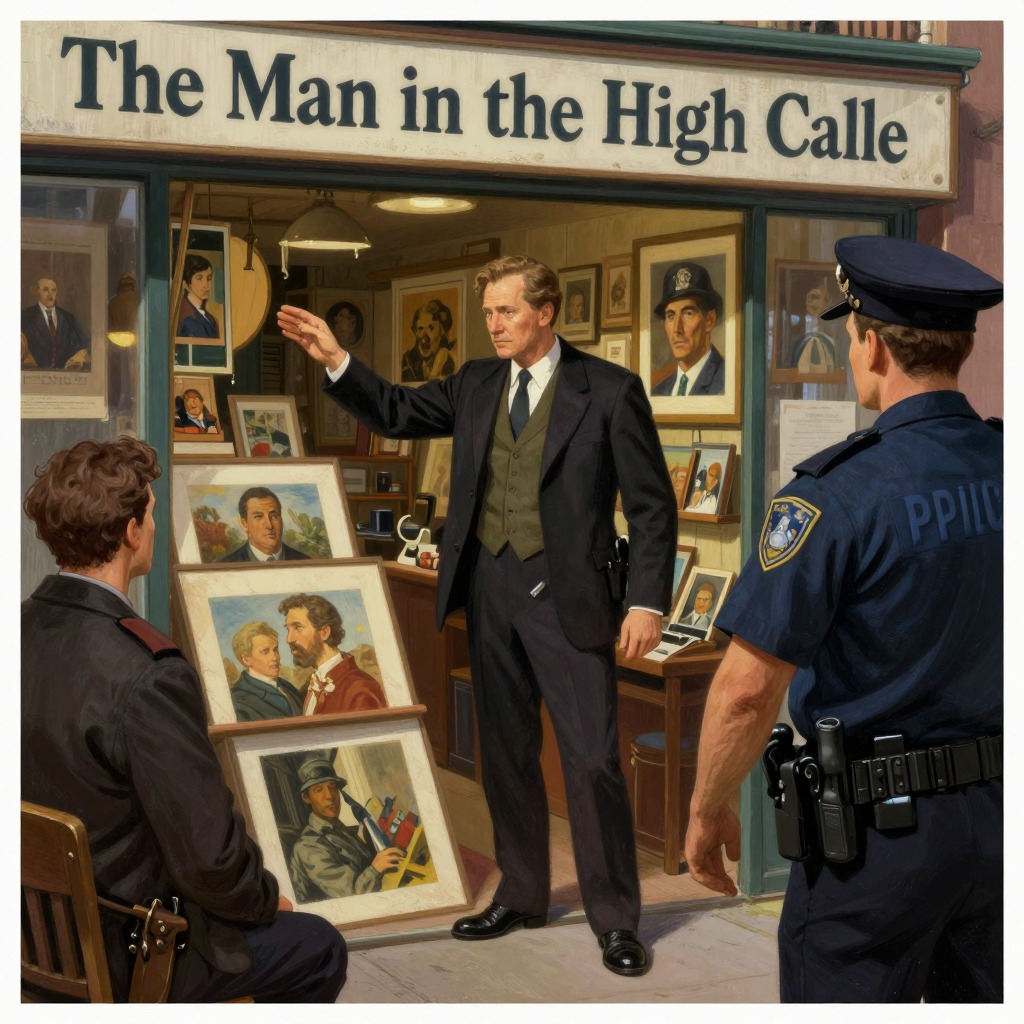
The incident begins when a slender, well-dressed white man enters American Artistic Handcrafts Inc. and presents a card bearing the Imperial emblem and military insignia of the Navy, identifying himself as the gentleman of Admiral Harusha, whose carrier, the Syokaku, lies in San Francisco Bay. The man explains that the admiral, a lover of the arts, wishes to present each of his twelve officers a valuable historic side arm from the American Civil War, a request that promises a sale of almost ten thousand dollars. Childan, his mind racing, brings out a Colt .44 of 1860, which he describes as having been issued to the U.S. Army and carried into battles such as Second Bull Run. The impostor examines the gun at length, then calmly declares, "Sir, this is an imitation," pointing to wood artificially aged by acid and noting that the piece is no older than six months. Childan, stunned, protests that it cannot be, but the man insists, advising him to hire an expert and, with a bow, departs, leaving Childan holding the gun and contemplating suicide.
The University Test and the Revelation
After the impostor leaves, Childan, desperate to verify the claim, sends the gun to the University of California Penology Department for analysis. The lab report confirms the worst: the revolver is a reproduction cast from plastic molds, with serial numbers all wrong, the frame not casehardened by the cyanide process, and the surfaces artificially aged by a modern quick-acting technique. The technician notes that the work was done by a real pro and that there is a regular industry turning out such fakes. Childan, his voice breaking, insists that such forgeries are only a rumor, but he is shaken to his core. He then traces the gun to Ray Calvin Associates, a major wholesale supplier, and confronts Ray Calvin, demanding restitution and threatening to ruin his reputation if he does not cooperate. Calvin, in turn, calls Wyndam-Matson, the owner of W-M Corporation, revealing that the fake Colt .44 came from his factory, and Wyndam-Matson, realizing that Frank Frink and Ed McCarthy are behind the exposure, begins to plot his revenge.
The Aftermath and the Kempeitai
The incident does not end with the gun. Childan, still reeling, later receives a visit from a Kempeitai officer, a pinoc employee of the Sacramento puppet government, who shows him a photo of the impostor, identified as Frank Frink, born Frank Fink, a Jew. Childan, recognizing him, signs a paper stating that Frink tried to swindle him, and the officer departs, leaving Childan with a sense of relief and a belief that the law protects him from such "subtleties." The incident also haunts Childan's thoughts, leading him to reflect on the nature of authenticity and the possibility that his entire stock might be compromised. He begins to have more pieces examined by the lab, and the fear of exposure grows, eventually prompting him to consider diversifying into contemporary, non-historic objects, a decision that will lead him to embrace the Edfrank jewelry and its concept of wu.
The Broader Implications
The Fake Admiral Incident is not merely a personal setback for Childan; it exposes the systemic fraud at the heart of the Americana trade. Wyndam-Matson, in a conversation with his mistress Rita, defends the forgery business by dismissing the concept of historicity, arguing that authenticity is a mental construct, not an intrinsic property of objects. He demonstrates this with two Zippo lighters, one of which supposedly belonged to Franklin D. Roosevelt, and claims that the only difference is a paper of authenticity. This cynical philosophy, which reduces history to a racket, is the same logic that allowed the fake Colt .44 to enter the market. The incident also foreshadows the fate of Frank Frink, who, though innocent of the specific fraud, is arrested for bunco based on Childan's testimony, and is nearly deported to Germany as a Jew before being released through the intervention of Nobusuke Tagomi. The event thus serves as a catalyst, exposing the precariousness of the characters' lives and the moral ambiguity of a world built on lies.