The wall falls back into the moat
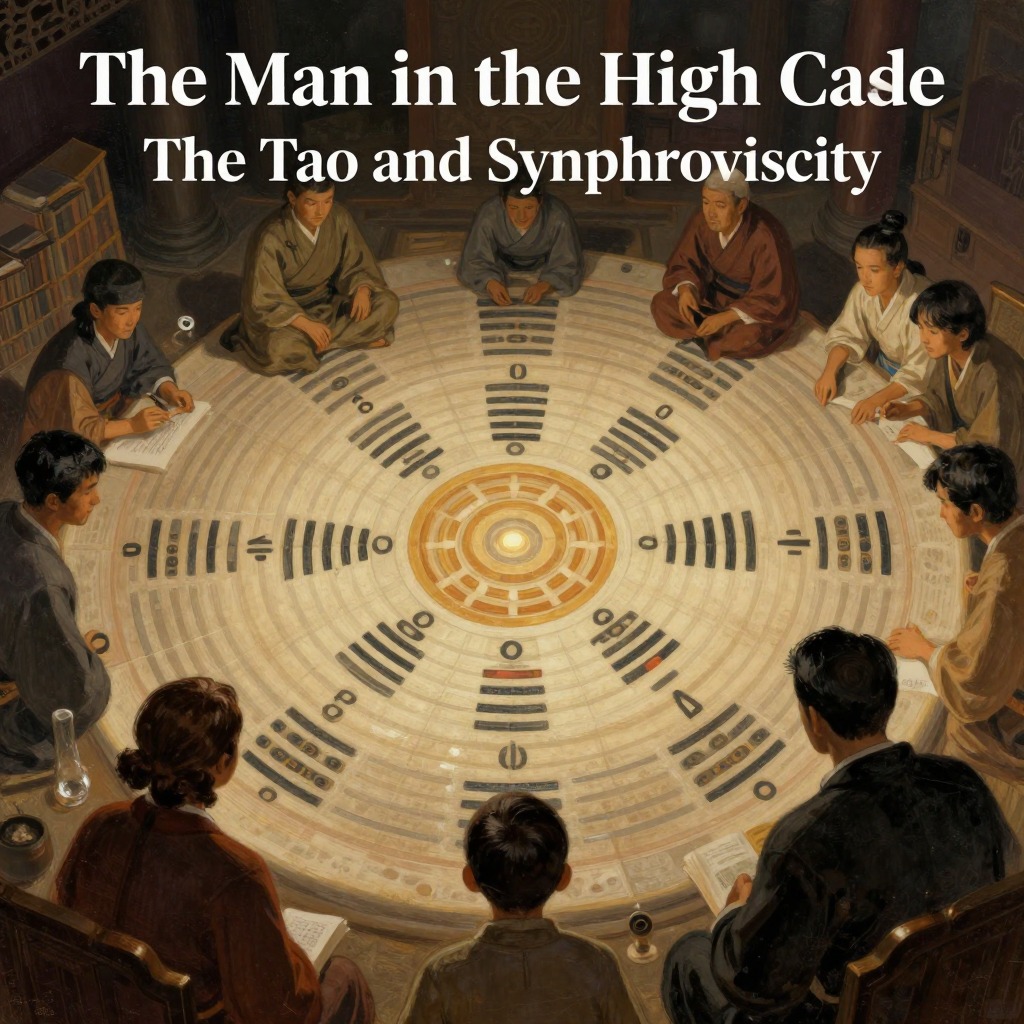
The Man in the High CastleThe wall falls back into the moat is a line from the I Ching, the ancient Chinese divination text that serves as a recurring oracle throughout Philip K. Dick's novel The Man in the High Castle. The line appears in the context of Frank Frink's consultation of the oracle, a practice he has adopted as a means of seeking guidance in a world where the Axis powers have won World War II. The I Ching, translated by Richard Wilhelm and rendered into English by Cary F. Baynes, is explicitly acknowledged in the novel's front matter, establishing its significance as a source of wisdom and a narrative device. Frink, a former employee of W-M Corporation, uses the oracle to navigate his personal and professional dilemmas, and the line's appearance marks a critical turning point in his fortunes.
The Consultation and the Hexagram
Frank Frink, having been fired from his job at W-M Corporation for speaking out of turn, is contemplating a new venture suggested by his former shop foreman, Ed McCarthy: starting a custom jewelry business. Seeking guidance, Frink consults the I Ching, using the traditional method of casting yarrow stalks. He asks, "Should I attempt to go into the creative private business outlined to me just now?" The resulting hexagram is Eleven, T'ai, Peace, which carries a favorable judgment: "PEACE. The small departs. The great approaches. Good fortune. Success." However, the hexagram contains a moving line, a six at the top, which transforms the situation. Frink reads the line's text: "The wall falls back into the moat. Use no army now. Make your commands known within your own town. Perseverance brings humiliation." The commentary further explains: "The change alluded to in the middle of the hexagram has begun to take place. The wall of the town sinks back into the moat from which it was dug. The hour of doom is at hand." This line, which Frink recognizes as one of the most dismal in the entire book, stands in stark contrast to the hexagram's overall promise of good fortune.
The Ambiguity of the Oracle
Frink is deeply disturbed by the contradiction between the favorable judgment and the ominous moving line. He reflects, "It had never happened to him before, good fortune and doom mixed together in the Dracle's prophecy; what a weird fate, as if the oracle had scraped the bottom of the barrel, tossed up every sort of rag, bone, and turd of the dark, then reversed itself and poured in the light like a cook gone barmy." He wonders if he has "pressed two buttons at once," jamming the works and receiving a "schlimazl's eye view of reality." Frink grapples with the possibility that the judgment refers to his immediate business prospects, while the line points to a deeper, future catastrophe—perhaps a third world war that would destroy civilization. He thinks, "War! he thought. Third World War! All frigging two billion of us killed, our civilization wiped out. Hydrogen bombs falling like hail." This interpretation aligns with the novel's broader themes of impending doom and the fragility of the Axis-dominated world order.
The Line's Significance in Frink's Decision
Despite the ominous line, Frink decides to proceed with the jewelry business, interpreting the oracle's message as a directive to continue living and working actively even in the face of inevitable doom. He concludes, "I should take my tools, get my motors from McCarthy, open my shop, start my piddling business, go on despite the horrible line. Be working, creating in my own way right up to the end, living as best I can, as actively as possible, until the wall falls back into the moat for all of us, all mankind." He sees the judgment as applying to his personal work, while the line speaks to a collective fate. Frink's decision to embrace the ambiguity and move forward reflects a stoic acceptance of fate, a theme that resonates throughout the novel. The line thus becomes a symbol of the tension between individual agency and larger historical forces, a central concern of The Man in the High Castle.
The Line's Broader Resonance
The line "The wall falls back into the moat" also resonates with the novel's exploration of historicity and the nature of reality. The I Ching, as an ancient text, represents a form of wisdom that transcends the political divisions of the world, offering a perspective that is both timeless and deeply personal. Frink's consultation of the oracle is part of a larger pattern in the novel, where characters like Nobusuke Tagomi and Juliana Frink also turn to the I Ching for guidance. The line's imagery of a wall collapsing into its own moat—a defensive structure turning against itself—can be seen as a metaphor for the self-destructive tendencies of the Nazi regime and the precariousness of the Axis victory. The novel's alternate history, in which the Axis powers have won, is itself a kind of "wall" that may fall, as suggested by the existence of The Grasshopper Lies Heavy, a novel within the novel that imagines an Allied victory. The line thus encapsulates the novel's central meditation on the contingency of history and the possibility of alternative outcomes.
The Line's Role in the Novel's Structure
The line appears at a crucial moment in Frink's narrative arc, just as he is about to embark on a new venture with McCarthy. The consultation takes place in the lounge of W-M Corporation, where Frink has gone to use the company's copy of the I Ching. The line's appearance foreshadows the difficulties that lie ahead for Frink and McCarthy, including their struggles to sell their jewelry and Frink's eventual arrest on charges of fraud. The line's warning of "perseverance brings humiliation" proves prophetic, as Frink's persistence in the jewelry business leads to his arrest and near-deportation to Germany. However, the line's ambiguity also allows for the possibility of redemption, as Frink is ultimately released and returns to his work. The line thus functions as a narrative device that underscores the novel's themes of fate, chance, and the interplay between personal choices and larger historical forces. In this way, "The wall falls back into the moat" becomes a key motif in The Man in the High Castle, encapsulating the novel's vision of a world poised on the brink of catastrophe, where individuals must navigate the uncertain terrain of their own destinies.