Trade Mission
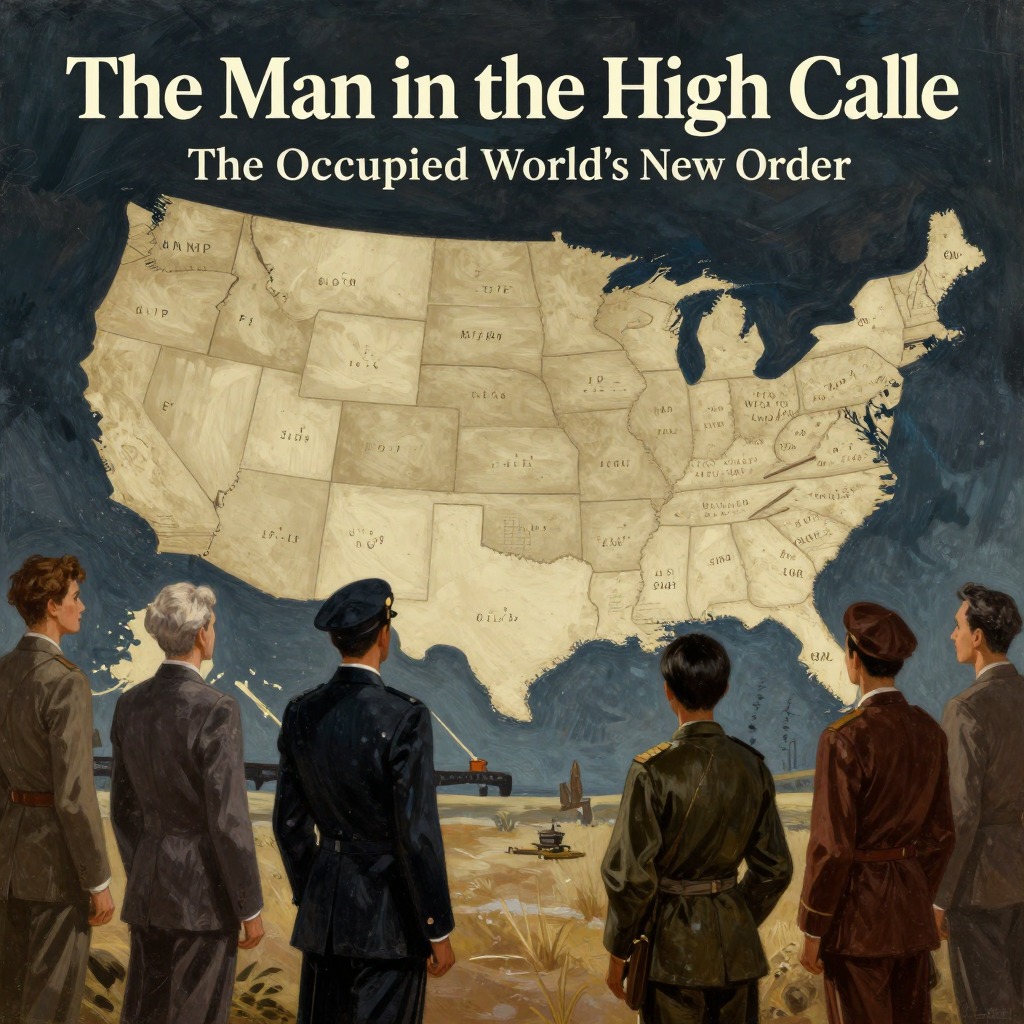
The Man in the High CastleThe Trade Mission is the central institution of Japanese imperial rule in the Pacific States of America, the administrative and commercial body that manages the occupied territories on the West Coast of the former United States. It operates as a hybrid of a colonial government and a business enterprise, wielding authority over trade, law, and social hierarchy. The Mission is the primary point of contact between the Japanese conquerors and the American population, and its offices, such as the one in the Nippon Times Building in San Francisco, serve as the nerve centers of occupation. Through its control of commerce and its enforcement of the rigid social order, the Trade Mission embodies the power dynamics that define the novel's world, where the Japanese are the ruling elite and the Americans, or "yanks," are subjugated subjects.
Structure and Authority
The Trade Mission is not a monolithic entity but a network of offices and officials that extend across the Pacific States, including California, Oregon, Washington, and parts of Nevada. It operates under the authority of the Imperial Government in Tokyo, and its representatives, such as Mr. Nobusuke Tagomi, hold significant power over local affairs. The Mission's authority is both commercial and political: it regulates trade, issues permits, and even has the power to override decisions made by the puppet white government in Sacramento, known as the pinoc government. This dual role is evident when Frank Frink, a former employee of W-M Corporation, considers appealing to the Trade Mission after being fired, hoping that its "rugged, stoic honesty" will protect him from the machinations of his former employer. The Mission's officials are portrayed as incorruptible, at least in the eyes of some, and they are seen as the ultimate arbiters of justice in the occupied territories.
The Trade Mission's offices are staffed by a mix of Japanese officials and American employees, such as Mr. Ramsey, who is a pinoc—a white American who collaborates with the occupiers. The hierarchy within the Mission is strict, with Japanese officials holding the highest positions and Americans relegated to subordinate roles. This structure is reinforced through daily interactions, as seen when Mr. Tagomi addresses Mr. Ramsey with a mixture of condescension and formality, reminding him of his place in the colonial order. The Mission also employs women like Miss Ephreikian, an Armenian secretary, who serve as support staff, further illustrating the gendered and racialized division of labor within the institution.
Economic and Cultural Control
The Trade Mission's primary function is economic, and it exercises this control through the regulation of trade and the promotion of Japanese commercial interests. The Mission is deeply involved in the trade of American historical artifacts, which are highly prized by Japanese collectors. This trade is a source of both profit and cultural power, as the Japanese use these objects to assert their dominance over American history and identity. Robert Childan, the owner of American Artistic Handcrafts Inc., depends on the Mission's patronage for his business, and his interactions with Mr. Tagomi are marked by a constant negotiation of power and status. The Mission's economic control extends to the regulation of goods, as seen when Mr. Tagomi orders a Civil War recruiting poster for a client, and when he later presents a Mickey Mouse wristwatch as a gift to Mr. Baynes, a visiting Swedish businessman. These transactions are not merely commercial; they are rituals of colonial exchange that reinforce the hierarchy between the Japanese and the Americans.
The Mission also plays a role in the cultural life of the occupied territories, promoting Japanese aesthetics and values while simultaneously commodifying American culture. This is evident in the Mission's support for the trade in Americana, which is driven by the Japanese fascination with the "historic objects of American popular civilization." The Mission's officials, like Mr. Tagomi, are connoisseurs of American artifacts, and their appreciation of these objects is both genuine and a means of exercising cultural authority. The Mission's cultural influence is also seen in the way it shapes the social aspirations of Americans like Robert Childan, who dreams of being accepted by Japanese society and who measures his own worth by his ability to cater to Japanese tastes.
Political Role and Crisis Management
The Trade Mission is not merely an economic institution; it is also a political actor that manages crises and maintains order in the occupied territories. This is most dramatically illustrated during the political upheaval following the death of Reichs Chancellor Martin Bormann, when the Mission is called upon to respond to the shifting balance of power between the German Reich and Japan. Mr. Tagomi, as a high-ranking official, is summoned to an extraordinary session at the Japanese Embassy, where he learns of the various factions vying for power in Germany. The Mission's role in such crises is to protect Japanese interests and to navigate the complex diplomatic landscape, often through covert means.
The Mission's political authority is also evident in its handling of the SD raid on the Nippon Times Building, when German agents attempt to capture Rudolf Wegener, a German spy who has defected to the Japanese side. Mr. Tagomi, with the help of General Tedeki, a retired Japanese military officer, defends the building and kills two of the SD men. This incident highlights the Mission's willingness to use force to protect its interests and its ability to act decisively in the face of external threats. The Mission's political role extends to the legal sphere, as seen when Mr. Tagomi signs a form releasing Frank Frink from custody, overriding the German consul's request for his extradition. This act of defiance demonstrates the Mission's power to challenge German authority and to assert Japanese sovereignty over the Pacific States.
The Trade Mission and the Individual
The Trade Mission's influence permeates the lives of individual characters, shaping their identities, aspirations, and fears. For Robert Childan, the Mission is both a source of livelihood and a constant reminder of his subjugation. His interactions with Mr. Tagomi are fraught with anxiety, as he struggles to maintain his dignity while catering to the demands of his Japanese superiors. The Mission's power is also felt by Frank Frink, who fears that his Jewish identity will make him vulnerable to persecution, and who sees the Mission as a potential protector against the machinations of the German Reich. For Mr. Tagomi himself, the Mission is a source of both pride and moral conflict, as he grapples with the ethical implications of his role in the colonial system.
The Trade Mission is thus a multifaceted institution that embodies the complexities of Japanese imperialism in the Pacific States. It is a site of economic exploitation, cultural exchange, political intrigue, and personal struggle, and its presence shapes the lives of all who come into contact with it. Through its portrayal of the Trade Mission, the novel explores the nature of power, the dynamics of colonialism, and the human cost of living under occupation.