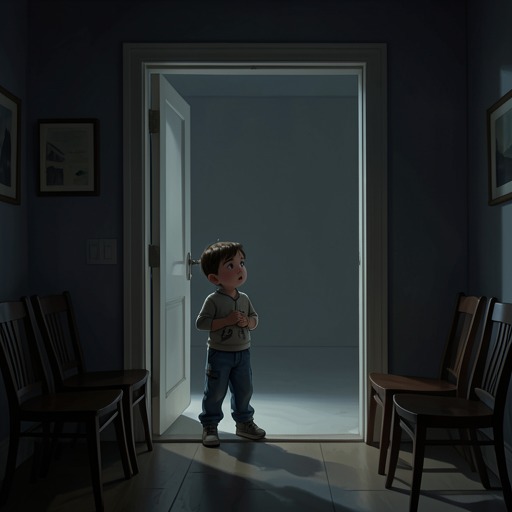
“Disasters, falling like chairs all around her”
The Master Butchers Singing Club“Disasters, falling like chairs all around her” is the novel’s defining image for Delphine’s experience of other people’s misfortune: she witnesses catastrophe at close range, feels its emotional force, and yet remains physically untouched and unable to change what happens. Its origin in a balancing act with Cyprian gives the metaphor a concrete, recurring shape: chairs crash around her, close enough to disarrange her hair, but never hit her.
The Image in the Balancing Act
In the pasture, Delphine lies still beneath a structure of chairs while Cyprian practices falling. He has arranged the chairs so that she cannot be harmed as long as she holds her position. Each time he falls, the structure collapses and strikes the ground around her; she waits until the chairs have fallen away before moving. A chair leg comes close enough to disturb her hair, but she is not touched.
The act makes stillness both the condition of Delphine’s safety and the limit of her agency. Cyprian learns the balancing trick through repeated falls; Delphine, beneath the structure, experiences each collapse without being able to prevent it. The episode supplies the image that her life will later repeat on a human scale: disaster arrives around her, near enough to leave a trace, while she survives its immediate impact.
From Childhood Witness to Metaphor
The narrative connects the chair image to Delphine’s childhood in the small house where her father’s drinking companions came and went. She had painted the doors and window frames blue after hearing that blue frightened ghosts, but what she really wanted was a color that could scare away drunks. No such color existed, and the visitors continued to arrive.
Delphine’s lasting wound is not described as a direct assault on her: she was not raped, robbed, beaten, or deprived of her voice. Instead, she heard the visitors’ sorrowful, often terrible stories and watched awful things happen to other people, powerless to alter their outcomes. The distinction matters to the image. The chairs are dangerous, but they fall around Delphine rather than upon her; her suffering comes through proximity, witnessing, and helplessness.
Recurrence and Significance
The metaphor gathers force through the repeated misfortunes Delphine encounters. A child down the road goes blind, and Delphine spends weeks dreaming that she too has lost her sight. Mrs. Vashon, abandoned by her husband, tries to kill herself while facing the prospect of raising nine children alone; she survives with a dark rope mark around her neck. Delphine’s best friend, Clarisse Strub, is also victimized by a secret disease. These events belong to other people, but Delphine experiences their emotional consequences with such intensity that she develops a nervous twitch and a reflexive rejection of hope.
The chairs therefore do more than picture danger narrowly avoided. Their repetition expresses the distance between survival and safety: Delphine is spared the direct blow, but not the knowledge of suffering or the burden of feeling it. The image also links the disciplined stillness of her performance beneath Cyprian’s collapsing structure to the helpless stillness of childhood witnessing. In both, remaining untouched does not mean remaining unaffected.