America
The Master Butchers Singing ClubAmerica is both a destination imagined from afar and a place entered through work, family sacrifice, and improvisation. For Fidelis Waldvogel, its machine-sliced bread first makes it seem like a country of abundance; when he reaches it in 1922, he must sell sausage to finance his journey inland. The broader narrative also places migration and settlement beside Indigenous dispossession and the confinement of German prisoners of war, making America a landscape of possibility whose freedoms are unevenly distributed.
The destination imagined
Shortly after marrying Eva Waldvogel, Fidelis sees a slice of bread in the public square of Ludwigsruhe. A neighbor’s relatives have sent it from a distant coastal city as an example of what inventive people can make of an ordinary food. The blank, white square initially looks to Fidelis like a picture. Learning that machines kneaded, baked, and sliced it, he becomes convinced that he should travel to America. The loaf is not merely a novelty: its regularity and precision give a practical, material form to the abundance he associates with the distant country.
That image sets a destination in motion, but it does not provide a settled plan. Fidelis intends to work with his trade’s tools until he has earned enough to continue toward the place he chose for the severity of its bread. America first appears as a promise attached to food and skilled production; the journey, by contrast, demands that he turn his own craft into immediate means of survival.
Arrival and settlement
In 1922, Fidelis steps off the RMS Mauretania into the crowded arrival scene at New York City. He carries a suitcase filled with his father’s smoked sausage and the family’s remaining wealth. Relatives have sold trinkets, cuff links, and their best woolens to pay for his passage and preserve his knives. The sausages themselves come from wild boar poached with Fidelis’s carefully saved bullets and hidden rifle, so the food that sustains his passage also embodies the resources and ingenuity he has carried from home.
His English is limited to words learned aboard ship and directed toward practical needs, including finding a train. As he sells sausages, he counts the money he still needs. Rather than wait until he has earned enough in one place, he buys a ticket into the beginning of the Midwest and plans to sell more to passengers during the journey. After one final sale, he closes his suitcase, keeps the ticket in his inside breast pocket, and boards. His first movement into the country is therefore not a completed passage to a chosen destination but a working journey, financed one sausage at a time.
Fidelis does not know that he will never leave. In the town where he settles, he initially expects to stay only long enough to earn money for the next leg of his journey. Searching for signs of the food economy he understands, he wonders where the bread is made, where beer comes from, how milk and butter are kept cold, and where sausages are stuffed and pork chops cut. The unfamiliar streets offer no clear directions. He adjusts his father’s hat, gathers his suitcase, and begins again from the practical ground of his trade; the temporary stop becomes home.
Movement, family, and borders
America also appears as a destination in plans made by the Waldvogel family. When the family prepares to travel to Chicago for consular paperwork, they intend to drive in the DeSoto, with Fidelis, Tante, and Delphine Watzka in front and the boys behind. After several days handling documents, Tante and the boys are to take a train to New York City, then board a ship. Their single cabin, with an added floor pallet and a small window, is described by the travel agent as luxurious and inexpensive. The itinerary shows how migration depends not only on desire but on passports, transportation, money, and the arrangements required to move a family together.
The consular office makes that process visible as a physical ordeal. The family enters a stone building whose offices circle an open central shaft beneath a vaulted skylight. They climb the broad stairs and join a very long line for passport photographs; people wait along the corridor, some seated on the floor and others leaning against the wall. Tante remains upright in her stiff suit despite her fatigue and insists that the boys need food. Paperwork and waiting, rather than the imagined open road, govern this stage of movement.
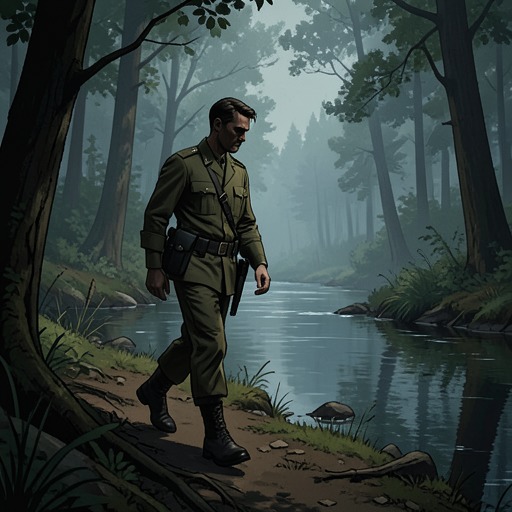
The narrative sets these family journeys alongside much less voluntary forms of movement. German prisoners of war travel north by train into pine forests, then leave the cars in a linked chain and walk for miles along a muddy road. The chain makes their movement a matter of custody rather than choice. Yet the account notes that prisoners in America often found relatives or former neighbors and worked on farms for good wages. Rules forbid civilians to speak with them, photograph them, feed them, or even acknowledge them, but many people do so anyway. The contrast between the family’s planned passage through consular procedures and the prisoners’ guarded transfer clarifies that crossing or traveling through America does not mean the same thing for everyone.
Indigenous identity and contested belonging
America’s history of belonging is also unsettled by the story of Indigenous people. When asked about his identity, Cyprian Lazarre says that he is Chippewa and Ojibwe, and explains that his grandfather used the word Anishinaabeg, meaning “the humans.” His answer places Indigenous identity in a living line of naming and inheritance, rather than treating it as a label imposed from outside.
Elsewhere, Roy Watzka tells the history of the Wounded Knee Massacre through the plight of Minneconjou Lakota people who arrive at a church seeking refuge. He describes them as displaced and hungry, recounts their surrender under a white flag, and tells of the military attack that followed. Within the novel’s America, the family’s search for a place to settle therefore coexists with an Indigenous history in which military power controls movement and violates the terms under which people seek safety. These histories are not equivalent, but their juxtaposition prevents the country’s promise of arrival from standing alone as its account of freedom.
That tension extends to the German prisoners’ camp. When Markus Waldvogel and his companions reach its barbed-wire-and-log entrance, a guard takes their papers and questions them, surprised to learn that one prisoner may have been born in America. The encounter makes the border between civilian and captive, and between outsider and possible compatriot, a matter of documents and military classification. Across its different journeys, America is at once a place where Fidelis can make a home and a place where institutions determine whose movement is permitted, restricted, or forced.