Balancing
The Master Butchers Singing ClubBalancing is the physical art practiced by Cyprian Lazarre and, in his account, a condition between conscious direction and surrender. The novel presents it both as a public performance—sustained through practice, bodily control, and risk—and as an idea that resists a simple technical definition. Cyprian says there is no single point at which balance resides: the performer must remain aware enough to shape what happens, yet relinquish the self-consciousness that would break the act.
The performer’s defining skill
Cyprian calls himself a balancing expert, and Delphine soon recognizes how completely the claim defines him. Balancing is not one talent among many in a settled life: he struggles with ordinary domestic tasks, conversation, and sustained reading, while his physical act is what he can reliably do. Delphine’s practical work around their show—mending, planning their travel, managing money, and arranging publicity—makes visible the contrast between his narrow specialty and the labor required to turn it into a livelihood.
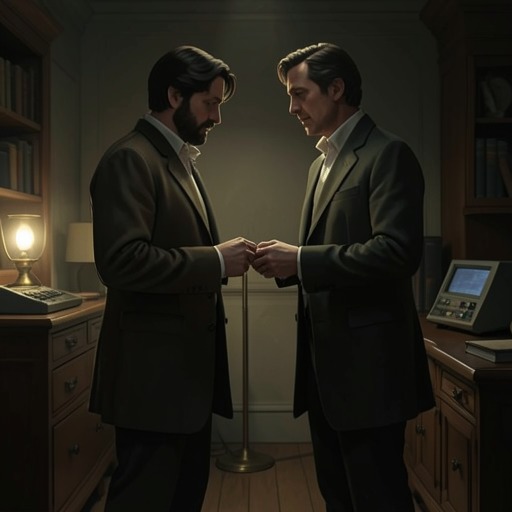
The skill depends on repetition. In one practice sequence, Cyprian falls again and again while memorizing the balancing trick through his body. Delphine lies beneath a tower of chairs, having learned how to hold her position so that the collapsing structure will not harm her. The chairs fall around her as Cyprian rehearses; she remains still, and he adjusts and repeats. The scene makes balance less like a miraculous, effortless pose than a discipline built through failure, bodily memory, and a partner’s trust.
A shared act and public spectacle
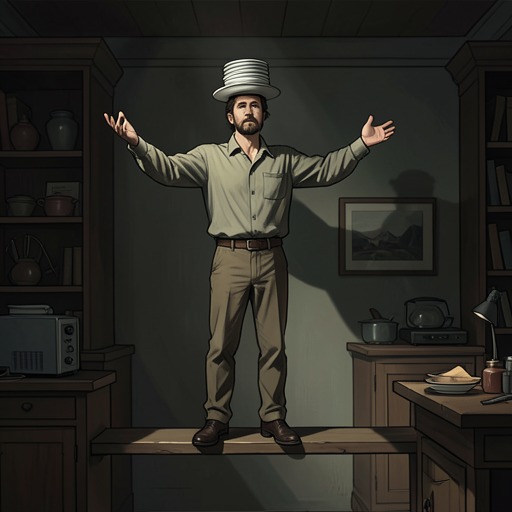
In performance, Cyprian turns that discipline into an escalating spectacle. He spins plates on poles balanced across his arms, shoulders, forehead, and teeth, runs alongside a line of twirling plates, and carries the audience’s chosen objects stacked on his head. Delphine takes bets on how long he can keep the plates moving, making the uncertainty itself part of their earnings. At the fairgrounds he rides a bicycle over wires; for the finale, he climbs a flagpole and balances upside down while gripping its top. His act makes precariousness visible, while his control makes it appear sustainable.
The performance also depends on Delphine’s participation. In another routine, she becomes a human table while Cyprian carries chairs and tea things, then serves himself a meal on her torso. The act turns her stillness into a platform for his movement: their spectacle is not his skill alone but an arrangement in which her strength and composure allow his balancing to appear. During rehearsal, she develops her stomach muscles to support him, and the bodily risk is managed through repeated practice rather than treated as an accident waiting to happen.
Cyprian imagines a finale in which he will be ten feet in the air, supported by Delphine’s stomach muscles. The ambition makes their partnership explicit: his balance would depend on her holding steady. Their show’s humor and spectacle therefore carry a practical relationship underneath them, one in which Delphine’s work helps turn Cyprian’s singular ability into a shared act.
Cyprian’s explanation
When Delphine asks how he balances, Cyprian admits that the experience is difficult to put into words. He says that his whole body becomes a thought, but rejects the idea that balance is a point. The explanation shifts the emphasis away from locating a stable center and toward an active, changing awareness: balance is something the performer experiences and adjusts, not a fixed place he can simply identify.
He offers a comparison with dreaming. A person who knows they are dreaming can influence the dream, he explains, but awareness pushed too far ends it. For Cyprian, balancing works in much the same way: the performer must have enough awareness to shape the act without becoming so conscious of that control that it collapses. This analogy gives the skill a mental dimension without detaching it from the physical performances that have already demonstrated its demands.
His account of falling completes the idea. Cyprian says that the performer must forget that he exists and meet the ground without weight. The formulation brings together two seemingly opposite requirements: the extraordinary control needed to balance and the letting go needed to fall. Balance is not the denial of falling; the fall is part of the same practice, governed by a change in attention and relation to the body.
Significance
The novel gives balancing meaning through contrasts rather than a technical formula. Cyprian’s public feats look effortless, but practice shows their dependence on repetition; his act appears to be a solo specialty, but Delphine’s strength and stillness help make it possible. His explanation likewise holds awareness and self-forgetfulness together. The skill’s defining condition is not perfect immobility but a temporary, practiced adjustment between directing an action and yielding to it.
Balancing also supplies a language for Cyprian’s limits. It is the ability around which he has organized his work and identity, while his explanation reveals that he cannot readily translate physical knowledge into ordinary speech. Delphine’s questions prompt him to try, and the answers remain analogies rather than instructions. The concept thus joins spectacle to intimacy: what an audience sees as a remarkable feat is, between the two performers, a difficult practice that requires repetition, cooperation, and a form of attention that must not become too rigid.