Belleau Wood
The Master Butchers Singing ClubBelleau Wood is the battlefield where Cyprian Lazarre was burned while serving in the United States Marine Corps during the Great War. Its brief appearance marks the war’s lasting physical cost and helps explain the silence shared by Cyprian and Fidelis Waldvogel, whose memories of the conflict continue to surface long after its trenches have disappeared.
Setting and Wartime Assault
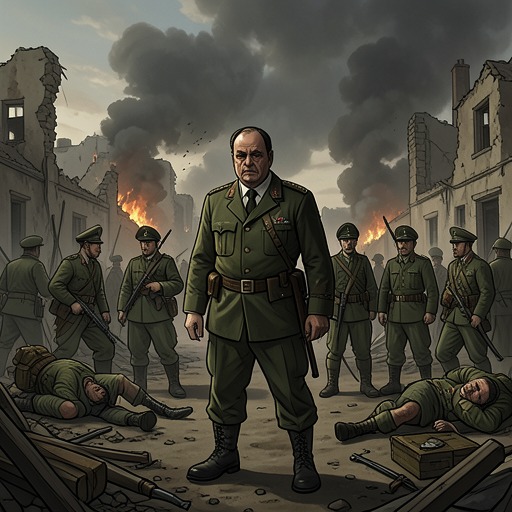
Cyprian reached Belleau Wood as a Marine in the fourth wave of an assault. He had enlisted with a cousin and a friend, endured training and the danger of Spanish flu, and then plunged into the attack. In the wheat at Belleau Wood, he was burned. The location is presented not as a distant landmark but as the setting of an injury that became one element in a succession of devastating wartime experiences.
Cyprian’s Injuries and Aftermath
Belleau Wood was only part of the harm Cyprian suffered during his service. In the war’s final year, chlorine gas blinded him, a split machine-gun barrel nearly took his hand, and dysentery left him helpless. His sense of humor failed, and he came to regret the zeal with which he had entered the conflict. He returned home to recover slowly, only then realizing that, as an Ojibwe, he was not yet a United States citizen; during his recuperation, he could not vote. The account joins bodily injury to the political limits that still shaped his life after combat.
Memory Between Survivors
Cyprian and Fidelis never spoke openly of the war they had shared. Its former trenches, like the mud of Belgium, had been covered over and turned green, but memory persisted beneath the apparent calm. A picture, sound, or word could interrupt either man’s day; each would struggle inwardly and continue, while the other sensed the impact and answered with a joke or a long drink of beer. Their silence does not mean the past has passed. Belleau Wood belongs to the buried history that remains active without becoming ordinary conversation.
The Battlefield’s Wider Echo
The novel sets the recollection of Belleau Wood among other forms of wartime remembrance. Delphine Watzka recalls the slaughter of 1934 and the subsequent militarization of the Rhineland as she considers the danger facing the boys; years later, a memorial to the bombing of Ludwigsruhe gathers survivors and families while master butchers sing. These scenes distinguish battle, political violence, and commemoration, while showing how public accounts and private memories coexist uneasily. Against that larger pattern, Belleau Wood is a precise point of reference for Cyprian’s injury and a measure of how war continues to inhabit the survivors who rarely name it.