Bombing of Ludwigsruhe
The Master Butchers Singing ClubThe Bombing of Ludwigsruhe is present in the novel less as a narrated account of the attack than as its aftermath: a memorial ceremony, the survivors who sing there, and Delphine’s vision of smoke and ash rising from their mouths. The bombing has destroyed lives and left a town to remember them; decades later, ritual and song cannot make that history harmless or fully resolved.
Memorial and survivors
The monument to the victims of the bombing is unveiled in 1954. Master butchers travel from nearby villages and more distant towns to sing at the ceremony. Fidelis has spent the month of the visit practicing with the few surviving men. The account gives no description of the bombing itself, its date, or its military circumstances; instead, it places the reader among those who have outlived the war and gathered to mark its dead.
Delphine attends with Tante, Fidelis’s relatives, and Erich and his new bride. The visit to Ludwigsruhe had been planned as a long-delayed honeymoon, but Fidelis has mysterious pains, an enlarged liver, and a threatened heart. While he rehearses, Delphine walks through the cemeteries and the town’s streets of blocky Marshall Plan shops and apartment houses. The setting joins remembrance to the visible work of postwar life: the monument is about to be unveiled amid a town rebuilt and changed, while the survivors assemble to sing.
The song and the vision
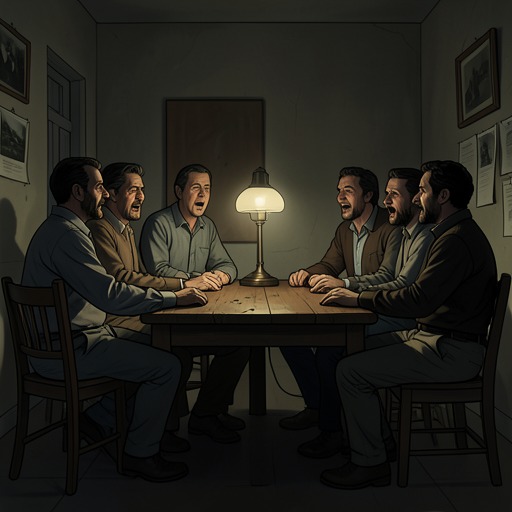
As the butchers move to the podium, their voices swell into a dense wall of melody. Delphine first hears a low sound beneath the speeches, then watches the men sing. Her attention slips from the music to their mouths opening and closing together; her mother’s indistinct photograph appears in her mind, alongside thoughts of burning, marching, and deeds she finds difficult to comprehend. The lovely sound of her husband’s voice in German air exists beside, rather than beyond, that remembered violence.
When the statue of the burned is uncovered in the sunlight, Delphine sees smoke and ash pouring from the singers’ mouths. In her disoriented perception, their hearts smolder, their guts burn, and their lungs act as hot bellows. The men continue singing; the crowd does not point or cry out. After the performance, the dark plumes disappear, leaving only the shadows cast in the garden. Delphine joins the applause and registers the impossible spectacle as ordinary. The vision makes the ceremony’s reassuring public surface unstable: the singers’ bodies seem to give visible form to the destruction their music and the monument commemorate.
Memory beyond the ceremony
The episode sets public commemoration against the persistence of private and collective memories that are not easily spoken. Elsewhere, Fidelis and Cyprian never discuss their shared war, though each carries memories that recur in images, sounds, or words; the silence between them functions as a recognition of what the other has endured. In Ludwigsruhe, by contrast, survivors stand together in an organized performance. Their singing gives the gathering a shared form, but Delphine’s vision suggests that participation does not erase what remains unassimilated.
The novel also places this memorial scene within a wider reckoning with war and historical remembrance. Delphine has followed reports of political terror and attacks on Jews, while Fidelis and Tante dwell on Germany’s strength and prosperity; the contrast exposes how accounts of recovery can coexist with neglected violence. The monument names the bombing’s victims, yet the ceremony cannot contain all the history Delphine senses around it. Her experience leaves remembrance unresolved: the men sing, the audience applauds, and the dark residue vanishes from sight, but the dead and the damage remain present in the act of remembering.