Chosen family
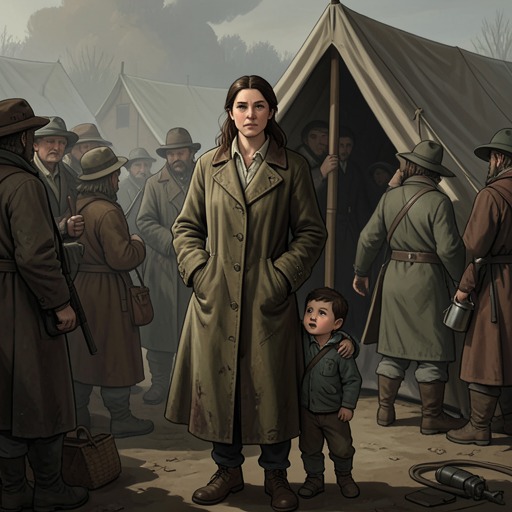
The Master Butchers Singing ClubChosen family in the novel takes shape through obligations and attachments that do not fit neatly into blood kinship, romance, or marriage. Delphine’s life with Cyprian, her care for Eva’s sons, and her eventual marriage to Fidelis show how intimacy can persist in altered forms: as friendship, practical labor, protection, and a shared home. The pattern is neither a simple substitute for conventional family nor a guarantee of happiness; it is built through specific acts of care and the choices people make after love and duty pull in different directions.
Kinship Beyond Romance
Delphine and Cyprian’s relationship changes after she discovers his attraction to men. At first, she imagines that acknowledging what she has seen might allow them to become lovers. Instead, they return to their room, undress only to their underwear, get into bed, and hold hands without speaking. The intimacy remains, but the future she had briefly imagined does not follow. Later, Cyprian asks her to consider why she likes being with men and explains that his own answer is the same. Delphine recognizes a kinship with him that feels less like heterosexual romance than a closeness between people who can understand one another’s inner lives. She accepts that they will not be lovers, while leaving open whether they will continue their traveling show. Their bond is not erased by the limit; it has to be understood in another way.
That distinction becomes especially clear in the night conversations between them. Cyprian does not speak to Delphine as he speaks to men, and he values their companionship and feels protective toward her, even as he knows his desire lies elsewhere. He imagines the possibility of a life with a man as something without a familiar or readily available model, while also wanting children and wanting to remain with Delphine. Their closeness therefore holds incompatible wishes without resolving them into a conventional couple: shared affection and trust coexist with sexual difference, uncertainty, and a future neither can simply claim.
Marriage, Duty, and Repetition
Fidelis’s earlier marriage to Eva began in the aftermath of war and loss. After Johannes died, Fidelis returned to Germany and told Eva that the father of her unborn child was dead. He later described their marriage as a straightforward decision: he would give Franz a father. Yet his account makes clear that duty was not the whole story. His body and Eva’s had already answered something between them when they first met, even if he could not explain that part of their relationship to Delphine. The marriage thus joins a practical commitment to a child with an emotional and physical attachment that exceeds the explanation Fidelis first gives.
Years later, Fidelis recognizes an echo between that history and his connection with Delphine. He wonders whether loving her would betray Cyprian, who had saved his son, and sees a repetition in which Delphine might rescue him and his boys as he once rescued Eva and Franz. Delphine, hearing the story of his marriage to Eva, concludes that marrying Fidelis would repeat the earlier arrangement. She understands this as a marriage he might not want: one formed from responsibility to children rather than a clear choice between two adults. Fidelis agrees, though Delphine’s reading does not fully capture what he feels. The scene keeps duty and desire distinct while showing how family histories can make a new relationship seem both familiar and difficult to read.
Care as Everyday Kinship
Delphine’s place in the Waldvogel family is established not only through declarations but through routine work. She keeps a job at the courthouse while returning to the shop each afternoon, and she resumes bookkeeping and ordering when she and Fidelis begin moving toward marriage. She also tends the kitchen and does laundry for the boys, though not for Fidelis, who has learned to iron his own shirts with exacting precision. Their household is held together by repeated acts of maintenance, shared work, and negotiated boundaries—not by a single claim that Delphine has replaced anyone.
Her care for Markus makes that kinship especially concrete. She helps him with school, celebrates his awards, knits mittens when he loses them, and tries different ways of feeding him when he remains thin. She worries about his enlistment and hopes that his eyeglasses will keep him out of the army, though he manages to join despite her concern. When she pleads with him to avoid combat, she explicitly grounds her plea in Eva’s sake, his father’s, and her own, even while acknowledging that she is not his biological mother. Markus answers by calling her Mom and gently tries to reassure her that he will be careful. The exchange shows that the maternal bond is real to both of them without requiring a fiction of shared blood.
Delphine’s care also takes practical, inventive forms before Markus grows up. When she decides that he must learn self-control to avoid being sent back to Tante, she and Cyprian establish morning practice behind the henhouse, with a pitcher of lemonade for each of them. By the end of the week, Markus is dry in the morning. The lesson is only the beginning of the survival skills Delphine wants to teach him. Her attention treats his needs as a responsibility that can be met through patience and planning, not merely as an emotional sentiment.
Commitment and Its Limits
Delphine and Fidelis approach marriage slowly and awkwardly. After a period of tension, they set a wedding date four months away, obtain the license at the courthouse, and sign their names with the briskness of people completing paperwork. Their cooperation is familiar from their work together: Delphine takes up the bookkeeping and ordering again, and begins bringing religious practice into the dusty office. The marriage grows from a history of work, family care, and mutual reliance, even as both have to face what they want from one another rather than treating the arrangement as self-evident.
The relationship is not presented as a clean replacement for Delphine’s earlier attachments. When Cyprian returns after she has married Fidelis, Delphine is genuinely glad to see him, and his presence stirs an involuntary response. At the same time, she catches herself wondering whether Fidelis is watching and resents her new susceptibility to a husband’s jealousy. The moment makes visible the persistence of old bonds inside a newer household. Marriage changes Delphine’s obligations and sense of accountability, but it does not erase her history with Cyprian or make her feelings simple.
A Family Made Through Survival
The novel’s chosen-family pattern is sharpened by Delphine’s knowledge that she is unlikely to have children of her own. Having helped raise Eva’s boys, she experiences that lack less intensely than she might otherwise have done; Markus, in particular, has received much of her maternal attention. His near-burial and return from the earth mark a change in him: he becomes quieter, more studious, and absorbed in reading and music. Delphine notices these changes as someone who has watched and cared for him across years, not as a distant observer.
That history gives force to her fear when Markus prepares to enter military service. She describes the realities of war to him and begs him not to put himself in its worst danger, speaking for Eva and Fidelis as well as for herself. Markus does not entirely share her fear, but he answers with gentleness, and she lets him go on his last night at home. Later, when he writes that he has failed the vision test and will probably do desk work, Delphine feels relief; his letters eventually let her understand the strange work he performs. Her worry and relief extend the family bond beyond the household, across distance and wartime uncertainty.
Chosen family in these relationships is therefore not a single alternative structure with fixed boundaries. It is a continuing practice: Delphine and Cyprian preserve a deep attachment without becoming lovers; Delphine becomes a mother to children who are not biologically hers; Fidelis and Delphine build a marriage informed by earlier loss and responsibility; and the household they create still carries the marks of absent people and past relationships. The novel locates kinship in that persistence—in work repeated, fears shared, and care offered even when the people involved cannot make their lives conform to one settled definition of love.