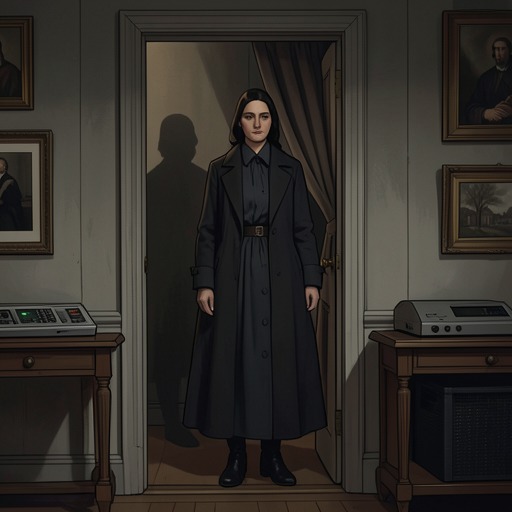
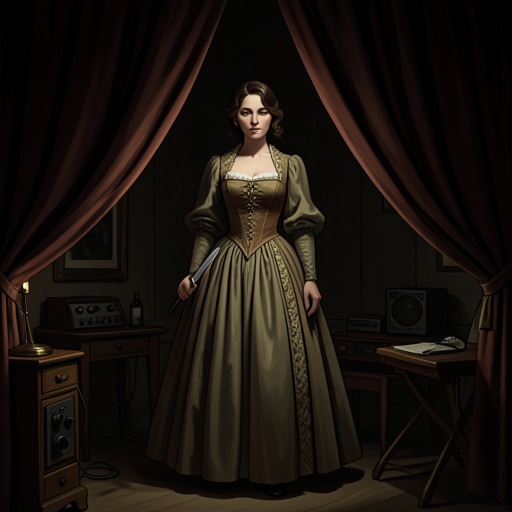
Clarisse Strub and Albert Hock
The Master Butchers Singing ClubAlbert Hock’s unrequited pursuit of Clarisse Strub is a persistent, unequal attachment that shapes Clarisse’s sense of safety and freedom. The town knows that Hock has pursued her for years and that she despises him, yet his position as sheriff helps keep his fixation from being openly challenged. Clarisse’s efforts to shut him out do not end the attention; instead, his presence becomes a recurring burden she must manage while protecting the life and work she has built.
Hock’s Public Standing and Private Fixation
Hock is introduced as the town sheriff, a man whose imposing softness and carefully controlled manner contrast with the vulnerability of his romantic fixation. When Roy Watzka arrives in a state of agitation over the bodies in his cellar, Hock leans away from the commotion and listens with patient contempt. His bearing is not simple indifference: when he looks at Delphine Watzka, his expression is described as tender. He is a figure of public authority who can appear composed, even attentive, while his private attachment to Clarisse remains unresolved.
Hock has a history as a local performer as well as an officeholder. Before winning the sheriff’s position, he made a name for himself playing King Henry VIII and Falstaff. The memory of those performances complicates Delphine’s view of him: she regards him with a mixture of respect and pity, recognizing both his theatrical past and the unhappy persistence of his feelings. His poems of self-pity and years of pursuit have become a stale joke among townspeople. Yet the joke is not shared with Hock, because he is the sheriff. His office does not make Clarisse reciprocate, but it gives the community reason to leave his assumptions undisturbed.
Clarisse’s Rejection and Hock’s Persistence
Clarisse’s rejection is not ambiguous to the people around her. She angrily despises Hock, and everyone who knows of his pursuit also knows how she feels. Still, Hock does not accept her refusal as decisive. Clarisse tells Delphine that he came to her house late one night, stood on the porch, and tried to behave as if they shared a secret. She shut the door in his face and remained behind it. Even after that plain refusal, she heard him whisper a threat drawn from the familiar story of the three little pigs: that he would huff and puff and blow her house down.
The incident shows how Hock recasts rejection as a private drama of his own. Clarisse says that nothing she does makes a difference because he turns her words around to hear what he wants. His attempts to create a shared secret, followed by the threatening line at her closed door, turn courtship into an unwelcome intrusion. The house’s threshold becomes a boundary Clarisse asserts, but one Hock’s persistence makes difficult to trust as final.
Clarisse experiences the pursuit as wearing and constraining, not as flattering attention. She is so tired of complaining about Hock that she says she is sick of herself for doing it. She would move away if she could, but leaving would mean giving up responsibilities and work that matter to her. Her reluctance to flee is not evidence of attachment to Hock; it reflects the value she places on her own place and profession, and the cost his behavior threatens to impose on both.
Work, Agency, and the Cost of Staying
Clarisse’s professional life gives her a reason to remain in town that is independent of Hock. She takes pride in her work and in her knowledge of anatomy, which Doctor Heech recognizes as comparable to his own. She is also experimenting with a new pump, an undertaking she considers part of her professional purpose. She refuses to let Hock ruin what she has made of her work. The contrast is central to the relationship: Hock’s attention narrows her choices, while her skill and commitment give her a reason to defend her place rather than surrender it.
Clarisse’s account to Delphine conveys the exhaustion of having to explain and re-explain a boundary that Hock refuses to understand. Her distress appears in her handling of the wrapped pork chop: she presses it to her forehead, closes her eyes, and speaks of her helplessness. The gesture accompanies a practical confession, not a romantic one. She has tried shutting him out, but still feels that he can distort what happens and make her resistance seem part of his imagined connection with her.
Delphine’s Response and the Relationship’s Significance
Delphine hears Clarisse’s account as both a close friend and someone willing to confront the problem. She jokes about killing Hock, and Clarisse responds wistfully, but the exchange records their shared exasperation rather than an actual plan. Delphine understands that the pursuit has become an oppressive routine for Clarisse; Clarisse, in turn, can speak candidly about her exhaustion and about the work she refuses to abandon.
Hock’s infatuation is therefore more than a one-sided romance in the background of the plot. It exposes the gap between private refusal and public power: Clarisse’s feelings are widely known, yet Hock’s position makes the town reluctant to tell him what everyone else understands. The relationship also gives shape to Clarisse’s insistence on professional independence. She does not leave, submit, or reinterpret his pursuit as affection; she continues to claim her work and her place despite the pressure of his attention. The enduring imbalance is the point: Hock’s romantic story may be a town joke, but for Clarisse it is a real constraint on ordinary life.